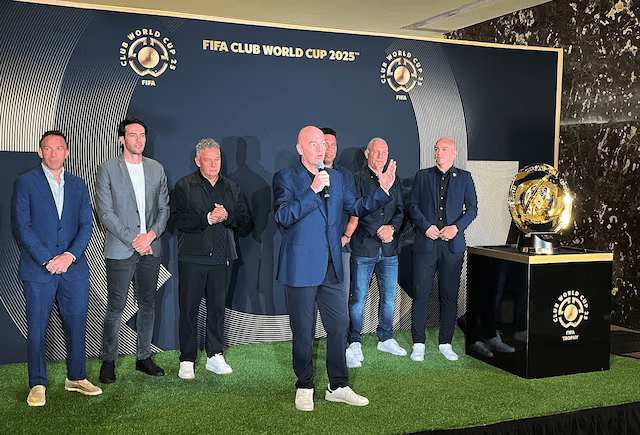
FIFA President Gianni Infantino has unequivocally declared the 2025 FIFA Club World Cup a triumph—despite mounting criticism over logistics, player welfare, and stadium attendance. Speaking from Trump Tower in New York on July 12, 2025, he hailed the newly expanded 32‑team tournament as the dawn of “the golden era of global club football”.
Infantino emphasised the tournament’s commercial success, noting a global revenue haul of around US $2.1 billion, translating to approximately $33 million per match and framing it as “the most successful club competition in the world,” financially and structurally . He pointed to 2.5 million tickets sold, averaging 40,000 spectators per match—levels comparable only to the English Premier League.
Acknowledging the criticism over partially filled stadiums—particularly in enormous U.S. venues—Infantino defended the strategy, stating he preferred 35,000 fans in an 80,000‑seat stadium rather than 20,000 in a small venue. He suggested that for the upcoming 2026 World Cup, matches played in daytime should be staged in covered stadiums, especially in cities such as Atlanta, Dallas, Houston, and Vancouver, to mitigate heat-related risks.
Critics of the 2025 format included high‑profile figures like Jürgen Klopp, who called it “the worst idea ever implemented in football”. However, Infantino dismissed the notion that European clubs or fans were overwhelmingly negative. Instead, he claimed that participating teams and travelling supporters were broadly satisfied with the event. Brazilian legend Ronaldo, present at the press event, echoed that criticism was minimal and praised the competitive quality and fan enthusiasm, saying: “I just saw two guys doing the critiques about FIFA Club World Cup. One of them … hates everything else but the Liga… I think … it has been a huge success”.
While Infantino asserted success, numerous football bodies raised serious concerns. Player unions such as FIFPRO and the World Leagues Forum warned of fixture congestion—highlighting the strain of additional European matches and scheduling pressure on elite athletes. FIFA responded that only about 1 % of the football calendar was occupied by FIFA competitions and insisted the event complied with the FIFA match calendar and was agreed upon with stakeholders in advance.
Another controversial subject was the qualification process. Inter Miami CF’s inclusion—featuring Lionel Messi—on the basis of the 2024 MLS Supporters’ Shield (not the MLS Cup) was widely criticized for lacking sporting merit and appeared orchestrated to leverage commercial advantage. Critics cited concerns over transparency and fairness, arguing the move prioritized spectacle over integrity.
Infantino defended his close ties to the U.S. government—particularly former President Donald Trump’s administration—as essential to executing large-scale events. He underscored that governmental support was critical to hosting both the Club World Cup and preparation for the 2026 FIFA World Cup, held jointly by the U.S., Canada, and Mexico. Indeed, FIFA recently opened a new office in Trump Tower as part of this growing U.S.-based presence.
Supporters like Ronaldo, Kaká, and Del Piero accompanied Infantino as visible endorsements, though critics argue their presence as FIFA legends may blur lines between sincere praise and orchestrated promotion. Some commentators, such as Sam Wallace in The Telegraph, questioned the transparency of Infantino’s figures—asserting that claims about revenue and viewership sometimes escaped independent verification.
Infantino also addressed future expansion. Though steering clear of firm commitments on format frequency or team numbers, he made clear his vision for the Club World Cup to become a lasting fixture, with ambitions to expand to 48 teams by 2029. He said FIFA has “created something new, something which is here to stay, something which is changing the landscape of club football”
In sum, Gianni Infantino’s message was unequivocal: despite logistical challenges and vocal critics, the 2025 Club World Cup marked a milestone step in FIFA’s strategy to elevate club football globally. From sports executives to fans and football legends, he portrayed a confident narrative—one that insists this is only the beginning of a commercial revolution for global club competition.