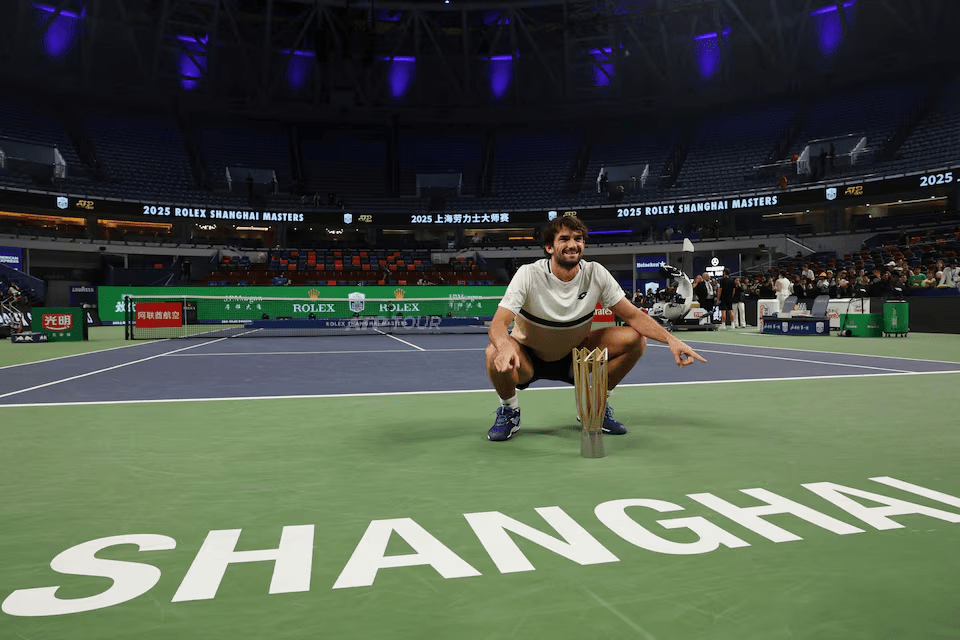
Valentin Vacherot’s victory at the 2025 Shanghai Masters will be remembered not just as a personal triumph but as a turning point for Monaco’s tennis legacy. In a dramatic final, the 26-year-old rallied from a set down to defeat his cousin Arthur Rinderknech 4-6, 6-3, 6-3, securing his first ATP title and, more significantly, Monaco’s first ever Masters 1000 singles crown.
The principality’s tennis federation president, Mélanie-Antoinette de Massy, did not mince words. She described the achievement as “extraordinary,” saying that “history has been made” and that this marks the first singles Masters 1000 for Monaco. Her praise underscored how rare and symbolic this victory is for a nation that, by population and scale, must contend with towering odds in global sport.
Prior to this, Monaco had celebrated Masters titles only in doubles, via Hugo Nys and Romain Arneodo. De Massy credited those doubles champions as trailblazers, saying they “opened the way” for Vacherot to follow in singles. Vacherot himself has been vocal about the inspiration drawn from his countrymen, reflecting a sentiment that Monaco’s small but tight-knit tennis community has helped him believe in the possibility of this moment.
The scale of the upset is striking. Entering Shanghai ranked No. 204 in the world, Vacherot became the lowest-ranked player ever to win a Masters 1000 event. His run included high-profile wins over top opponents, including Novak Djokovic in the semifinals. He also overcame Holger Rune and Alexander Bublik en route, defying expectations at every turn.
Vacherot’s path to the title was not straightforward. He entered Shanghai as a qualifier, even requiring fortunate withdrawals to make the qualifying draw, and in the second round of qualifying nearly lost—surviving by the slimmest margins. His composure under pressure late in matches became a theme of this run.
In the final itself, after dropping the first set, he regrouped and seized control in the next two sets. The emotion was palpable: the two cousins embraced at the net, and the moment felt larger than sport. Vacherot called it “unreal,” saying he had “no idea what is happening.”
Prince Albert II also expressed deep admiration, calling the achievement “simply breathtaking” and praising not only Vacherot’s technical and physical skill but also his mental strength. He highlighted the unity behind the player—his coaching team, national federation, and the family-style environment around Monaco’s tennis.
For Monaco, a state with about 40,000 inhabitants and limited sporting infrastructure compared to traditional tennis powerhouses, this title is a statement that ambition and belief sometimes outmatch resources. De Massy pointed out that Monaco punches above its weight, noting that their Davis Cup men’s team is currently ranked 44th of over 160 nations. She spoke of hoping this is just the beginning.
There are several legacies already in motion. Vacherot becomes the first Monaco player ever to win an ATP singles title and the first to break into the top 50 in singles. His success may fuel greater interest in tennis in Monaco, both from youth and from sponsors or infrastructure investment. De Massy’s emphasis on integrating junior players with senior players—in shared tracksuits, shared courts, shared meals—speaks to an approach that aims to build culture and continuity.
In sum, Vacherot’s Shanghai win was not just a sensational underdog story, but a milestone: a breakthrough moment for a small nation, a vindication of system and community, and proof that in tennis, history can be rewritten by those who dare to believe.