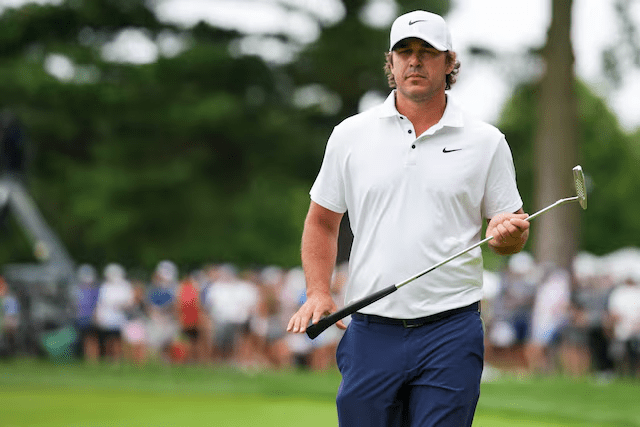
When Brooks Koepka stepped onto the first tee of the Torrey Pines South Course on Thursday at the Farmers Insurance Open, the moment carried an emotional weight few early rounds do. After more than three years away from full PGA Tour competition — playing instead on the Saudi-backed LIV Golf circuit — the five-time major champion made his long-anticipated return to the Tour with both nervous excitement and a palpable sense of relief.
The reception from the gallery, boisterous and overwhelmingly positive, seemed to confirm that Koepka’s decision to return was not only professionally meaningful for him but personally resonant for the fans who have watched his career unfold. Familiar chants of “Welcome back!” and shouts of “Brooksie!” echoed down the fairways as the 35-year-old made his way around the course, greeting supporters with fist bumps and autographs after his round.
A Reception That Eased the Jitters
Koepka admitted candidly that one of his biggest concerns in the lead-up to this week was how golf’s most fervent spectators would greet him. After all, his departure in 2022 to join LIV Golf was controversial and marked a major shift in the sport’s landscape. Questions lingered: Would traditionalists embrace him? Would the crowd’s reaction be mixed or lukewarm? Would there be resentment?
“I don’t like thinking ahead at all or trying to anticipate what was going to happen, but I wasn’t sure, which is kind of weird to be uneasy,” Koepka said after Thursday’s 1-over-par 73. “From the first tee on, it was great. It actually made me settle down a little bit and made me feel good.”
Indeed, the applause and support seemed to settle any lingering nerves. For a player accustomed to the pressures of major championships and elite competition, the psychological shift of returning to the PGA Tour felt both familiar and oddly new. Yet the crowd’s energy unmistakably lifted him, offering affirmation that his presence still matters deeply to golf fans.
More Than Just a Score
Koepka’s 73 on Thursday may not have been a headline-grabbing score by PGA standards, but the narrative around it was far richer. While his game may show signs of rust after so long away, the larger story was clearly about his reentry into the professional fold and the human side of that transition.
On the course, Koepka showed flashes of his trademark competitiveness. He closed with a birdie on the 18th, a small but meaningful moment that seemed to mirror the relief he felt off the course — that his comeback was unfolding with encouragement rather than antagonism.
Fans were quick to engage, following him around a glorious day along the Pacific bluffs, offering cheers and reaching out for brief interactions. Two young boys called out to him early in the round, prompting Koepka to walk back a few yards to deliver fist bumps — a simple exchange that punctuated how much this return means not just to him but to those who have followed his career.
The Weight of Public Perception
Throughout the day, Koepka’s comments hinted at how much public perception has factored into his mindset. “I care about what everybody’s thinking out here, what everybody’s doing, and just trying to be as good of a person and good of a player as I can be,” he said. “Just wanted a warm reception.”
That desire for acceptance is telling. In sports, few things are as public or as personal as the reaction of fans — and for Koepka, the applause in San Diego seemed to offer more than just encouragement. It signaled a sort of reconciliation, a reassurance that he is still valued by many in the game’s broad community.
Yet he also acknowledged a more competitive side of fan interaction, joking about being heckled at times — something he said he actually enjoys, framing it as part of the fun and intensity of sports. “Sometimes it makes you lock in and play a little better,” he said.
A Personal and Professional Turning Point
Koepka’s journey back to the PGA Tour has been as much about personal growth as professional recalibration. Freed from the final year of his LIV Golf contract late last year, he immediately applied for Tour membership and was provided a fast-tracked path back, highlighting how seriously both sides regard his role in the modern game.
His decision to leave LIV Golf was driven by a combination of factors, with family considerations playing a significant part. Koepka’s wife, Jena Sims, and their young son, Crew, were in attendance this week in San Diego, underscoring how family ties influenced his priorities. While he has not detailed all motivations publicly, Koepka has been open about how much his family means to him and how his perspective on golf has evolved over time.
This broader context casts his return not just as a competitive move but as a meaningful life shift — a chance to reconnect with the traditions and community of the PGA Tour while balancing the priorities of being a husband and a father.
What Comes Next
Looking ahead, Koepka faces the reality that his return doesn’t automatically restore his past status. He will need to earn his way into signature events through performance, and he remains ineligible for some Tour equity perks for a set period. But among the players and fans who matter most, he has already taken a crucial step in re-establishing his place.
For now, Thursday’s round stands as a symbolic beginning — perhaps not indicative of where his scoring will ultimately settle, but definitely emblematic of where his mindset is: grounded in gratitude, driven by competition, and validated by the cheers of those who turned out to welcome him back.
In a sport often defined by margins and measurements, Koepka’s story this week was about something less tangible but far more resonant: the relief of acceptance and the joy of return. And in the unpredictable world of golf, that might be the most satisfying victory of all.