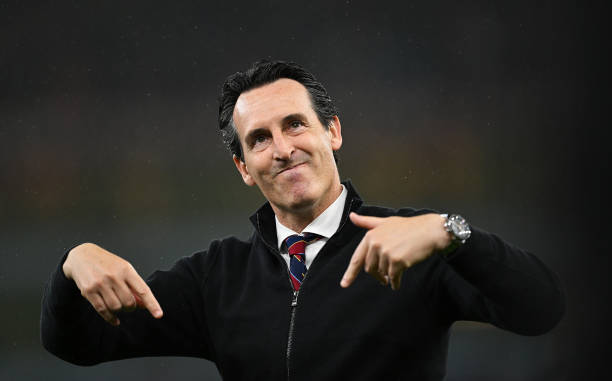
On May 20, 2026, Unai Emery stood on a podium in Warsaw and lifted the UEFA Europa League trophy for the fifth time in his career.
Aston Villa had beaten Freiburg 3-0 to end a 44-year wait for European silverware, and in doing so, their head coach had cemented his place alongside Carlo Ancelotti, Jose Mourinho, and Giovanni Trapattoni as a manager with five major European titles to his name.
It was the kind of moment that makes you step back and trace the full arc of a remarkable career. And when you do, Unai Emery’s coaching history reads like nothing else in the modern game.
Where It All Began: Emery’s Lorca and the Accidental Manager

Unai Emery’s coaching history did not begin by design. During the 2004-05 season, Emery, then a player at Lorca, suffered a serious knee injury that effectively ended his playing days. The club president, perhaps seeing something in the Basque midfielder that others had not, offered him the vacant coaching position. Emery accepted.
What followed was beyond impressive. Emery guided Lorca to promotion to the second division for the first time in the club’s history, and along the way defeated top-flight side Málaga in the Copa del Rey. The Spanish football federation took notice, awarding him the Miguel Muñoz Trophy as coach of the season.
In his second year, Lorca, competing in the second tier for the first time ever, finished fifth with 69 points, only five points off promotion to La Liga. It was an extraordinary overachievement for a newly converted manager at a modest club, and it set the template for everything that would follow in Unai Emery’s coaching history.
Almería and Valencia: Building a Reputation
From Lorca, Emery moved to Almería in the second division, and the pattern repeated itself. He guided them to their first ever promotion to La Liga in 2007, and in their debut top-flight campaign, the Andalusian side finished eighth, a result that drew attention from clubs operating at a significantly higher level. Valencia came calling, and Emery succeeded Ronald Koeman as their head coach.
The Valencia chapter is one of the most underappreciated in Unai Emery’s coaching history. He inherited a club crippled by serious financial problems and, in his first season, guided them to a sixth-place finish and Europa League qualification.
He then led them to third place in 2009-10, returning Valencia to the Champions League after two years away. The 2010-11 season began without David Villa and David Silva, both sold to Barcelona and Manchester City respectively, yet Valencia still finished third and again qualified for the Champions League. By the time Emery left in June 2012, having finished third in three consecutive seasons, Valencia were a reliable Champions League presence on a fraction of the budget their competitors enjoyed.
There was also an uncomfortable detour to Spartak Moscow in July 2012, where he lasted only six months before being dismissed after a 5-1 home loss to Dynamo Moscow in the derby. It is a footnote in Unai Emery’s coaching history that his admirers prefer to skip, but it matters, because it shows that even his methodology has limits when the environment is fundamentally dysfunctional.
Sevilla: Three Europa Leagues and the Making of a Legend
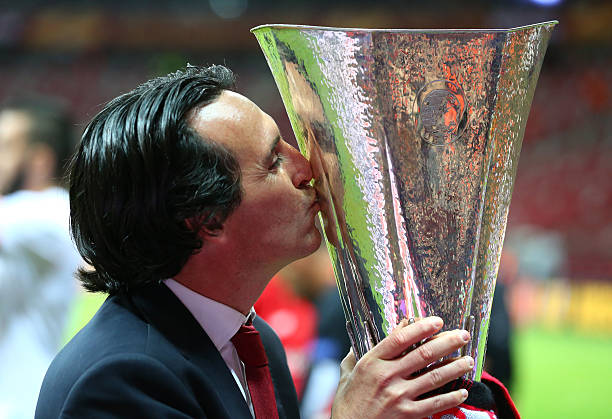
If one chapter in Unai Emery’s coaching history above all others explains who he is as a coach, it is Sevilla. He arrived in January 2013, replacing the sacked Míchel, and across three and a half seasons produced one of the greatest sustained runs of European success any manager has achieved.
In 2013-14, he led Sevilla to the Europa League final, where they defeated Benfica on penalties to claim the trophy. The following season, he repeated the feat, defeating Dnipro Dnipropetrovsk in the final to make Sevilla the most successful club in the history of the competition. Then in 2015-16, he did it again, coming from a goal down at half-time to defeat Liverpool 3-1 in Basel, with goals from Kevin Gameiro and a Coke brace completing one of the great European final comebacks.
Three consecutive Europa League titles. No manager in the history of European football had ever done it. Unai Emery’s coaching history had produced something genuinely unprecedented. He left Sevilla in June 2016 having turned the club into the continent’s most feared cup team.
PSG: Domestic Domination, European Heartbreak
Paris Saint-Germain came next, and Unai Emery’s coaching history entered its most high-profile, and most complicated chapter. He signed a two-year deal in June 2016 to succeed Laurent Blanc, inheriting a squad of extraordinary talent and even more extraordinary expectation.
Domestically, Emery delivered. In 2017-18, PSG won a clean sweep of all four domestic honours, the Ligue 1 title, the Coupe de France, the Coupe de la Ligue, and the Trophée des Champions. It was a quadruple, achieved with ruthless efficiency. But in Europe, the catastrophic became defining.
PSG destroyed Barcelona 4-0 at the Parc des Princes in the last 16 of the Champions League, only to travel to the Camp Nou and lose 6-1, one of the most shocking results in Champions League history, and exit the competition. The Unai Emery coaching history had delivered its first genuinely difficult verdict: brilliant in domestic competition, unable to crack Europe’s elite knockout rounds. He left PSG in the summer of 2018.
Arsenal: Promise, Pain, and an Early Departure
Emery was appointed Arsenal head coach on May 23, 2018, succeeding Arsène Wenger, a task that carried enormous symbolic weight. His first season showed genuine promise. Arsenal went on an 11-game winning run early in the campaign and extended their unbeaten streak to 22 matches, including a 4-2 win over Tottenham in his first North London derby. He reached another Europa League final, though Arsenal lost 4-1 to Chelsea in Baku. They finished fifth.
His second season unraveled. After a winless run of seven games, Emery was sacked on November 29, 2019. Unai Emery’s coaching history had suffered its most high-profile failure, and it stung. But what happened next said everything about the man.
Villarreal: Beating Bayern, Beating Arsenal, Making History
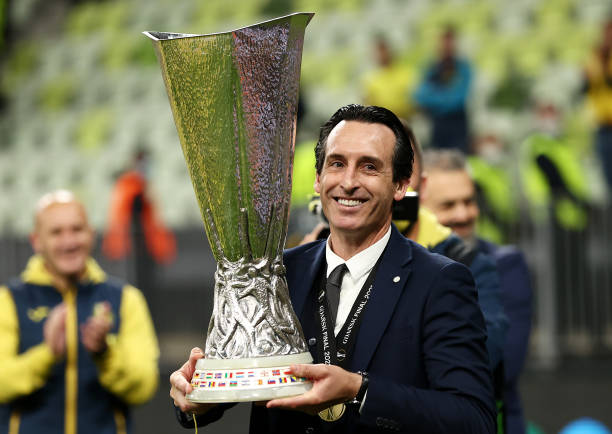
Emery joined Villarreal in July 2020 and immediately set about rebuilding his reputation. In December, he broke the club record of 18 matches unbeaten. Then, in May 2021, he led Villarreal to their first European final, defeating his former club Arsenal 2-1 on aggregate in the semi-finals, before winning the Europa League final against Manchester United in Gdańsk, 11-10 on penalties after a 1-1 draw.
It was his fourth Europa League title, a record at the time. In the following Champions League campaign, he took Villarreal to the semi-finals by eliminating Juventus and Bayern Munich. Unai Emery’s coaching history had recovered completely.
Aston Villa: The Greatest Chapter
When Emery was appointed Aston Villa head coach on October 24, 2022, the club were 16th in the Premier League, two points above the relegation zone. What he has built since is, by any reasonable measure, the defining achievement of Unai Emery’s coaching history.
In his first half-season, Villa won 15 of 25 league games to finish seventh and qualify for European football for the first time since 2010-11. In his first full season, he secured Champions League football for the club for the first time since 1982-83, with 15 consecutive home league wins setting a new club record. In 2024-25, Villa reached the Champions League quarter-finals before being eliminated by eventual winners PSG.
And then came 2025-26: eleven consecutive wins in all competitions to equal records from 1897 and 1914, a 100th managerial win at the club on March 19, and ultimately, on May 20, the Europa League title, Villa’s first European trophy since 1982, and Emery’s record fifth in the competition.
He has moved level with Ancelotti, Mourinho, and Trapattoni on the list of managers with five major European trophies. Former Villa midfielder Ashley Young captured what the Unai Emery coaching history means to those who have seen it up close:
“If you had said when we were in 16th position that he would come in and win the Europa League, not one player would think that would be true. He’s just got a way.”
Unai Emery’s Coaching History
From an injured midfielder at Lorca to a five-time European trophy winner at Aston Villa, Unai Emery’s coaching history is the story of obsessive preparation, relentless overachievement, and the refusal to be defined by failure. He watches Racing Santander at 2am. He plays chess online under his own name. He says nobody works harder than him. Well, the trophies suggest he is right.
Unai Emery’s coaching history is still being written. And if Villa Park on a European night is anything to go by, there are more chapters to come.
