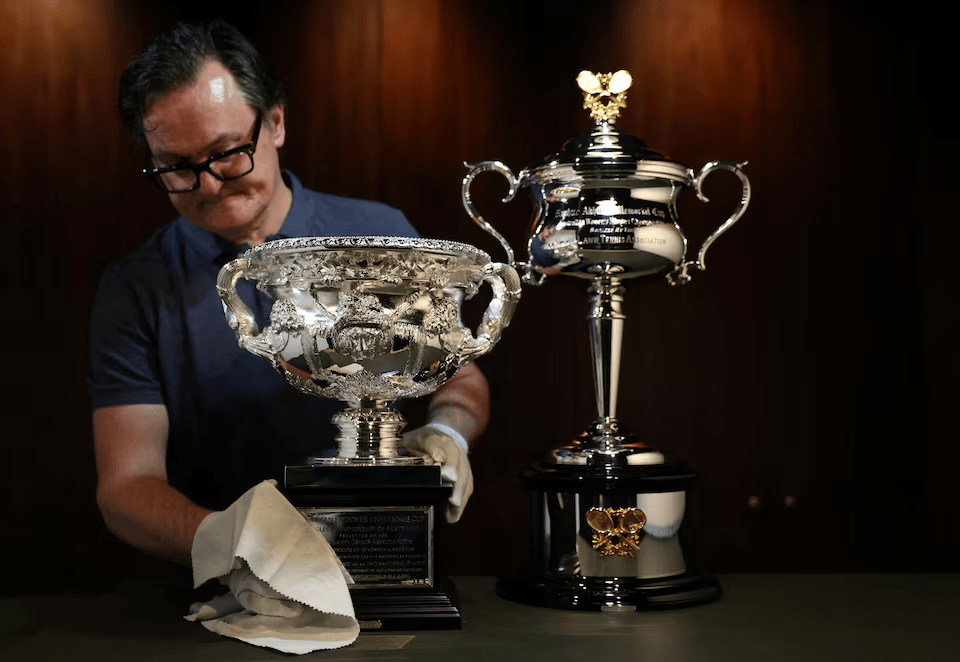
As anticipation builds for the 2026 Australian Open, attention is not just on the players and prize money but also on the tangible symbols of success — the trophies. Behind the scenes in Sydney, a dedicated team of silversmiths is working meticulously to craft the prestigious trophies that champions will lift at Melbourne Park next January.
At the heart of this effort is W.J. Sanders, a Sydney-based silversmithing workshop entrusted with producing the exact replicas of some of tennis’ oldest and most iconic trophies. While the original Daphne Akhurst Memorial Cup (for the women’s singles champion) and the Norman Brookes Challenge Cup (for the men’s singles champion) remain in Australia’s tennis heritage collections, it is the replicas made by these artisans that winners take home.
Silversmith Paul Smith leads a team of around 10 artisans who have been crafting roughly 150 trophies for the Australian Open — not just singles honours but doubles and mixed doubles awards as well. The painstaking work began well before the previous tournament and will be finished only when the trophies are presented after the finals at Rod Laver Arena.
Smith explained that despite what might appear to be simple designs, the trophies require exceptional precision: “It’s not technically an easy trophy to make,” he said, noting that the elegant simplicity of the shapes demands exacting skill. Making exact replicas that honour the heritage and significance of the originals is a challenge that machines cannot replicate, underscoring the continuing importance of hand craftsmanship.
The trophies themselves are substantial works of art — each of the “major” pieces (men’s and women’s singles, men’s and women’s doubles, mixed doubles) is handmade from roughly 18 kg of silver and carries a material value of at least A$860,000 (about $573,000 USD). Yet their true value lies not in price alone but in their representation of excellence, perseverance and sporting achievement.
General Manager Darren May emphasised the pride and tradition behind the process. For him and his team, there is deep satisfaction in remembering the hours of handcrafted effort when a champion lifts the trophy in the spotlight. The meticulous work reflects an appreciation for heritage — a craft now considered endangered and listed on Britain’s Heritage Crafts Red List — and a commitment to preserving an art that ties Australia’s cultural craftsmanship to one of the world’s biggest sporting stages. Sydney
Top players such as Jannik Sinner and Aryna Sabalenka, who previously lifted these trophies, are expected back in Melbourne from January 18 to February 1 aiming to add to their collections — and to claim another piece of W.J. Sanders’ masterful work.
Summary: Sydney’s silversmiths are playing an indispensable role in shaping the Australian Open’s legacy by handcrafting beautifully detailed trophies that celebrate sporting excellence and uphold traditions in an age of mass production.