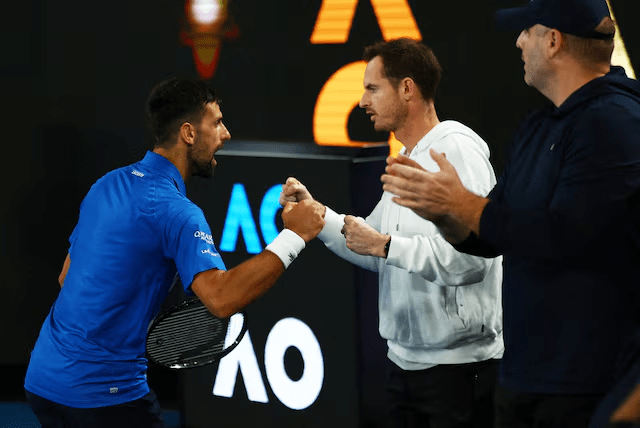
Former world No. 1 Andy Murray has not closed the chapter on his coaching ambitions following a brief but influential spell assisting Novak Djokovic—recently affirming he’s leaving the door ajar for a potential future in coaching, though he doesn’t foresee jumping back in anytime soon.
From Retirement to the Coaching Chair
Since retiring after the 2024 Paris Olympics, Murray has embraced a slower pace—playing casual doubles matches and focusing on family life. His return to tennis this season was unexpected, not as a player, but as a coach, partnering with Djokovic. The duo teamed up at the Australian Open, with aspirations of combining Djokovic’s elite talent with Murray’s analytical insights. Despite high hopes, the partnership was short-lived—six months of training across tournaments but no titles to show for it—and wrapped up just before the French Open . Andy Murray
Valuable Lessons, Unique Opportunity
Digging deeper, Murray described the experience not just as an experiment, but as a valuable crash course in coaching psychology, team unity, and elite athlete support structures:
“I wasn’t planning on going into coaching … but it was a pretty unique opportunity. It was a chance to learn from one of the best athletes of all time,” Murray told BBC Sport.
He also detailed the complexities beneath top-tier tennis: coordinating with physios, trainers, and agents, tailoring messages that could resonate with Djokovic and understanding what truly motivated him. It was the kind of backstage exposure most players never experience—now under Murray’s belt.
Reflecting on Results
Despite the off-court growth, performance on the court was inconsistent. Djokovic’s title drought during their time together included a final appearance in Miami but early exits in Madrid and Monte Carlo. Murray pointed out:
“Results weren’t as we wanted but we gave it a go. It was a brilliant opportunity … we got to spend some really nice moments away from the court”.
For Murray, the experience mattered more than trophies—it was about learning the machinery of a champion’s support system and understanding the dynamics of coaching at the summit of men’s tennis.
Future Plans: Not Rushing It
Although Murray acknowledged, “I would do it again at some stage,” he stressed that a return to coaching isn’t around the corner. He repeated this sentiment across platforms, including Sky Sports, where he clarified that while coaching is on the radar, it’s not imminent—and that he’s in no rush . Andy Murray
Instead, Murray appears content dividing his time between raising a young family, enjoying grassroots tennis engagements, and playing golf—a sport he’s growing to love . One memorable moment? A lighthearted doubles rally with a 10-year-old and a seven-year-old at the freshly renamed “Andy Murray Arena” at Queen’s Club—a symbolic reflection of his shift to nurturing the next generation.
Why This Matters in Tennis
Murray’s openness to coaching carries deeper resonance for several reasons:
- Bridging Rivalries
As one of Djokovic’s fiercest rivals, Murray stepping into a coaching role is a vivid reminder of how respect and knowledge transcend on-court competition. Their partnership, though brief, showcased shared dedication to tennis excellence. - Shifting to Coaching Role Models
Murray’s evolution from player to mentor underscores a growing trend: former champions harnessing their experience to guide top talents—bringing mentorship, not just technical input, to coaching roles. - Leaving Legacy Off the Court
Even as Murray steps back from active coaching, his influence continues—through the academy at Queen’s, grassroots charity events, and insight into team dynamics that could shape future tennis mentors. Andy Murray
In Conclusion
Andy Murray’s words are measured, but they’re filled with purpose. He’s neither closing the door on coaching nor rushing inside. Instead, he’s walking a deliberate path—savoring family life, embracing new interests, and holding onto the lessons of coaching Djokovic. When the time is right, he may answer the call again—but for now, Murray savors the journey off the court as much as he once did at its centre.
If you’d like, I can help craft a focused profile on Murray’s coaching philosophy, or explore how his transition compares with other retired athletes turned mentors.