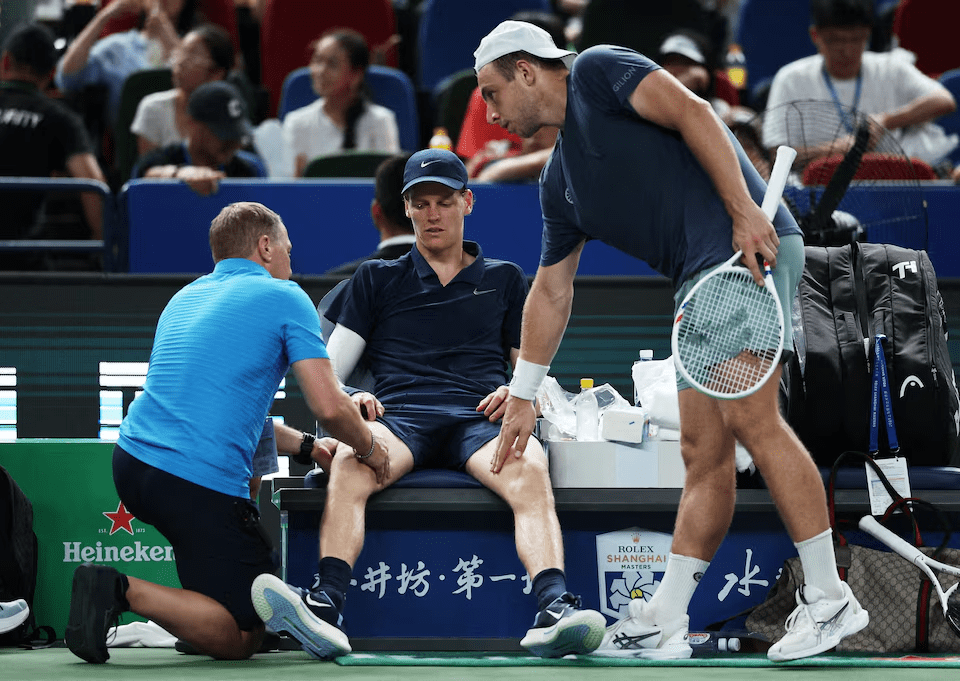
The ATP is exploring a formal policy on extreme heat following a wave of retirements at the 2025 Shanghai Masters, where demanding weather conditions pushed several top tennis players to their limits.
Relentless conditions spark concern
Matches during the tournament saw temperatures around 30°C (86°F) and humidity often exceeding 80%, creating near-oppressive conditions under which players visibly struggled.
Among those affected:
- Jannik Sinner, whose title defence ended when cramping made it impossible to continue in his third-round match.
- Novak Djokovic, who vomited during a match, and Holger Rune, who asked officials if players were expected to “die on court” amid the heat.
- Other retirements came from Casper Ruud, David Goffin, Terrence Atmane, Tomas Machac, Hamad Medjedovic, and Wu Yibing, among others.
These incidents were not isolated: players and commentators drew attention to how conditions in Shanghai are becoming more punishing due to temperature and humidity combinations.
Existing rules and pressures for change
Under current ATP rules, weather-related suspensions (including in extreme heat) are handled by an onsite ATP supervisor in coordination with medical teams and local authorities. There is no codified heat policy specifically outlining thresholds or required action.
Following the retirements in Shanghai (and similar concerns in earlier events such as Cincinnati) there is increasing pressure from players, teams, medical experts and fans for more systematic protections.
What changes are being considered
The ATP has stated it is under active review and evaluating “additional measures including the implementation of an official heat policy” in consultation with players, tournaments, and medical experts.
Possible components of a heat policy might include:
- Defined temperature/humidity thresholds (or wet-bulb globe temperature measures) beyond which matches are delayed, suspended, or shifted.
- More stringent medical timeouts or cooling breaks.
- Adjusting match scheduling (avoiding mid-day play in extreme conditions, using evening or cooler hours) or even moving courts under cover or roof.
- Improving facilities (shade, air circulation, cooling systems, player recovery zones) at tournament venues.
Implications for players and tournaments
A formal heat policy would align the ATP more closely with other tennis bodies. For example, many Grand Slams and the WTA Tour already have some form of rule for extreme heat or other harsh conditions.
For players, having clear rules would reduce risk of sudden retirements, health issues like cramping, exhaustion, heatstroke, or other heat-related injuries. It could also encourage tournaments to be more proactive in scheduling and preparing for high-heat scenarios.
On the tournament side, there would be logistical challenges: making provisions for delays, possibly altering court assignments, installing cooling infrastructure, and balancing spectator experience and broadcast schedules. Financial and scheduling trade-offs may be required.
What remains unresolved
Some key questions are yet to be answered:
- Exactly what thresholds of heat/humidity would trigger policy measures?
- How to standardize across diverse tournament locations (some with roofs, others open courts; differing climate systems).
- Whether roofed courts or indoor alternatives will be more widely used.
- How to enforce the policy, and what penalties or consequences there will be if tournaments fail to uphold it.
Overall, the Shanghai Masters retirements seem to have catalysed what many see as a necessary rethink: balancing the demands of the tour and competition with the health and safety of players. ATP’s openness to a formal heat policy may mark a turning point in how professional tennis deals with increasingly extreme weather.

2 comments
Oh, the Shanghai Masters heatwave was *peak* tennis drama! We saw cramping, vomiting, and players genuinely fearing for their lives on court – a real page-turner! Now the ATP is finally considering a heat policy? About time! Its like waiting for your mom to buy pants that actually fit. But defining those heat thresholds? Thats a comedy of errors waiting to happen – will Miami get a pass because its beach season? Lets hope they implement this faster than Novak can say out during a match point. The health risks are clear, and honestly, its probably better for the spectacle too. Imagine if Roger Federer just retired due to oppressive humidity – the headlines!tải video YouTube
Who knew playing tennis in the Amazon wasnt exactly peak athletic performance? Good on the players for speaking out and on the ATP for considering action – though figuring out universal heat thresholds sounds like a scientific mystery worthy of its own tournament! Honestly, if the courts had air conditioning, maybe fewer players would need to retire to die on court – though thats clearly dramatic theatre which adds to the drama, right? Lets hope the ATPs heat policy review doesnt take as long as deciding whether to delay a match; players health (and dignity) cant keep waiting in the sweltering sun.random số