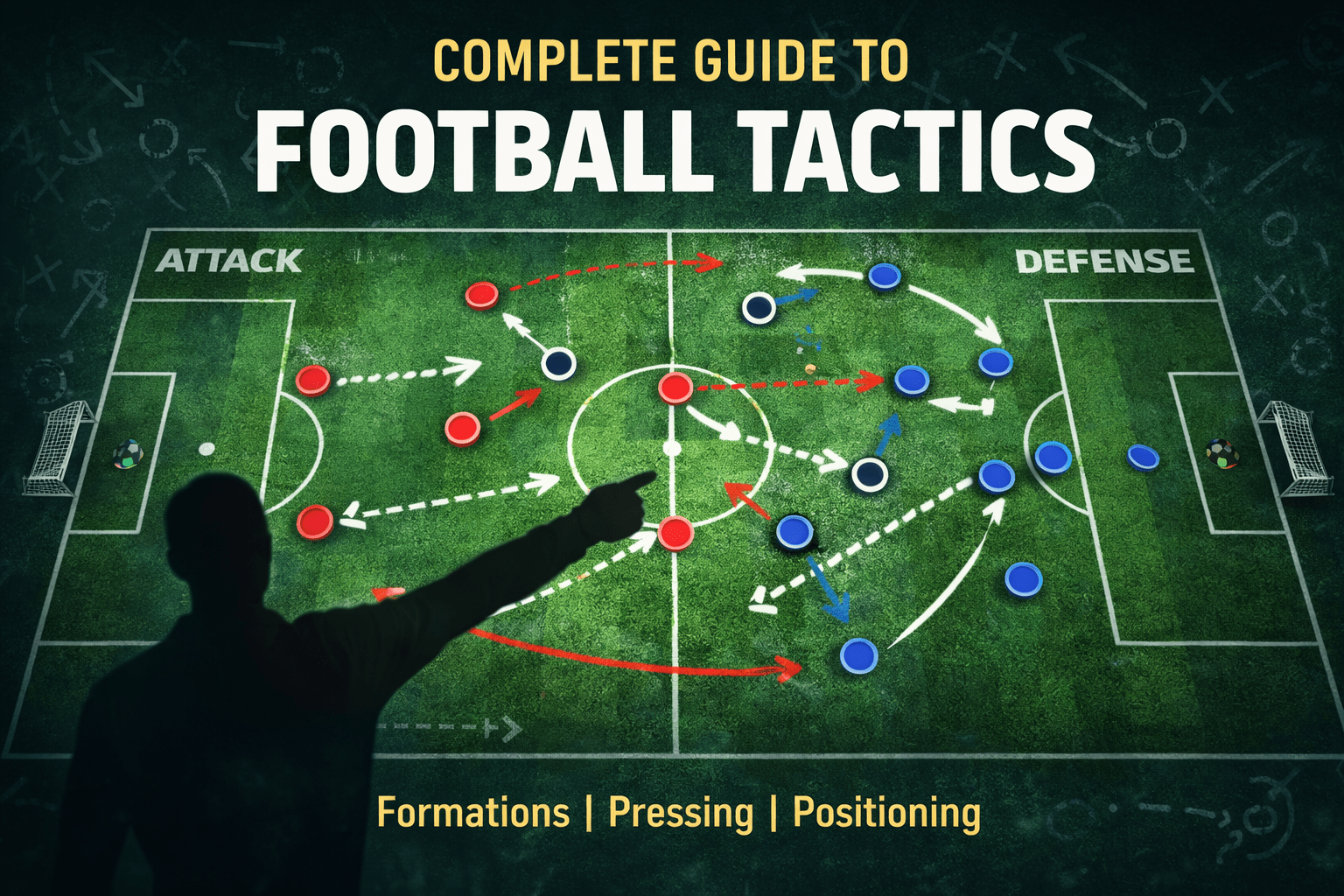
Football has always been more than just a game of goals and moments. Beneath the excitement lies a structured and deeply strategic system that shapes how matches are played and won. Understanding football tactics allows fans to see the game from a different perspective, one where every pass, movement, and decision carries meaning.
In today’s game, tactics are not reserved for coaches alone. They define how teams control space, manage transitions, and impose their identity on opponents. For beginners, learning the basics of football tactics is the first step toward truly understanding the sport.
What Are Football Tactics?

At its core, football tactics refer to the methods and strategies teams use to organize themselves during a match. It is the framework that determines how players position themselves, how they move as a unit, and how they respond to different phases of the game.
Modern football has evolved into a tactical contest where structure often outweighs spontaneity. Teams no longer rely solely on individual brilliance. Instead, success is built on a clear system that maximizes collective efficiency. This is why even the most talented squads struggle without a defined tactical approach.
Understanding Formations
Formations provide the foundation for all football tactics. They describe how players are arranged on the pitch and serve as the starting point for both attacking and defensive strategies.
A team set up in a 4-3-3 formation typically focuses on width and attacking fluidity, while a 4-4-2 structure offers balance and defensive solidity. These shapes are not rigid. They shift constantly depending on whether a team is attacking or defending.
Over time, formations have become more flexible. Players are expected to move between roles, creating dynamic systems rather than fixed structures. This evolution reflects how tactics have become more sophisticated in the modern era.
Attacking Play and Movement
Attacking football is no longer about simply moving the ball forward. It is about creating and exploiting space with precision. Effective tactics in attack rely on coordinated movement and intelligent positioning.
Teams stretch the pitch to pull defenders out of shape, creating gaps that can be exploited. Players make runs not only to receive the ball but also to create opportunities for teammates. The emphasis is on movement without the ball as much as movement with it.
This approach explains why some teams dominate possession without immediately scoring. They are patiently waiting for the right moment to break through. It is a calculated process rather than a rushed one, showing how football tactics shape attacking decisions.
Defensive Structure and Discipline

Defending in modern football is as structured as attacking. Strong defensive tactics are built on organization, discipline, and awareness.
Teams aim to remain compact, reducing the space available to opponents. By staying close together, they limit passing options and force mistakes. A well-organized defense does not chase the ball unnecessarily but instead controls space intelligently.
The positioning of defenders is especially important. Maintaining a coordinated defensive line allows teams to control attacking threats and manage situations more effectively. This structure often determines whether a team can withstand pressure or collapse under it.
Pressing and Intensity
Pressing has become one of the most influential elements of modern football tactics. It involves applying pressure on opponents to win the ball back quickly and disrupt their rhythm.
Rather than waiting passively, teams now actively hunt for possession. Pressing requires coordination, timing, and energy. Players must move together, closing down spaces and forcing errors.
The effectiveness of pressing lies in its ability to turn defense into attack almost instantly. When executed well, it creates opportunities before the opposition can reorganize. This is why pressing has become a defining feature of elite football tactics.
Transition Moments
Transitions are often the most decisive moments in a football match. These occur when a team switches from defense to attack or vice versa. Modern tactics place significant emphasis on these phases.
When a team wins the ball, the objective is to exploit the opponent’s temporary disorganization. Quick, direct movement can lead to immediate scoring opportunities. On the other hand, when possession is lost, players must react instantly to regain shape and prevent counterattacks.
The speed and efficiency of these transitions often separate top teams from the rest. It is not just about what a team does with the ball, but how quickly it reacts when circumstances change.
Use of Space and Width

Space is one of the most important concepts in tactics. Teams are constantly trying to create space for themselves while denying it to their opponents.
Wide players play a crucial role in this process. By stretching the pitch, they force defenders to spread out, creating openings in central areas. These gaps can then be exploited by midfielders and forwards.
Movement is key to controlling space. Players rotate positions, make runs, and adjust their positioning to keep the opposition guessing. This constant motion makes modern tactics far more dynamic than in previous eras.
Set Pieces as a Tactical Weapon
Set pieces have become an increasingly important aspect of football tactics. Situations such as corners, free kicks, and throw-ins are now treated as carefully planned opportunities rather than random events.
Teams spend significant time rehearsing these scenarios. Every movement is designed to create confusion and open up scoring chances. The level of detail involved highlights how tactical preparation extends beyond open play.
In many matches, set pieces provide the difference between winning and losing. This reinforces the idea that football tactics influence every aspect of the game, including moments when the ball is not in open play.
The Importance of Roles
Each player on the pitch has a defined role within the tactical system. Understanding these roles is essential to understanding football tactics.
Midfielders often control the tempo of the game, defenders maintain structure, and attackers focus on creating and finishing chances. However, modern football demands versatility. Players are expected to contribute in multiple phases of play.
This flexibility has made the game more fluid and unpredictable. It also highlights how football tactics continue to evolve as players adapt to new demands.
Conclusion
Football has grown into a sport defined by intelligence as much as skill. The importance of tactics cannot be overstated, as they shape every aspect of how the game is played.
From formations and attacking patterns to defensive organization and transitions, tactics provide the structure that brings order to the chaos of football. For beginners, understanding these principles opens up a deeper appreciation of the game.
As football continues to evolve, so too will the strategies that define it. Learning the fundamentals of football tactics is not just about understanding today’s game, but about preparing to understand the future of football as well.
