CORTINA D’AMPEZZO, Italy In a performance for the ages that captured the heart of the host nation and stunned the alpine skiing world, Italy’s Federica Brignone sealed a dramatic gold medal in the women’s Super-G on Thursday at the Milano-Cortina 2026 Winter Olympics, delivering one of the most emotional and inspiring comebacks of the Games.
At 35 years old — an age when many alpine racers contemplate retirement Brignone produced a breathtaking run on the demanding Olimpia delle Tofane course to finish the women’s Super-G in 1:23.41, holding off a deep field of the world’s best speed skiers and etching her name into Olympic history. The result brought her first Olympic gold after years of near-misses and a turbulent injury layoff that threatened to derail her career.
A Storied Career Set Up for a Fairytale Ending
Brignone, affectionately nicknamed “The Tiger” for her fierce drive and mental steel, has long been a stalwart of the alpine skiing circuit but until Thursday she had never stood atop the Olympic podium in gold. Prior to Milan-Cortina 2026, her Olympic resume included multiple medals: silver in the Super-G at Beijing 2022 and bronze in giant slalom at Pyeongchang 2018, along with other podium finishes in Olympic combined events.
Her Super-G triumph served not only as a personal milestone but also as a symbolic culmination of perseverance. She became Italy’s first alpine skiing Super-G Olympic champion at these Games and added a prized gold to a decorated career that spans over a decade on the World Cup tour.
The Road Back: Injury, Doubt and Determination
What makes Brignone’s victory so compelling is not merely that she won — but how she won. In April 2025, just ten months before the Games, she suffered a terrifying crash at the Italian Championships in Val di Fassa that left her with multiple fractures in her left leg and a torn anterior cruciate ligament (ACL). The injury was considered severe enough that her Olympic participation was in serious doubt for months.
Brignone endured two surgeries and grueling rehabilitation, enduring long days of physical therapy that tested her patience and mental strength. At times, the task of walking again seemed Sisyphean, let alone skiing at full throttle. A doctor from the Italian Winter Sports Federation later said it was her willpower and sheer competitive fire that ultimately propelled her back into contention.
Despite persistent pain and an abbreviated preparation schedule, she made her World Cup return only in January 2026, a scant month before the Olympics, finishing a respectable sixth in downhill. Even after that promising result, few outside her inner circle expected that she would produce a gold-medal performance on home snow especially on a Super-G course that proved unforgiving to many competitors.
The Super-G: A Test of Nerves and Skill
The Super-G race itself unfolded under foggy conditions that flattened visibility and added another layer of difficulty to a technical track that demanded precision, courage and split-second judgment. Forty-three athletes started the event, but nearly a quarter of them failed to finish, underscoring both the course’s challenge and the tension that Brignone faced as she launched from the start gate.
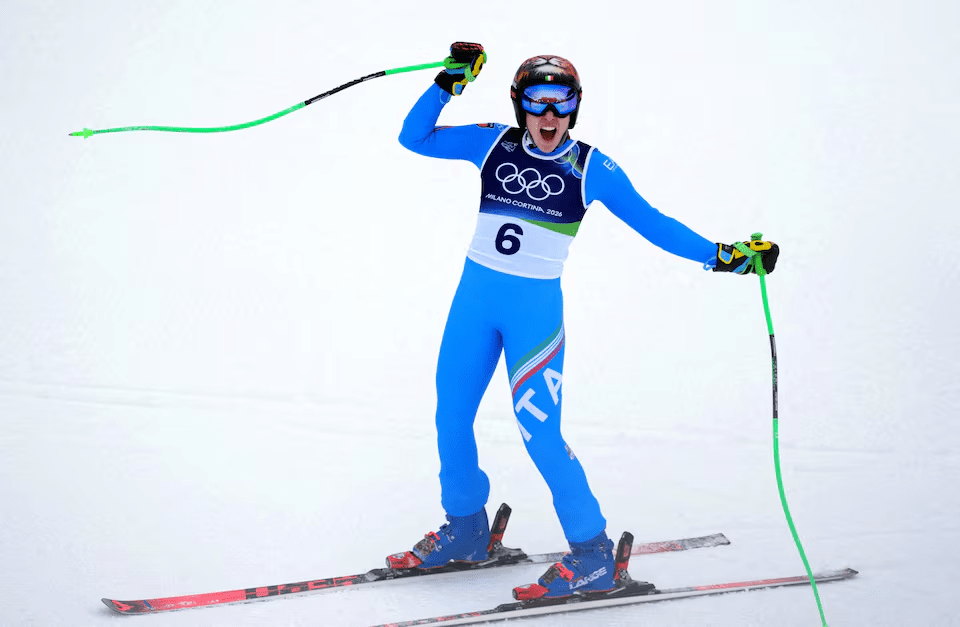
Brignone’s run was a masterclass in balance between aggression and control. Starting sixth, she attacked the course with confidence, letting her skis flow through the terrain rather than holding back in fear of mistakes. Her time proved just enough to keep rival challengers at bay as they sought to topple her mark.
French skier Romane Miradoli took silver, finishing 0.41 seconds behind, while Austria’s Cornelia Huetter earned bronze. The podium was a tableau of both rising stars and seasoned veterans, each pushing the limits of speed and precision down a slope that offered little margin for error.
A Storybook Moment Played Out Before Rapt Fans
The crowd reaction was electric as Brignone blazed across the finish line, greeted with thunderous applause and cries of “Forza Fede!” from Italian fans who packed the grandstands. Among the spectators was Italian President Sergio Mattarella, lending a national-historic air to the occasion. Moments later, the Italian Air Force’s famed Frecce Tricolori performed a celebratory flyover trailing smoke in the colors of the Italian flag a vivid visual salute to one of the country’s most remarkable Olympic moments.
It was a scene that seemed scripted for cinema, yet it was all too real for Brignone, whose emotional reaction made clear that this gold medal was more than a sporting accomplishment. It was the culmination of years of determination, pain, repair and unshakable belief a fairytale ending for an athlete who dared to return from the brink.
Historic Milestones and Personal Records
Brignone’s victory comes with several historical footnotes. At 35, she became one of the oldest alpine skiing Olympic gold medalists, a distinction that puts her alongside some of the sport’s most enduring champions. Her win also moved her closer to the all-time podium records in Italian skiing history, trailing only legend Alberto Tomba’s impressive tally of World Cup wins.
More personally, the gold medal completed a full set of Olympic medals for Brignone adding the one medal that had eluded her throughout her storied career. In doing so, she not only realized a lifelong ambition but also inspired a generation of skiers who see in her journey a template for resilience and hope.
Reactions From Rivals and Teammates
The skiing community was quick to praise Brignone’s performance. Her fellow competitors marveled not only at her technical ability on a challenging course but also at the spirit she displayed in executing a near-flawless run amid conditions that humbled others. U.S. downhill champion Breezy Johnson, who had been considered a contender before crashing out of the event, acknowledged the toughness of the course and the brilliance of Brignone’s run.
Silver medallist Romane Miradoli echoed these sentiments, expressing honor at sharing the podium with Brignone and admiration for her performance. World Cup rivals, including New Zealand’s Alice Robinson, lauded Brignone’s composure and technique, even as their own efforts fell short of the Italian’s benchmark. Italian teammate and World Cup leader Sofia Goggia, who did not finish her race, also extended her congratulations and recognition of Brignone’s achievement.
Such peer praise speaks volumes about the respect Brignone commands on the circuit not just as a champion, but as a role model who embodies the competitive spirit that alpine skiing demands.
The Emotional Resonance of a Home Victory
For the home crowd in Cortina, Brignone’s win carried extra resonance. Olympic gold on native snow is a rare and cherished occurrence in any sport, but in alpine skiing where conditions, competition and variables can shift with the wind it has a mythology all its own. Brignone grasped that reality, acknowledging the surreal mix of calm confidence and controlled aggression that fueled her race.
“I didn’t expect anything else,” Brignone said afterward, reflecting on her philosophy during the run and her mindset in the days leading up to the race. “I tried to always be in front of the slope and to attack … today I was an underdog, but I know what I can do with my skis.”
Her candid acknowledgment of uncertainty paired with fierce execution — is part of what makes this victory so compelling. It wasn’t merely a performance of skill, but one of courage in the face of adversity.
Legacy of a Tiger: What Brignone’s Win Means
In the annals of Winter Olympic history, stories of comeback triumphs have a special place. They resonate not just because they defy expectations, but because they embody the human drive to persevere beyond pain and predictability. Brignone’s achievement will be remembered not only as a high point of Milano-Cortina 2026 but as a chapter in the broader narrative of sport and resilience.
Her victory also highlights the depth of Italian alpine skiing at these Games, contributing to a rising tide of national pride and Olympic success that has energized audiences across Italy and beyond.
For Brignone herself, Thursday’s gold medal is a testament to years of hard work, setbacks and triumphs a legacy that young athletes can look to as an example of what can be achieved when talent is met with unwavering belief.
What’s Next for Brignone
While Brignone has already achieved one of the highest honors in her sport, questions remain about what comes next. At 35, after conquering injury and Olympic gold, she stands as a figure at the crossroads between continued competition and the transition to life beyond elite racing. Whether she chooses to extend her World Cup career or focus on mentoring the next generation, her legacy is secure: a champion who turned adversity into gold.
In the meantime, fans, fellow athletes and the alpine skiing community will savor the memory of her majestic run a moment when grit, grace and sheer belief aligned on the snowy slopes of Cortina d’Ampezzo.