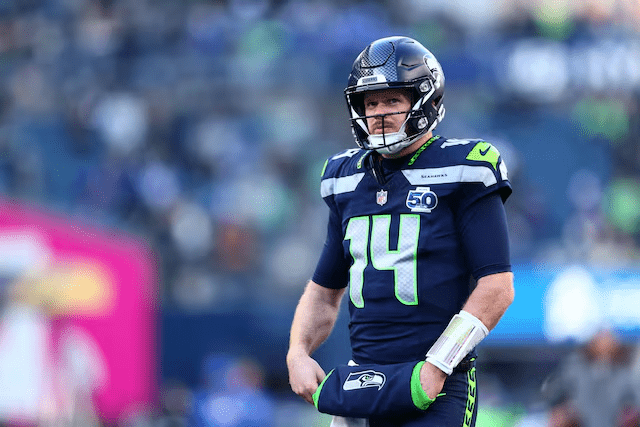
The Seattle Seahawks’ starting quarterback—once written off by many around the league after an uneven early career—says his dramatic turnaround is less about proving critics wrong and more about a fundamental change in how he approaches the game on a daily basis. What has propelled the 28-year-old back into the NFL spotlight, leading a perennial contender to the league’s biggest stage, is not a “redemption arc” in the clichéd sense. Rather, Darnold says his success stems from a mental recalibration he’s carried into every practice and every snap.
That perspective resonates beyond the football field: it suggests that mastery in any craft often arrives not through vindication, but through self-acceptance. Darnold’s experience has become one of the NFL’s most compelling narratives this season—an unexpected arc from journeyman to franchise leader, driven as much by maturity of mind as mastery of mechanics.
A Journey Marked by Peaks and Valleys
Darnold’s professional arc has been anything but linear. Selected third overall by the New York Jets in the 2018 draft, he quickly became fodder for franchise frustration rather than hope. Early struggles led to moves through multiple organizations—the Carolina Panthers, San Francisco 49ers and then the Minnesota Vikings—before he landed in Seattle via free agency on a three-year deal.
It was with the Vikings that Darnold first began to show flashes of renewed promise. Step into the spotlight after an injury to a rookie starter, he guided Minnesota to the playoffs and earned Pro Bowl honors. Yet even that breakthrough did not secure him long-term allegiance from the franchise, prompting his move to the Seahawks.
Now he finds himself preparing to face the New England Patriots in a game that could define not just a season, but his legacy.
Yet when asked about the sources of his resurgence, Darnold demurs from the usual script of anger or retribution. “It doesn’t really come down to that for me,” he told reporters. “It’s always just been about putting in the hard work every single day.”
A Mindset Shift, Not a Narrative Reboot
The key to that hard work, he has explained, has been learning to let go of perfection. In his early years, Darnold struggled to shake off mistakes, letting a bad practice or an errant throw linger in his mind and affect subsequent decisions. But as he gained experience, he began to recognize the futility of dwelling on errors.
That shift was inspired, in part, by a philosophy attributed to Hall of Famer Jerry Rice: that no practice or game will ever be perfect. Fully internalizing that idea allowed Darnold to play more freely, liberated from the self-criticism that had once stifled him. “Once you understand that … you can go out there and just play free. That really unlocked something for me mentally,” Darnold said. Seattle
This evolution isn’t unique among elite athletes, of course. Coaches and psychologists alike emphasize the importance of process over outcome, of focusing on what one can control rather than obsessing over external validation. For Darnold, that change didn’t happen overnight. It was the result of countless repetitions, introspection and a willingness to let go of the “perfect performance” myth that can paralyze even the most gifted. Seattle
Trusting the Team Around Him
Another significant piece of Darnold’s turnaround is a renewed trust—not just in himself, but in his teammates and the broader structure around him. In Seattle, that has meant leaning on one of the NFL’s most balanced rosters: a stout defense, special teams that can swing field position, and an offense capable of explosive plays when given the chance.
“I stopped forcing throws,” Darnold explained, “and started trusting Seattle’s defense to keep games close.”
That trust reflects a maturation rare for quarterbacks still in their 20s. It’s a recognition that football, at its highest level, is a team sport and that sustained excellence comes from collaboration, not heroics.
Seahawks head coach Mike Macdonald has been effusive in his praise, not only for Darnold’s physical gifts but for his unshakeable, quiet resilience. “Sam’s story … is made him who he is today,” Macdonald said, highlighting both the mental and emotional components of his growth.
The Narrative Trap
Despite Darnold’s insistence that he isn’t motivated by vindication or redemption, such narrative tags have nonetheless followed him through much of the season. From social-media discourse to punditry, commentators have alternately labeled his rise a “redemption story” or a “comeback tale” worthy of prime-time headlines.
But Darnold himself pushes back against that framing. The difference is more subtle than a mere media talking point: it’s a shift from “look at me” to “look at this process.” Where a redemption narrative implies proving someone wrong, Darnold’s mindset centers on proving something to himself—namely, that he can refine his craft, maintain equilibrium through adversity and contribute meaningfully to a winning culture. Seattle
That internal grounding has helped him navigate the very public scrutiny that comes with being a Super Bowl quarterback. It also suggests something deeper about the modern athlete’s relationship with pressure: those who thrive often do so not by rejecting criticism, but by not letting it define them. Seattle
Legacy on the Line
Now, as the Seahawks prepare for the sport’s grandest stage, Darnold’s mental evolution may be just as consequential as his arm strength or decision-making under duress. A victory in Super Bowl LX would cement a personal and professional turnaround that few predicted when he struggled to find footing early in his career. It would also underscore the centrality of mindset in elite performance. Seattle
But even without a Lombardi Trophy, Darnold’s narrative—defined by daily discipline and a belief in incremental improvement—offers valuable insight into what it means to overcome adversity in professional sports. Seattle
If this season has taught us anything, it’s that mastery can be less about rewriting past mistakes than about reframing how we think about them. For Sam Darnold, the mental shift has already yielded a remarkable journey back to relevance. Whether it results in football immortality this Sunday remains to be seen, but the lesson resonates well beyond the final whistle: success can come not from silence after failure, but from learning to play through it. Seattle