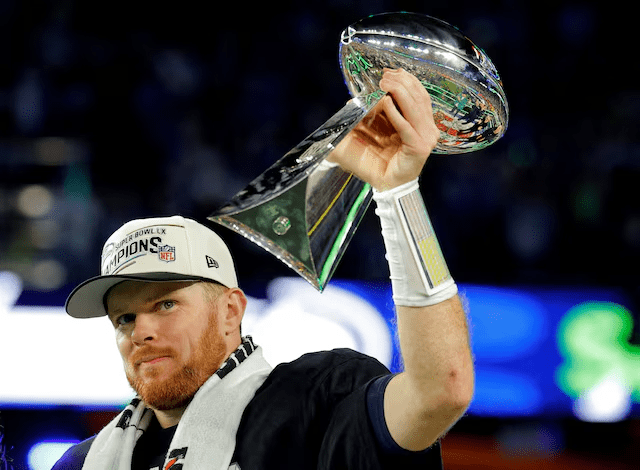
When Sam Darnold hoisted the Lombardi Trophy on Sunday night after the **Seattle Seahawks’ 29–13 victory over the New England Patriots in Super Bowl LX, it wasn’t just a career milestone — it was the culmination of one of the most unlikely and emotionally rich journeys in recent NFL history. What stood out just as much as the final score was the way Darnold spoke about the people who got him there: the family whose faith in him never wavered, even when the wider football world did.
For a quarterback once labeled a bust, who’s now 28 and a Super Bowl champion, this moment meant far more than a championship ring. It was a vindication of resilience, self-belief, and — above all — the enduring power of family support.
A Career Defined by Peaks, Valleys — and Persistence
Darnold entered the NFL with enormous promise as the No. 3 overall pick, but his professional path was anything but smooth. Over eight seasons, he suited up for five different teams, including the New York Jets, Carolina Panthers, San Francisco 49ers and Minnesota Vikings, before landing in Seattle. Critics often questioned his decision-making, consistency and long-term potential as a franchise quarterback.
Yet, rather than allowing those doubts to derail him, Darnold leaned into them — using criticism as fuel to refine his game and belief system. That perseverance paid off spectacularly in the NFL’s biggest moment, even if his performance in Super Bowl LX wasn’t statistically dominant. He finished 19 of 38 for 202 yards and one touchdown, providing steady leadership rather than highlight-reel theatrics while Seattle’s defense and special teams took on a heroic role.
What mattered most in the postgame celebration was not the finer points of box-score metrics but why Darnold felt the victory was possible in the first place.
“I’m Here Because of Their Belief in Me”
Speaking to the media after the game — his voice thick with emotion as he reflected on triumph and struggle — Darnold made a point that resonated far beyond the football field. He credited his parents for helping him retain confidence during periods of intense scrutiny and professional instability.
“Me and my dad don’t really cry very often,” Darnold said of a rare emotional moment shared with his father, Michael, and his mother, Chris. “I told my dad — and my mom — I’m here because of their belief in me. It was because of the way that they believed in me throughout my entire career. It allowed me to go out there and play free and have that kind of confidence.”
Those words weren’t just a token acknowledgment. They encapsulated the foundation upon which Darnold built his self-assurance: a family unit that supported him unconditionally, through ankle-biting criticism and frequent team changes, and reminded him of his worth when public opinion wavered.
Behind the Scenes: Roots of Resilience
Darnold’s upbringing wasn’t one of NFL privilege. His father, Michael, spent decades working in a skilled trade as a plumber, illustrating diligence and humility rather than sports stardom. His mother, Chris, was a physical education teacher — a profession tied intrinsically to encouragement, growth and a nurturing spirit.
According to profiles of the Darnold family, this background helped instill in Sam a work ethic rooted in consistency and composure, values that served him well during both his early promise and subsequent professional turmoil. His older sister, Franki, also brought an element of competitive sports perspective from her own volleyball career at the University of Rhode Island, enriching the athletic environment in which Sam grew up.
That resilient mindset — modeled in quiet moments long before Sunday night’s confetti showers — is now central to Darnold’s identity as both a player and a person.
A Journey of Transformation and Perspective
After years of being doubted, Darnold’s Super Bowl victory is not just a personal celebration but a reframing of how careers are evaluated in professional sports. Rather than leaving a trail of unfulfilled promise, he now stands as an example of durability, reinvention and late-blooming triumph.
“I feel like we didn’t play as good as we could have,” he said candidly after the game, admitting that even on the biggest stage, he didn’t feel he reached his best. But that humility — paired with the assurance that his family’s belief gave him — only deepened the meaning of the moment. “We got it done. I knew my job was to take care of the football, and I did that.”
It’s worth noting that Darnold joined a select group of quarterbacks who have won a Super Bowl in their first season with a new team — a rare achievement matched by names like Tom Brady, Trent Dilfer and Matthew Stafford.
Yet the context behind Darnold’s achievement feels markedly different. His journey lacked the clarity of a consistent upward arc; it was a winding path that required internal fortitude and emotional grounding to navigate. That grounding, he says, came from his family — and that’s the part of the story that might resonate with athletes and non-athletes alike.
What This Means for the Future
As the confetti settles at Levi’s Stadium and football fans digest the Seahawks’ triumphant night, the broader narrative around Darnold is shifting. No longer viewed merely through the lens of early career disappointment, he now represents the art of endurance — a quarterback who embraced challenges, adapted to changing roles and environments, and emerged at the peak of the sport.
More than that, Darnold’s story underscores a universal truth: belief can be contagious, especially when it begins at home. For young athletes facing obstacles or veterans navigating career crossroads, Darnold’s message is clear — confidence sustained over time, rooted in a deep support system, can outlast public criticism and transform adversity into achievement.
In the end, Sam Darnold’s Super Bowl moment wasn’t just a professional milestone — it was a reminder that success isn’t only about physical talent or statistical dominance. Sometimes, it’s about who believed in you before anyone else did.