When FIFA awarded the 2026 World Cup to a joint bid from the United States, Canada, and Mexico, the decision was framed as a celebration of unity, commercial strength, and logistical ambition. A 48-team tournament, spread across three vast nations, promised record revenues, global reach, and a new chapter for the world’s most popular sporting event.
But as the geopolitical climate grows more volatile and domestic crises simmer within each host nation, a pressing question has emerged: has FIFA bitten off more than it can chew?
A Tournament of Unprecedented Scale
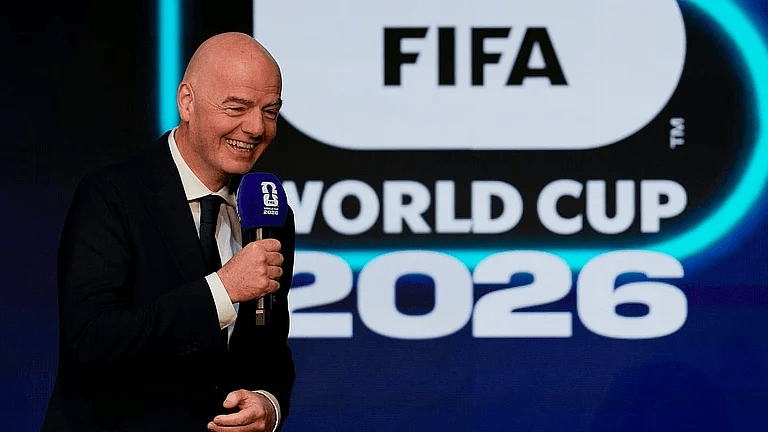
If football is meant to unite the world, the FIFA 2026 World Cup may test that ideal like never before. On paper, the joint hosting of the tournament by Mexico, United States, and Canada looked like a masterstroke by FIFA commercially powerful, logistically capable, politically influential. But as the countdown continues, the global and regional climate surrounding two of those hosts has become increasingly turbulent. The 2026 edition will be the largest FIFA World Cup in history with 48 teams, 104 matches, and 16 host cities. From New York to Vancouver to Mexico City, the tournament spans thousands of miles, multiple time zones, and three different political systems.
In theory, this tri-nation model distributes infrastructure demands and financial risk. In practice, it multiplies complexity. Border logistics, security coordination, immigration policy, and transportation networks must align seamlessly. That’s no small task even in stable times. However, these are not entirely stable times.
The United States: Polarization and Global Commitments
The United States remains a global superpower, but it is also deeply polarized domestically. Political divisions, concerns over gun violence, and debates around immigration policy all create potential flashpoints.
Additionally, America’s extensive involvement in international conflicts and strategic alliances means global tensions can spill over domestically. A tournament of this magnitude becomes not just a sporting event but a symbolic global gathering and therefore a potential target for protest, cyber disruption, or worse.
Security for 48 national teams and millions of fans will require extraordinary coordination between federal, state, and local agencies.
The U.S.–Iran Conflict: A Geopolitical Wildcard
Perhaps the most dramatic international event intersecting with the World Cup is the rapid escalation of hostilities between the United States and Iran, compounded by the involvement of Israel.
In late February 2026, a major coordinated series of military strikes by U.S. and Israeli forces targeted Iranian military infrastructure and leadership figures, resulting in the reported death of Iran’s Supreme Leader, Ayatollah Ali Khamenei, along with other senior officials. This triggered retaliatory actions by Iran, including missile launches against military bases and allied positions in the Gulf.
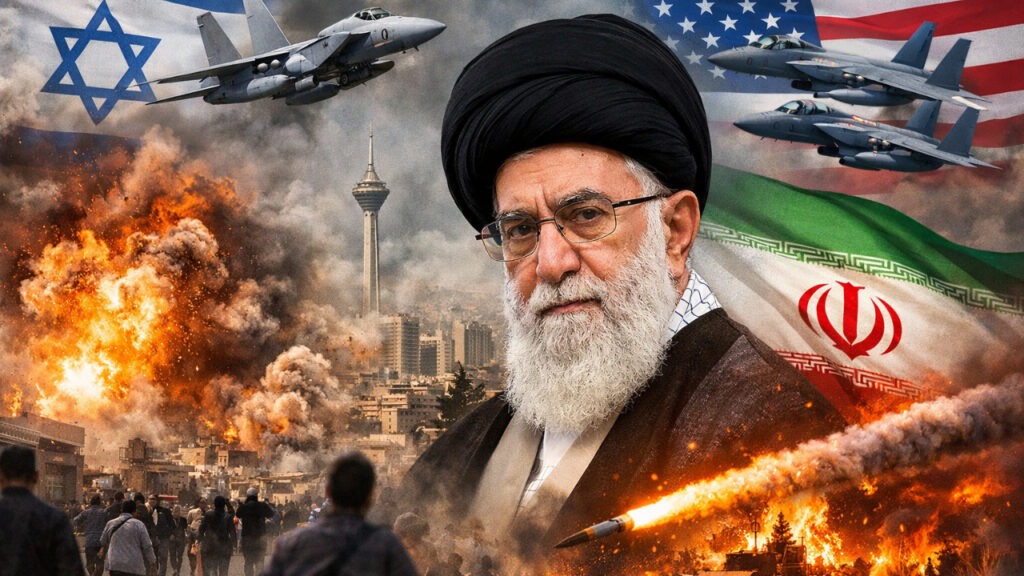
The conflict’s implications spill far beyond the Middle East:
- Regional instability: tensions have prompted diplomatic rifts between Gulf states and Tehran, and several governments around the world have publicly expressed concern about the crisis spilling over into broader instability.
- Global security risk: airspace closures and disruptions in regional travel have already affected flights. This a factor that could complicate international travel plans for fans, teams, and media personnel in the months ahead.
- Sports diplomacy at risk: Iran qualified for the FIFA 2026 World Cup and is scheduled to play all its group-stage matches on U.S. soil, two in Los Angeles and one in Seattle. But Iranian sports officials have publicly said that this escalating crisis makes participation “improbable,” even as FIFA says it hopes all teams will attend.
This is not merely diplomatic posturing; real logistical constraints are now on the table:
- Visa and travel hurdles: International air travel disruptions and tightened border control measures related to the conflict could complicate Iran’s ability to enter and compete.
- Sports administration pressure: If Iran were unable to participate, FIFA regulations allow the governing body to replace the team, but such a move would carry political weight and could risk sanctions or long-term exclusion for Iran from future competitions. Also, replacing a qualified team due to geopolitical conflict would ignite controversy and raise uncomfortable questions about whether sport can truly remain separate from statecraft.
- Public perception and safety: Even if Iran participates, the broader geopolitical backdrop will affect how fans perceive safety around their matches especially games held in the United States, where heightened alerts and increased patrols have been reported in several major cities due to national security concerns linked to the U.S.–Iran conflict.
The possibility that an active conflict involving two World Cup co-hosts (the U.S. as host and Iran as a qualified team) could influence the tournament is unprecedented in recent history. It recalls but far surpasses past politically tinged matches like the United States v Iran (1998 FIFA World Cup), which was played amid tension but well before outright military conflict.
Mexico: Security Challenges and Cartel Violence
For Mexico, the concerns are more internal. Organized crime and cartel-related violence remain persistent challenges. While World Cup host cities are typically secured and heavily monitored, perception matters as much as reality.
Ensuring the safety of fans, players, and officials in a country where security headlines frequently dominate international news will demand immense resources and international cooperation. The tournament offers Mexico a global platform but also places it under intense scrutiny.
Mexico’s Cartel Crisis: Security in the Shadow of Violence
While Mexico is gearing up to host thirteen matches in the 2026 World Cup, including the opening game in Mexico City, as well as key matches in Guadalajara and Monterrey. Mexico faces a significant internal security challenge. The recent death of cartel leader Nemesio Oseguera Cervantes (“El Mencho”) in a targeted operation generated waves of retaliatory violence across multiple states. Armed groups-imposed roadblocks, attacked security forces, and sparked deadly clashes in areas that include major transport routes and urban centers.
This unrest is not isolated, it is an extension of the long-standing issues related to powerful criminal syndicates like the Jalisco New Generation Cartel (CJNG), which have maintained a pervasive presence across swaths of Mexico for years. Analysts warn that such violence cannot be “fixed” merely by high-profile takedowns of cartel leadership, because splintering factions often emerge and expand their influence in the violence vacuum. (Scholarly research on cartel dynamics suggests that reactive law enforcement, like removing bosses, can inadvertently increase violence unless accompanied by structural changes to recruitment and community resilience).
FIFA while publicly confident that Mexico remains prepared to host matches, is actively monitoring the situation, reviewing detailed incident reports from local committees, and holding frequent briefings with authorities. Internal documents sent to FIFA headquarters in Zurich outline incidents across around 20 states, reflecting the unpredictability of the security environment as the tournament date nears.
For fans and teams, the presence of organized violence raises layered concerns:
- Movement and transit: roadblocks and attacks could impact travel between stadiums and cities.
- Perception vs. reality: global media coverage can amplify fear, regardless of whether the threat is direct.
- Coordination across borders: the United States and Canada will inevitably be drawn into cooperative security planning with Mexican agencies to mitigate risks.
These aren’t abstract questions they are practical considerations for FIFA, individual federations, and national security agencies as they finalize logistics.
Canada: Stability Amid Global Uncertainty
Compared to its co-hosts, Canada is widely viewed as politically stable and secure. However, it too faces economic pressures, political debates, and the broader ripple effects of global crises from energy markets to refugee flows.
Canada’s challenge may be less about internal instability and more about logistical alignment with two much larger partners. Coordinating travel, border policies, and security standards across three sovereign nations is an administrative balancing act rarely attempted at this scale.
The “War or Crisis” Question
While none of the host nations are active war zones, each is entangled in broader geopolitical tensions whether through foreign policy commitments, domestic unrest, or organized crime conflicts. In an era defined by cyber warfare, terrorism threats, and rapid political escalation, stability can never be assumed.
The 2026 World Cup will not exist in a vacuum. It will unfold against whatever global climate defines that summer whether relative calm or heightened conflict.
And that unpredictability is what makes critics uneasy.
Commercial Ambition vs. Political Reality
There is no denying the commercial logic behind FIFA’s decision. North America offers:
- Massive stadium infrastructure
- Corporate sponsorship markets
- Broadcast-friendly time zones
- Proven event-hosting experience
But commercial ambition does not eliminate geopolitical risk. In fact, the bigger the tournament becomes, the more exposed it is to disruption.
A 48-team World Cup across three countries is not just a football event. It is also a diplomatic, logistical, and security mega-project.
Lessons from the Past
Major tournaments have navigated crises before. From security concerns at the 1998 World Cup in France to political controversies surrounding more recent editions, global sport has often thrived amid turbulence.
The question is not whether challenges will arise, they will.
The question is whether FIFA has built a structure resilient enough to absorb them.
So, Has FIFA Overreached?
It depends on perspective. If stability holds, 2026 could be remembered as the most commercially successful and widely attended World Cup in history and will be viewed as a model for future multi-nation tournaments.
But if geopolitical tensions escalate, if security incidents occur, or if coordination fractures under pressure, critics will argue that FIFA expanded too quickly and gambled too boldly.
What is certain is this: by stretching the tournament across three nations in uncertain times, FIFA has raised both the ceiling of possibility and the floor of risk.
The 2026 World Cup may prove visionary or it may reveal that even the world’s most powerful sports body can misjudge the weight of global instability.
The world will be watching not just the football, but the framework holding it together.
What This Means for the 2026 World Cup
FIFA often emphasizes that sport should transcend politics but yet when heads of state are killed, governments are at war, and national security agencies are on high alert, those ideals are put to the test. That is precisely what makes the intersection of football and geopolitics in 2026 so compelling but also potentially precarious.
For a global event that aims to bring people together through sport, the backdrop of intensified cartel violence in Mexico and a broader U.S.–Iran conflict introduces uncertainties that extend far beyond the pitch. At stake isn’t just logistics or safety it is whether the beautiful game can withstand the real-world dynamics of political unrest and international conflict without undermining its core promise of unity and celebration.