Understanding the tennis scoring system is often the first hurdle for new fans. At first glance, it feels confusing. Points go from 15 to 30 to 40, games stack into sets, and matches can swing dramatically within minutes. However, once the structure is clear, tennis becomes one of the easiest sports to follow and one of the most exciting to watch.
This guide breaks down the tennis scoring system in a simple, beginner-friendly way while explaining the logic behind it.
What Is the Tennis Scoring System?

The tennis scoring system is built in layers. A match is divided into sets, sets are made up of games, and games are made up of points. Every rally you watch contributes to this structure.
A player must win enough points to claim a game, enough games to win a set, and enough sets to win the match. This layered format is what creates tension, comebacks, and dramatic finishes.
How Points Are Scored in Tennis
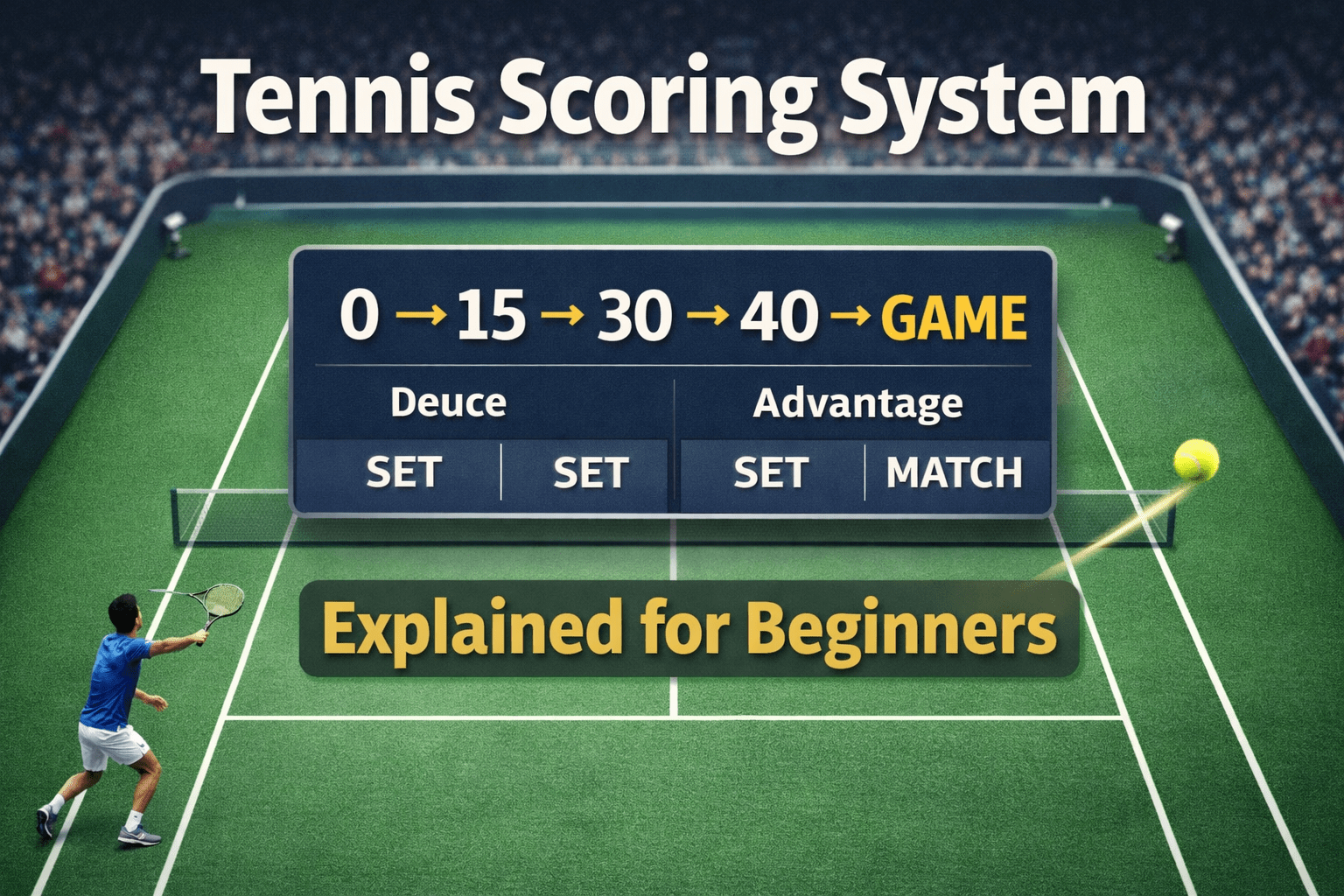
Every point begins with a serve. The player who wins the rally earns a point, but instead of counting 1, 2, 3, tennis uses a unique system: 15, 30, 40, and then game.
If both players reach 40, the score becomes “deuce.” From there, a player must win two consecutive points to win the game. The first point after deuce is called “advantage.” If the same player wins the next point, they win the game. If they lose it, the score returns to deuce.
This structure is a defining feature of the tennis scoring system because it ensures games are rarely decided by a single lucky point.
How Games Work
A game is won when a player reaches at least four points and leads by two clear points. Because of the deuce rule, games can extend far beyond four points, especially in closely contested matches.
Players alternate serving each game, which adds another layer of strategy. Holding serve is considered crucial in tennis, as breaking an opponent’s serve often determines the outcome of a set.
Understanding Sets in Tennis
A set is won when a player wins six games with at least a two-game advantage. For example, a set can end 6-3 or 6-4. However, if the score reaches 5-5, a player must win 7-5 to close the set.
If the score reaches 6-6, most tournaments use a tie-break to decide the set. This is where the pace and tension of the tennis scoring system change dramatically.
What Is a Tie-Break?

A tie-break is a special game used to decide a set when players are level at 6-6. Instead of the traditional 15-30-40 scoring, points are counted numerically as 1, 2, 3, and so on.
The first player to reach seven points with a two-point lead wins the tie-break and the set. If the score becomes 6-6 in the tie-break, play continues until one player leads by two points.
Tie-breaks are often the most intense moments in tennis because every point carries significant weight.
Match Formats Explained
The number of sets required to win a match depends on the competition. In most professional tournaments, matches are played as best-of-three sets. This means a player must win two sets to win the match.
In major tournaments like those organized by International Tennis Federation, men’s matches are often best-of-five sets, requiring three sets to win. This format tests endurance, consistency, and mental strength over a longer period.
Why Tennis Scoring Is Unique
The tennis scoring system stands out because it combines structure with unpredictability. A player can dominate a set but still lose it if they fail to convert key points. Momentum can shift quickly, and even a trailing player always has a chance to come back.
This unpredictability is what makes tennis so engaging. Every point matters, and matches often hinge on a few critical moments.
The Role of Serving in Scoring

Serving plays a central role in the tennis scoring system. The server has the advantage of starting each point and often dictates the pace of play. Strong servers can win games quickly, while weaker serves can be targeted by opponents.
Players alternate serves every game, and in tie-breaks, the serve rotates more frequently. This balance ensures fairness while maintaining strategic depth.
Common Terms You Should Know
As you follow tennis matches, certain terms appear frequently. “Love” means zero, so a score of 15-love indicates one player has one point while the other has none. “Break point” refers to a situation where the receiving player is one point away from winning the game on their opponent’s serve.
Understanding these terms makes it much easier to follow the flow of a match and appreciate the nuances of the tennis scoring system.
How Scoring Shapes Strategy
The structure of tennis scoring system directly influences how players approach matches. Because points build into games and games into sets, players must think long-term while staying focused on each rally.
For example, a player might take more risks when facing break points or play conservatively when protecting a lead. Tennis scoring system encourages both aggressive and defensive strategies, depending on the situation.
Conclusion
The tennis scoring system may seem unusual at first, but it quickly becomes intuitive once you understand its structure. Points lead to games, games lead to sets, and sets decide the match. Within that framework lies the drama that defines tennis.
From tense deuce battles to high-pressure tie-breaks, the system ensures that every match tells a story. For beginners, learning how scoring works is the key to fully enjoying the sport and appreciating why tennis remains one of the most thrilling games in the world.
