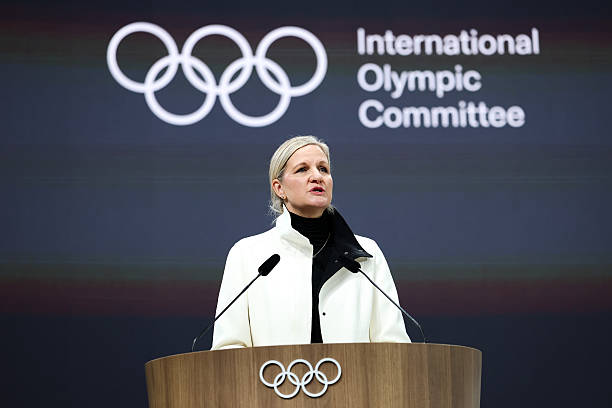
The International Olympic Committee (IOC) has announced a landmark decision to ban transgender women and certain DSD athletes from competing in female events at future Olympic Games, starting with 2028 Summer Olympics.
The ruling marks one of the most significant policy shifts in modern Olympic history, with the IOC stating that the move is designed to protect “fairness and safety” in women’s sport.
IOC transgender women Olympics ban explained
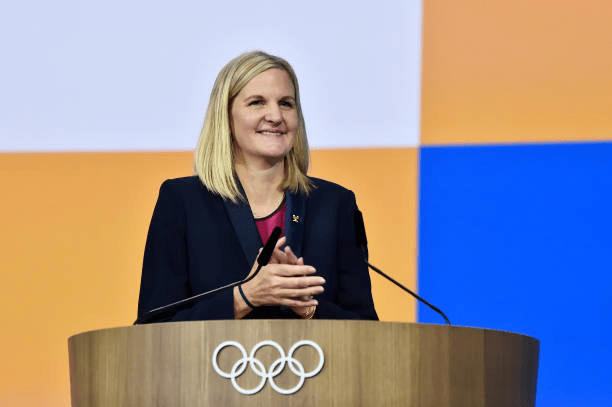
The new policy, confirmed by IOC president Kirsty Coventry, introduces strict eligibility rules for athletes competing in the female category.
Under the guidelines, all athletes entering women’s events will be required to undergo a one-time SRY gene screening test. This test, typically conducted via a cheek swab or saliva sample, is used to determine biological sex based on the presence of the sex-determining region Y gene.
According to the IOC, the test is non-invasive and only needs to be completed once in an athlete’s lifetime.
Coventry emphasized that the decision was grounded in scientific evidence and aimed at preserving competitive integrity.
Why IOC introduced transgender women Olympics ban
The IOC’s 10-page policy document highlights what it describes as measurable performance advantages linked to male puberty.
According to the findings:
- Male athletes have a 10–12% advantage in endurance events such as running and swimming
- The advantage increases to over 20% in jumping and throwing disciplines
- In explosive sports like boxing and weightlifting, the advantage can exceed 100%
The IOC concluded that these differences create an uneven playing field, particularly at elite level competition where marginal gains often determine medal outcomes.
The organization also cited safety concerns in certain contact sports, arguing that physical disparities could increase the risk of injury.
Past Olympic cases that shaped the debate

The issue of gender eligibility has been a growing topic in international sport for over a decade.
At the Tokyo 2020 Olympics, Laurel Hubbard became the first openly transgender woman to compete in Olympic history, marking a milestone moment for inclusion in sport.
There have also been high-profile cases involving athletes with differences in sex development (DSD). Among them is Caster Semenya, who won gold medals in the women’s 800m at the London 2012 Olympics and Rio 2016 Olympics.
More recently, Imane Khelif and Lin Yu-ting have also been part of discussions around eligibility in women’s events.
These cases have intensified global debate around fairness, inclusion, and the definition of female competition in elite sport.
IOC transgender women Olympics ban reactions

Reactions to the IOC’s decision have been mixed.
Advocacy group Sex Matters welcomed the policy, describing it as a necessary step to ensure fairness in women’s sport. The organization also supported the use of SRY screening as a “simple and non-invasive” solution.
However, other groups have raised concerns. DSD families expressed disappointment, warning that the policy could negatively impact athletes with DSD conditions.
Critics argue that while fairness is important, eligibility rules must also be proportionate and sensitive to the rights and dignity of affected athletes.
What IOC transgender women Olympics ban means for future Games
The IOC has made it clear that the policy applies strictly to elite-level competition, including both Summer and Winter Olympic Games. Grassroots and recreational sports will not be affected.
The organization is also encouraging international federations to adopt similar regulations, which could lead to widespread changes across global sport.
For the Olympic movement, this decision represents a decisive shift toward a stricter, biology-based definition of female competition.
A defining moment for modern sport
The IOC transgender women Olympics ban will likely remain one of the most debated decisions in sports governance.
It sits at the intersection of science, fairness, inclusion, and human rights, and its long-term impact will shape not just the Olympics, but the broader structure of elite competition worldwide.
As preparations continue for Los Angeles 2028, the focus will now turn to how federations implement the policy and how athletes respond to one of the most consequential rulings in Olympic history.
