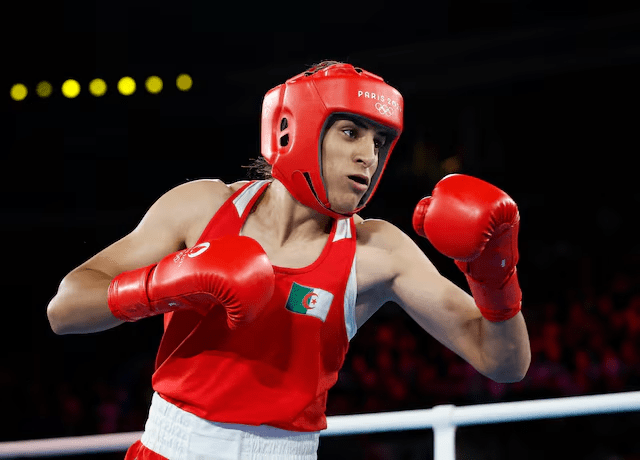
Algerian boxing champion Imane Khelif has injected fresh clarity into one of Olympic sport’s most contentious eligibility debates, saying she is willing to undergo genetic testing to compete at the 2028 Los Angeles Games — as long as the tests are conducted under the authority of the International Olympic Committee.
The 26-year-old welterweight gold medallist — whose victory at the Paris Olympics in 2024 was overshadowed by fierce scrutiny over her eligibility — made her position clear this week in media interviews, reaffirming her commitment to her sport while underscoring deep concerns about fairness and personal dignity in how such rules are applied.
From Olympic Gold to Eligibility Storm
Khelif’s journey from Olympic champion to the centre of a gender testing debate has been dramatic. After her triumph in Paris last year, she was barred from the 2023 World Boxing Championships by the International Boxing Association (IBA) on grounds related to sex chromosome criteria — a decision that triggered international debate and legal challenges.
World Boxing, the sport’s new governing body that will oversee Olympic boxing in Los Angeles after receiving provisional recognition from the IOC, later announced mandatory sex testing for all participants in its competitions. The policy has been framed as an effort to ensure a level playing field for women’s competition.
Khelif has appealed the requirement to the Court of Arbitration for Sport (CAS), arguing that it unfairly targets her and violates principles of equity and athlete rights. Despite that legal battle, she told reporters she would accept genetic testing if it comes under the auspices of the IOC itself.
A Conditional “Yes” — But With Clear Boundaries
In interviews published this week, Khelif stressed that her willingness to be tested is not unconditional. She said she would comply with whatever requirements the IOC sets for participation in the 2028 Games, but pointedly insisted that tests must be administered by the IOC, not solely by World Boxing or other federations.
“Of course, I would accept doing anything I’m required to do to participate in competitions,” she said in comments reported by international media, including CNN. “They should protect women, but they need to pay attention that while protecting women, they shouldn’t hurt other women.”
Her remarks reflect an attempt to straddle competing demands from sporting authorities and critics, affirming her commitment to compete under the rules — but also drawing a line around who gets to set and enforce those rules.
Crucially, Khelif also reiterated her identity as a woman and rejected narratives that have mischaracterised her gender identity. “I’m not transgender. I’m a woman. I want to live my life. Please do not exploit me in your political agendas,” she said.
At the Heart of a Broader Sports Debate
Khelif’s situation highlights wider friction in global sport over how gender eligibility is defined and regulated. After years of debate across multiple disciplines — from athletics to cycling — boxing has become a high-profile flashpoint.
World Boxing’s new policies include mandatory sex testing for all boxers in female categories, with athletes required to undergo genetic or chromosomal screening before they are cleared to compete. The federation’s announcement specifically mentioned Khelif’s eligibility, a move that drew criticism and later prompted an apology from the organisation for singling out an individual athlete.
While the policies are intended to create clarity, critics argue they can produce confusion and stigma. Variation in testing standards across organisations — and the lack of scientific consensus on the best ways to assess eligibility — have made gender verification a fraught and often controversial process.
In Khelif’s case, the fact that she was allowed to compete in Paris under IOC eligibility standards underscores how complex and inconsistent the landscape has been. Those standards cleared her to fight for and win Olympic gold, even as other bodies reached different conclusions.
Legal and Personal Stakes Still High
The legal appeal lodged with the Court of Arbitration for Sport continues to be a central element of Khelif’s strategy. By challenging World Boxing’s mandate, she is seeking not only to safeguard her own eligibility but also to push back against what she sees as overreach by sporting authorities that did not previously govern Olympic competition.
Her comments this week also echoed a wish to reclaim control over a narrative that has at times spiralled into public scrutiny and political debate. Figures in global politics have weighed in, and social media commentary has at times turned personal, placing her at the intersection of sport, identity, and public discourse.
That pressing media spotlight has taken an emotional toll on the Algerian athlete. A recent report highlighted Khelif’s remarks about hormone treatments she underwent before the Paris Games to manage testosterone levels — a topic that itself has become part of broader discussions about gender diversity and sport.
Looking Ahead to Los Angeles
With the Paris Olympics now behind her, Khelif’s focus has visibly shifted to the Los Angeles Games in 2028. Her statement on testing is designed to both comply with the letter of evolving Olympic rules and to push for fairness and due process in how those rules are applied.
“I will not surrender until I have justice because I know justice is on my side above all else,” she said in her latest round of comments, underscoring her determination to both compete and challenge what she sees as unfair treatment.
As the debate around genetic and sex testing continues to evolve, Khelif’s stance — a measured openness paired with insistence on oversight — could shape how other athletes and governing bodies navigate these complex issues in the years ahead.
Her position reframes a controversy that has sometimes been reduced to headlines and soundbites into a deeper conversation about athlete rights, the role of science in sport, and how global institutions balance fairness with inclusivity.
Whether Khelif’s conditional acceptance of IOC testing will satisfy regulators, critics and fellow competitors remains to be seen. But her voice is now an unmistakable part of the dialogue that will shape the future of Olympic competition