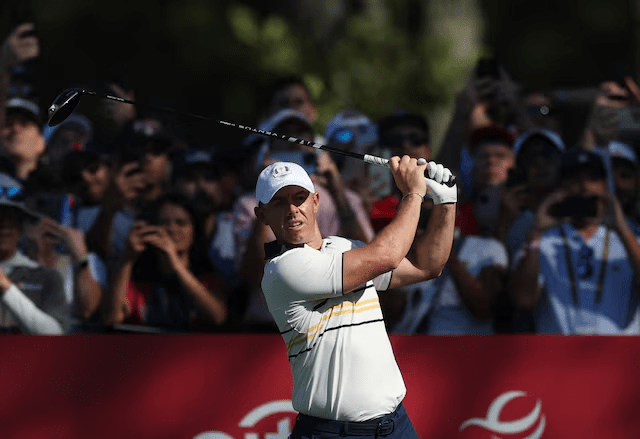
Rory McIlroy has sounded a blunt warning about the state of LIV Golf, suggesting that the rival Saudi-backed tour is losing momentum after failing to attract any new high-profile player signings and suffering a significant blow with the departure of Brooks Koepka. McIlroy’s remarks reflect broader concerns among golf insiders about the long-term appeal and competitive sustainability of the breakaway league.
The comments came while McIlroy was competing at the Dubai Invitational, where he held the early lead. The Northern Irishman’s assessment followed the announcement that Brooks Koepka — a five-time major champion and one of LIV Golf’s most prominent names — has decided to leave the circuit and pursue a return to the PGA Tour under its “Returning Member Program.”
McIlroy, one of the most vocal critics of LIV since its inception, said the Saudi-backed tour’s inability to secure “players who move the needle” is a real problem that could undermine its credibility and growth.
Koepka’s Exit: A Turning Point
Koepka’s decision to depart LIV Golf and head back to the PGA Tour has been viewed by many as a symbolic turning point. While the PGA Tour’s Returning Member Program involves financial penalties and restrictions on benefits — including limits on Koepka’s participation in the Tour’s player equity plan — his return is widely seen as a boost for traditional tours.
For McIlroy, Koepka’s departure is significant not just because of his stature but also because it highlights a perceived shift in player sentiment. “They’ve lost Brooks … He is one of the best players in the world and anything that makes the traditional tours stronger is a good thing in my book,” McIlroy told The Telegraph.
Koepka’s return was facilitated by his eligibility under the PGA Tour’s program, which opened the door for players who had won a major championship or The Players Championship since 2022. While other stars such as Jon Rahm, Cam Smith and Bryson DeChambeau are technically eligible to re-join the PGA Tour, all three have so far declined the opportunity.
No “Needle-Moving” Signings for LIV
One of the core elements of McIlroy’s critique is that LIV Golf has not signed any new player who significantly elevates its competitive appeal. Despite the league’s multi-billion-dollar backing from the Saudi Public Investment Fund (PIF), the absence of new marquee names has raised doubts about its ability to sustain fan interest and media attention.
“They haven’t signed anyone who moves the needle and I don’t think they will,” McIlroy said, emphasising that even potential re-signings of top players would not substantially enhance the league’s product. “They could re-sign Bryson [DeChambeau] for hundreds of millions of dollars, but even if they do, it doesn’t change their product … They’ll just be paying for the exact same thing.”
That point underlines a critical tension for LIV Golf: money alone may not be enough to establish its legitimacy alongside the more established PGA Tour and DP World Tour structures. Players like DeChambeau, Rahm and Smith remain under contract with LIV, but their continued presence has not, in McIlroy’s view, drastically altered the league’s competitive stature.
LIV’s Current Player Landscape
In recent off-seasons, LIV has managed some signings, most notably Thomas Detry, the Belgian who became the first from his country to win a PGA Tour event last year. The league also extended a multi-year deal with Dustin Johnson, although he did not qualify for PGA Tour reinstatement.
However, these moves have not satisfied critics like McIlroy, who view the presence of needle-moving stars — players whose participation significantly influences media interest and fan engagement — as essential for a rival league to truly thrive.
Meanwhile, the PGA Tour and LIV Golf have not finalised the framework agreement first announced in June 2023 that was intended to unify the sport and provide a coherent path forward for professional golf globally. Informal discussions continue, but progress toward resolution remains slow, and the ongoing division persists.
McIlroy’s Perspective on Golf’s Future
McIlroy’s remarks are part of a broader narrative in which he has consistently advocated for the strength and continuity of the traditional golf ecosystem. He has frequently emphasised that golf’s future depends on competitive depth, compelling rivalries and a stable environment that benefits players and fans alike.
While other PGA Tour players have expressed mixed views — some supportive of reintegrating LIV players, others focused on principles and fairness — McIlroy’s stance remains rooted in the belief that the sport is best served by a unified, high-quality tour structure.
He has previously indicated openness to welcoming former LIV golfers back to the PGA Tour without punitive measures, arguing that their reintegration could ultimately strengthen the traditional tours.
Industry Reaction and Competitive Dynamics
Not all voices in golf agree on McIlroy’s perspective. Some observers see LIV Golf’s continued ability to secure contracts with established players as evidence of its ongoing relevance. Others argue that the league’s format and global reach provide new opportunities for golfers outside the traditional system. Despite this, Koepka’s exit and McIlroy’s comments have sparked renewed debate about LIV’s long-term strategy and identity.
The financial dimensions of these decisions are also crucial. Koepka’s reinstatement involved significant financial considerations — including donations and adjustments to earnings potential — and highlighted the complexities players face when balancing competitive aspirations, personal goals and financial incentives.
What’s Next: Golf’s Divided Path
As the 2026 golf season progresses, the relationship between LIV Golf and the PGA Tour will remain a defining storyline. The lack of breakthrough signings for LIV raises questions about whether its model can sustain long-term excitement and competitive heft, while the PGA Tour’s openness to reintegrate certain players hints at a slow evolution toward reconciliation.
For McIlroy, the focus remains clear: professional golf thrives on competition that captures the imagination of fans and honours the sport’s traditions. His critique of LIV Golf — grounded in Koepka’s exit and the absence of big-name signings — underscores a fundamental debate about money, relevance and meaning in modern sport.