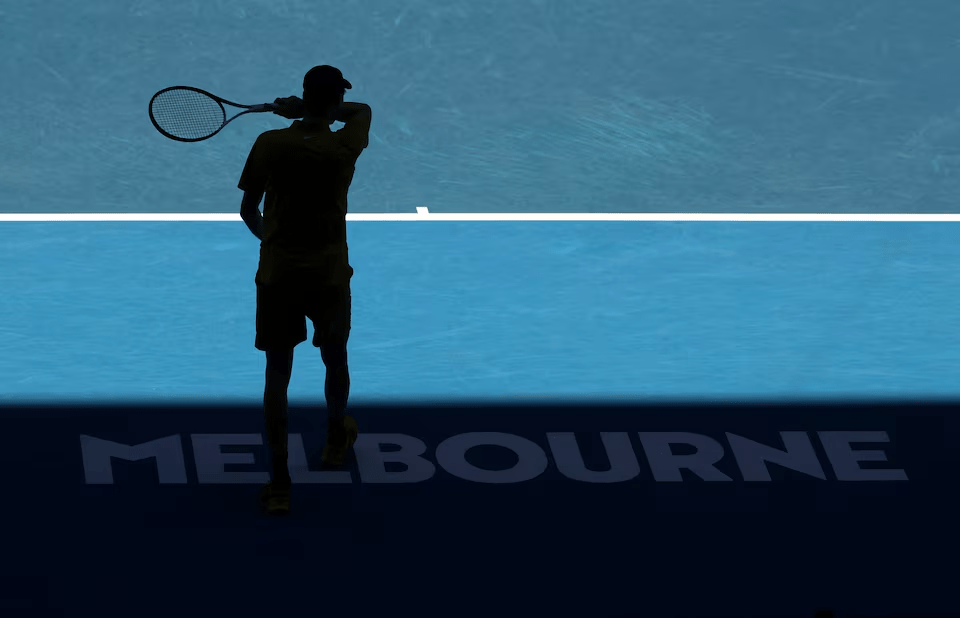
The Australian Open’s showcase of elite tennis was forced into an abrupt and dramatic pause on Saturday as Melbourne Park turned into a near-open oven, pushing temperatures toward 40°C and triggering the tournament’s extreme heat safeguards. On one of the busiest days of the year’s opening Grand Slam, officials were compelled to suspend play on outdoor courts, shift schedules and close arena roofs in a bid to protect players, officials and spectators from potentially dangerous conditions.
The brutal conditions, described by players and fans alike as some of the toughest seen at Melbourne Park in recent memory, brought matters to a head around mid-afternoon. With the Australian Open’s Heat Stress Scale peaking at level 5, national and international officials declared that it was simply too hot to continue normal competition on open courts — a rare but increasingly necessary interruption amid rising temperatures in Australia’s summer months.
Safety First: Extreme Heat Policy Comes Into Full Effect
For the uninitiated, the Australian Open operates an Extreme Heat Policy designed to safeguard wellbeing when conditions become severe. Rather than relying solely on a thermometer, tournament officials use a Heat Stress Scale that factors in ambient temperature, radiant heat, humidity and wind speed — giving a more complete picture of how conditions actually affect players. When the scale hits 5, play on outdoor courts must be suspended until conditions improve or alternative arrangements, such as roof closures on major arenas, are in place.
At around 2:30 p.m. local time, conditions reached that critical threshold. Matches on outside courts were halted immediately, while play under covered roofs at Rod Laver Arena, Margaret Court Arena and John Cain Arena continued, albeit in an altered format as officials scrambled to adapt to the searing weather.
“The safety of our players and spectators has to come first,” said a tournament official in a statement released to the press. “Given the forecasted temperatures and the readings from our Heat Stress Scale, we had no option but to take decisive action this afternoon.”
Players Battle Both Opponents and Elements
Defending men’s champion Jannik Sinner found himself at the heart of one of the day’s most compelling narratives. Locked in a third-round duel with American qualifier Eliot Spizzirri, Sinner was visibly struggling with cramps and signs of physical distress as the mercury climbed. Just as the Italian appeared poised to fight back into the contest after splitting the first two sets, officials suspended play on Rod Laver Arena, closing the roof and giving players a brief window to recuperate in cooler, conditioned air.
Sinner’s predicament encapsulated the challenge faced by many of the competitors: a sport built on explosive court movement, gritty endurance and razor-sharp focus, now being tested against an environmental foe that doesn’t blink. After a short delay, play resumed — but the interruption not only changed the atmosphere inside the arena but also offered a stark reminder of how extreme conditions can swing momentum and strain even the most prepared athlete.
Elsewhere, experiences varied. Madison Keys, the defending women’s champion, showcased resilience in navigating her early afternoon match on a main court under roof, defeating Karolina Plíšková in straight sets. Keys, who grew up playing in Florida’s heat, credited early start times and hydration strategies for helping her cope with the punishing sun. She will now face fellow American Jessica Pegula in the round of 16.
Logistical Shifts and Fan Precautions
The extreme heat also forced tournament organisers to implement schedule changes, with many matches beginning earlier than usual to avoid the worst of the afternoon temperatures. Main show courts opened their gates closer to the cooler part of the morning, while some outer court action even began as early as possible under tournament rules.
Fans in the stands — many with tickets booked months in advance — found themselves seeking shade, applying sunscreen at frequent intervals and sipping water to stave off dehydration. Organisers advised supporters to make use of the many misting stations and shaded areas around the Park precinct. “Hydration is key,” an event bulletin reiterated. “Please look after yourselves and those around you.”
Despite the discomfort, many spectators voiced understanding of the decisions made by tournament officials, acknowledging the challenges posed by Melbourne’s famously unpredictable summer weather. A few described leaving the stands for cooler indoor spaces as a necessary trade-off to ensure the remainder of the competition could continue safely.
A Growing Concern: Heat in the Era of Climate Change
While heat delays at the Australian Open are not new — the extreme heat policy dates back several years and has seen play interrupted in past editions — this year’s conditions have underscored a larger conversation around climate change and its impact on global sport. Melbourne’s summer temperatures are known to soar, but peaks approaching 40 degrees Celsius (104 Fahrenheit) push even seasoned athletes to their limits and stretch the capacity of tournament safeguards.
Experts say that such heat extremes are becoming more frequent and intense, warranting continued evolution of safety policies. “We are in a new era,” one sports scientist remarked. “Tournament organisers must adapt protocols to protect athletes, and that includes flexible scheduling, improved cooling infrastructure and clear thresholds for play suspension.”
Looking Ahead: Resilience and Adaptation
As the tournament enters its second week, the spectre of more high temperatures looms. Forecasts for later in the event suggest a continuation of hot conditions — potentially another brush with the conditions that brought Saturday’s outdoor action to a halt.
For competitors, it will be a test not just of skill but of resilience and recovery. Strategic hydration, shifts in pacing and mental fortitude will be as critical as athletic prowess in the rounds to come. And for tournament officials, the priority remains clear: safeguard health while preserving the excitement and integrity of one of tennis’s most storied championships.
In a sport already marked by intense rivalries and dramatic storylines, this year’s Australian Open is adding another chapter — one where extreme heat doesn’t just influence results, but reshapes how the game is played and watched in the age of unpredictable weather.