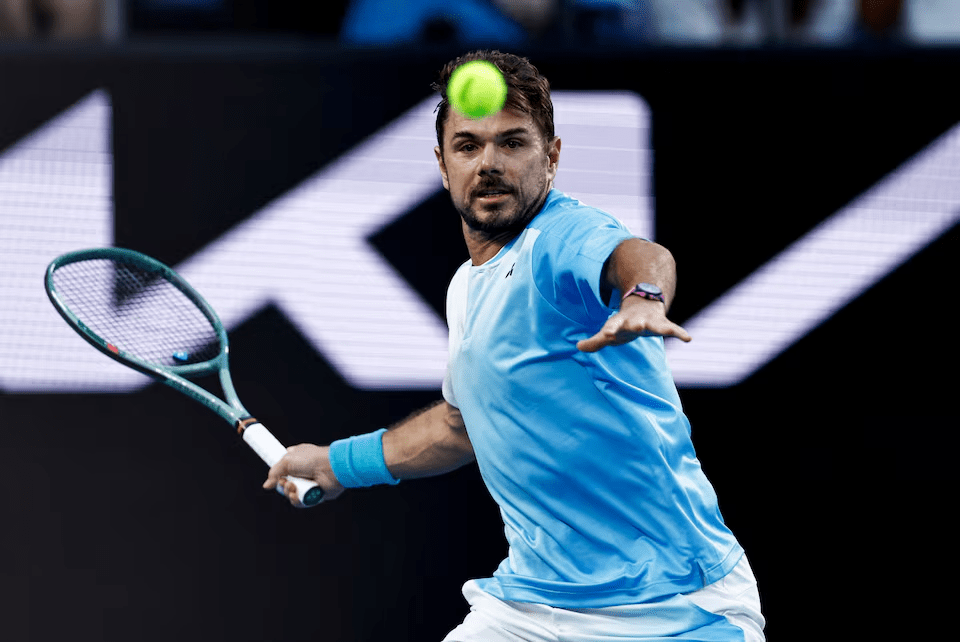
Stan Wawrinka carved out a classic Grand Slam victory in the second round, outlasting French qualifier Arthur Gea in an epic five-set duel that will be remembered as one of the standout matches of the tournament. The three-time major champion, competing in what he has announced will be his final season on tour, extended his stay at Melbourne Park with a 4-6, 6-3, 3-6, 7-5, 7-6(10-3) victory that lasted more than four hours.
At 40 years old, Wawrinka’s performance was not only a testament to his enduring competitive fire but also a remarkable chapter in a farewell campaign that has captured the imagination of tennis fans around the world.
A Match That Lived Up to Its Build-Up
Early Back-And-Forth Sets
From the outset, the contest had drama. Gea — the 21-year-old Frenchman making his Australian Open debut — came out swinging, using depth and aggression to take the first set 6-4. His fearless baseline hitting and court awareness brought early applause, and the opening frame hinted this would be no routine encounter. Wawrinka, typically the aggressor in his prime, was pushed into extended rallies and had to weather a patient opponent who was unfazed by the occasion.
Gea’s momentum continued into the third set after Wawrinka leveled at one set apiece with a 6-3 second-set win. The qualifier broke serve and carried his lead through to pin Wawrinka into tough defensive positions. At times, the younger man’s consistency and athleticism seemed to balance out the Swiss star’s strategic shot-making and hardened instincts.
Experience Edges Youth
But tennis — especially Grand Slams — has a way of rewarding experience. Wawrinka began to find traction in the fourth set, blending his heavy groundstrokes with improved serve placement and steadier movement. He broke late in the set to clinch it 7-5, keeping the match alive and swinging the emotional pendulum in his favour.
As the hours stretched on and the fifth set loomed, it became clear this would be a battle of wills as much as a test of skill. Both players traded breaks and holds in a see-saw final set, refusing to yield to pressure. In the decisive tiebreak, Wawrinka’s trademark one-handed backhand — still a thing of beauty and tactical precision — began to dictate crucial points, turning the tide when it mattered most.
Writing His Own History in Melbourne
A Return to Third Round Glory
The victory marks Wawrinka’s first ascent into the third round at Melbourne Park since 2020, a noteworthy milestone in a tournament where he has long been at his best. With this result, he also becomes the oldest man to reach the third round of a Grand Slam since Ken Rosewall in 1978, a remarkable historical achievement that underscores how rare such longevity is in the modern game.
For Wawrinka — a former world No. 3 and a player known for raising his level on the sport’s biggest stages — this win will resonate beyond mere statistics. It is a reminder that even as his farewell season progresses, his competitive instinct remains sharp and formidable.
Records and Resilience
This match also added to Wawrinka’s legacy in another fascinating way. With 49 five-set matches at Grand Slams, he has now surpassed compatriot Roger Federer for the most in the Open Era, a record that speaks volumes about both his physical endurance and his willingness to dig deep when the stakes are highest.
Such resilience was on full display in this encounter. Wawrinka rallied from behind twice — each time rebounding from deficit — showcasing a blend of patience and aggression that has defined his standout performances throughout a career built on late-stage breakthroughs.
More Than Just a Win — A Statement
Emotion Meets Endurance
Throughout the final stages of the match, the energy in Kia Arena built to a crescendo — not just for the points at stake, but for what Wawrinka represents at this stage of his career. The crowd’s support, which often sings louder for the underdog or the veteran, seemed to give the Swiss a tangible boost. In a post-match court interview, a visibly exhausted but exhilarated Wawrinka uttered words that captured the spirit of the day, joking about celebrating with a beer after such a gruelling encounter while thanking the fans for their unwavering support.
Behind every statistic and record lies a story of persistence, and that story was trenchantly apparent here. Wawrinka’s ability to transition from defense to attack under duress — keeping rallies alive and waiting for the right moments to strike — illustrated why he has remained a fan favourite long after many of his peers have retired from the tour.
What’s Next for Wawrinka’s Farewell Run
A Third-Round Challenge Awaits
With this win under his belt, Wawrinka will turn his attention to a third-round clash that promises a significant test: either ninth seed Taylor Fritz or rising star Vit Kopriva loom as his next opponent. Both players present distinct challenges — Fritz with power and consistency, Kopriva with youthful unpredictability — and each will test different aspects of Wawrinka’s game as the veteran seeks to push even deeper into what could be a storybook end to his Australian Open tenure.
A Farewell We’ll Remember
For fans of tennis, Wawrinka’s marathon triumph over Gea was more than just another result. It was a reminder of why sports draw us in — the thrill of competition, the clash of generations, the beauty of grit and grace under fire. As the Swiss continues his final tour, each victory feels like a chapter in a long and storied career that has delivered unforgettable moments on the sport’s biggest stages.
In Melbourne this year, Wawrinka hasn’t just extended his tournament stay — he’s extended the legacy of a champion who still knows how to rise to the occasion when it matters most.