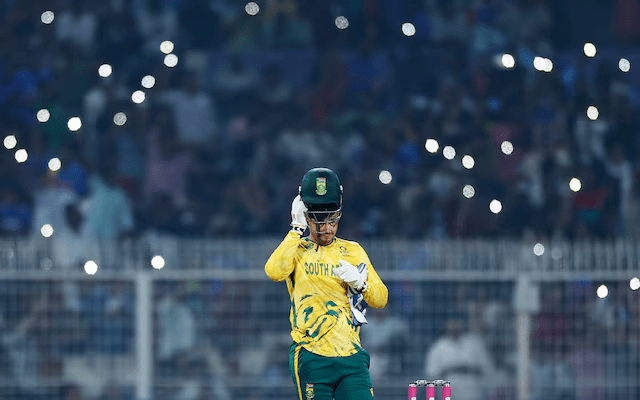
South African cricketers Quinton de Kock and David Miller have publicly criticised the International Cricket Council (ICC), claiming England’s team was given priority in travel arrangements after the conclusion of the ICC Men’s T20 World Cup.
The complaint comes amid major disruptions to international travel caused by escalating tensions in the Middle East, which forced the cancellation of thousands of flights across key Gulf transit hubs used by teams returning home from the tournament.
Players Left Waiting After Tournament Exit
South Africa’s campaign ended in the semi-finals after defeat to New Zealand national cricket team, leaving several players stranded in Kolkata while they waited for confirmation of travel arrangements. Meanwhile, the West Indies national cricket team eliminated earlier in the tournament were also stuck in India due to the same travel complications.
In contrast, the England national cricket team, which had been knocked out of the competition by India national cricket team in the semi-finals, managed to depart from Mumbai on a chartered flight arranged soon after their exit.
The situation quickly sparked frustration among some players who felt the scheduling suggested unequal treatment.
De Kock and Miller Voice Frustration
De Kock took to social media to express his confusion about the situation, questioning why his team had received no clear information while another side had already left.
“Funny @icc, we have heard nothing… meanwhile England are leaving before us somehow,” he wrote, suggesting that some teams appeared to have more influence than others.
Miller echoed the sentiment, pointing out that England had been eliminated later than both South Africa and West Indies but still managed to fly home first.
The comments quickly spread across cricket circles and reignited debate over governance and fairness in tournament logistics.
Others Join the Debate
The criticism did not come only from the South African camp.
Daren Sammy, head coach of the West Indies team, backed Miller’s remarks publicly on social media, suggesting the issue deserved more attention. Former England captain Michael Vaughan also weighed in, arguing that all teams should receive equal treatment regardless of influence within cricket’s governing structures.
Their reactions highlighted how travel and scheduling challenges often overlooked aspects of global tournaments can quickly become controversial when communication breaks down.
Why Travel Was Disrupted
The chaos stems largely from the closure of several Middle Eastern airspaces following a geopolitical crisis involving Iran, the United States, and Israel. These routes serve as major connecting corridors for flights between South Asia, Europe, and Africa.
With multiple airlines cancelling or rerouting flights, the disruption affected not only cricket teams but also thousands of passengers across international airports.
Because many cricket squads rely on chartered flights or specific travel corridors to move large groups quickly after tournaments, even small disruptions can leave teams stranded for days.
ICC Yet to Respond
As the controversy grew, the ICC had not immediately issued a public response addressing the allegations of preferential treatment.
Reports suggest the governing body was working to arrange a charter flight for the South African and West Indies teams from Kolkata once logistics could be confirmed.
Still, the episode has sparked broader questions about how international sports organizations handle travel crises and whether all participating teams receive equal consideration during emergencies.
Shadow Over Tournament Finale
The travel row unfolded on the same day that India national cricket team defeated New Zealand national cricket team to retain the T20 World Cup title, becoming the first nation to win the tournament three times.
While the dramatic final provided a fitting sporting climax to the competition, the logistical dispute has somewhat overshadowed the celebrations and shifted attention toward administrative decisions behind the scenes.
A Reminder of Global Sports’ Complex Logistics
Major tournaments like the T20 World Cup involve hundreds of players, staff members, and officials traveling across continents within tight schedules. When geopolitical events disrupt airspace or commercial travel, organizing bodies must quickly coordinate alternative arrangements.
In this case, the perception that one team left earlier than others has triggered accusations of favoritism if the circumstances may ultimately prove more complicated.
For De Kock, Miller, and their teammates, the priority remains simple: getting home after a long and demanding tournament. Yet the episode may prompt deeper reflection within the ICC about transparency and communication when unexpected disruptions arise.