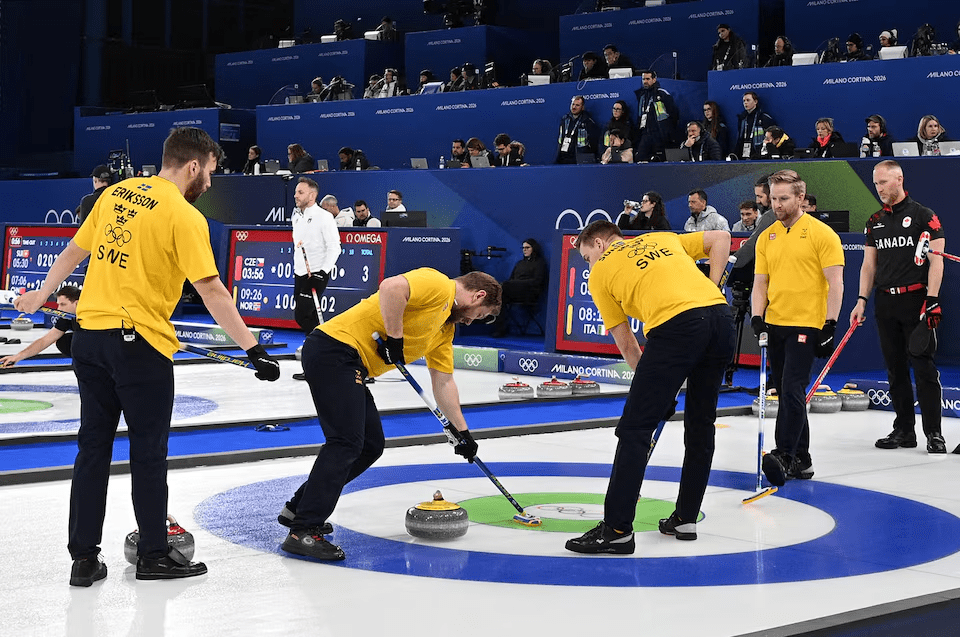
At the Milan-Cortina 2026 Winter Olympics, the usually calm and respectful sport of curling was thrust into the headlines after a controversial men’s round-robin match between Canada and Sweden saw highly unusual cheating allegations, heated on-ice verbal exchanges and an intervention by the sport’s governing body, World Curling. The dispute has triggered heightened officiating measures and sparked discussion about rule enforcement, sportsmanship and how elite curling is governed at the Olympic level.
The incident occurred during an 8-6 victory by Canada’s team, skipped by Brad Jacobs, over Sweden, led by Niklas Edin, in a crucial round-robin contest on Friday. Partway through the match, the Swedish team raised a formal complaint with officials, asserting that a Canadian player third Marc Kennedy had illegally “double-touched” a curling stone after release, meaning he allegedly made contact with it past the hog line. According to Swedish players, what they believed they saw on broadcast video and during play was contact with the stone’s granite body, something they argue should be deemed a rule violation.
In curling, players must deliver stones using the handle and release them cleanly before they cross the hog line the thick line on the ice that designates the point at which the stone enters full play. At this year’s Olympics, stones are outfitted with electronic handles that incorporate sensors; if a stone is touched past the hog line, the handle normally lights up red to indicate a violation. However, the sensors do not cover the granite portion of the stone itself, and the team from Sweden contended that what they saw involved that part of the stone, meaning the sensor would not have triggered.
The On-Ice Exchange and Accusations
The game took on an unusual edge as tensions escalated. According to reports from broadcast and social platforms, Swedish third Oskar Eriksson confronted Kennedy about what they saw during play, insisting that the Canadian player had touched the stone in a way that contravened the rules. In response, Kennedy vehemently denied the allegation, leading to an unusually heated verbal exchange on the ice for a curling event a sport widely respected for etiquette and sportsmanlike conduct. At one point, Kennedy was quoted saying: “I haven’t done it once. You can f off,” in frustration at being accused of cheating in front of his peers and a global audience.
The confrontation was not only between the two players but also involved Swedish protestations to officials and moments where both teams asked umpires to watch deliveries Canada even asked officials to watch Sweden’s throws for similar infractions. Despite these concerns, umpires stood at the hog line for several ends after being alerted and reported no violations during that period of observation. World Curling later confirmed that no official breach had been recorded during the monitored sequence.
World Curling’s Response
In response to the controversy, World Curling issued a statement announcing heightened officiating measures for the remainder of the curling competition. Instead of relying solely on fixed officials at specific points which is typical in curling the federation said that two roaming officials would be positioned to observe deliveries across all four sheets of ice in subsequent sessions. This was intended to ensure closer supervision of stone release and to address concerns raised by competing teams. The governing body stressed that decisions made during play remain final, as curling does not use video replay to adjudicate rulings, making on-ice officiating and player honesty central to enforcement.
World Curling also addressed the language used by Kennedy during the heated exchange, issuing a verbal warning to the Canadian team under conduct rules. Officials made clear that further inappropriate behaviour, such as offensive or foul language, could result in escalated sanctions, including a possible suspension under Rule R.19 of the sport’s code of conduct.
Technical Rules and Enforcement Challenges
The incident highlighted some of the technical and officiating challenges in elite curling. While electronic sensors on handles are intended to catch late touches past the hog line, they do not cover the stone’s body. Sweden’s complaint centered on the notion that a player could legally avoid triggering the handle sensor while still touching the granite portion of the stone which, according to the World Curling rulebook, should also be considered a violation if it occurs during the stone’s forward motion. That rule states that a stone must be delivered using the handle and that contact with any other part of the stone during forward motion is not allowed.
Because curling traditionally emphasizes self-policing with players often calling their own infractions officials typically do not stand at every hog line for every delivery unless a team requests it. This reliance on trust and sportsmanship, while a long-held cultural norm within the sport, has shown limitations under the pressure of Olympic competition, where every shot and every rule call can influence medal aspirations. Sweden
Reactions from Teams and Athletes
Reactions from both sides were mixed, with Sweden maintaining that their complaint was rooted in a desire for fair play and proper rule enforcement. Eriksson said his team simply wanted to “play by the same rules” and to ensure that all competitors were held to the same standard. He reiterated that they raised the concern not to unsettle their opponents but to uphold the sport’s integrity.
On the other hand, Kennedy and Canadian officials defended their player’s integrity, suggesting the accusation was misplaced and may have been influenced by the intensity of the rivalry and competitive circumstances. Kennedy, a veteran with a long and respected career on the international circuit, expressed frustration at being accused of cheating, especially in a public forum like the Olympics. He later indicated some regret about the language he used but stood by his denial of any intentional wrongdoing and emphasised that he had never competed with the intention of bending the rules. Sweden
Some observers have suggested that the incident may partly reflect heightened nerves and competitive history between the teams — Canada and Sweden are frequent rivals on the World Curling Tour and in international events. Opponents will often look for any edge in observation or rule enforcement, especially when games are tightly contested.Sweden
Broader Impact and Continued Coverage
Beyond the Olympics, the controversy has sparked broader conversation within the curling community about whether officiating and technology need updating. Some argue that more comprehensive sensor coverage or alternate review systems could reduce ambiguity in future matches, while others assert that traditional self-policing and umpire observations are adequate when properly implemented. The debate underscores the evolving nature of officiating in sports where trust and ethics are as important as technical adherence.
The curling tournament continued with both Canada and Sweden competing under the heightened officiating regime, with officials closely observing deliveries and teams reminded of the importance of maintaining decorum on and off the ice. Despite initial tensions, the overarching goal remains fairness, respect and adherence to both the written rules and the spirit of the sport. Sweden
What Happened Next
As the competition moved forward, World Curling’s enhanced officiating presence was seen as an effort to pre-empt further disputes and clarify acceptable delivery practice to all teams. These measures were intended not only to ensure rule compliance but also to protect the sport’s reputation at a time when curling is under the global spotlight during its showcase at the Olympic Games. Sweden
While no formal sanctions related to the alleged cheating incident were imposed on Canada beyond the verbal warning for conduct, the situation has undoubtedly become one of the more talked-about moments in the Olympic curling program. It is a rare example of on-ice tension spilling into diplomatic officiating decisions and has added an unexpected layer of drama to a sport typically associated with tradition, courtesy and mutual respect. Sweden
In the immediate aftermath, teams and officials alike took stock of the lessons from the incident, with many calling for reflection on how best to balance traditional self-regulation and modern competitive pressures in a sport where precision and rule observance are paramount. Whether this moment leads to longer-term changes in officiating procedures or technologies remains to be seen, but for now it stands out as a defining controversy of the 2026 Winter Olympics curling competition.