Football- The introduction of the Video Assistant Referee (VAR) represents one of the most transformative developments in the history of football. Designed to assist referees in making accurate decisions, VAR has evolved from a controversial experiment into a central feature of elite competitions. Since its widespread adoption after the 2018 FIFA World Cup, VAR has influenced not only officiating but also tactics, player behavior, match dynamics, and the overall experience of the game.
While its primary purpose is to correct clear and obvious errors, VAR’s broader impact has fundamentally reshaped modern football. From statistical changes in penalties and fouls to shifts in defensive strategies and fan engagement, the system has altered the sport in both measurable and intangible ways.
Increased Accuracy and Decision-Making Reliability
The most significant and widely acknowledged impact of VAR is the improvement in refereeing accuracy. Before its introduction, referees relied solely on real-time judgment, often leading to controversial errors that could influence match outcomes.
Data from recent seasons shows that decision accuracy has improved dramatically:
- Accuracy increased from approximately 82% before VAR to around 96–97% after implementation
- Incorrect key decisions dropped from around 7% to below 1.5%
This improvement means fewer incorrect goals, penalties, and red cards—making football outcomes more just and credible. VAR has also ensured that incidents previously missed, such as off-the-ball fouls or handballs, are now detected and addressed.
However, while accuracy has improved, the expectation of “perfect officiating” has also increased, leading to new forms of criticism when errors still occur.
Transformation of Goals, Penalties, and Match Statistics
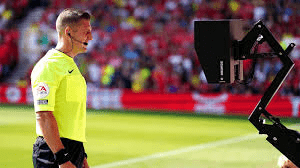
VAR has had a measurable effect on match statistics, particularly in key decision areas.
Increase in Penalties
Since VAR’s introduction, penalties have risen significantly across major leagues:
- Penalties increased by 12% to 25% in top competitions
This is largely because VAR detects fouls and handballs that referees may have missed in real time.
Changes in Goal Outcomes
VAR has also altered how goals are awarded:
- Goals are frequently disallowed due to offside or fouls in buildup
- At the same time, some legitimate goals are reinstated after review
In one season alone, dozens of goals were both disallowed and reinstated through VAR intervention .
Reduction in Fouls and Cards
Interestingly, statistical studies show:
- Fouls and yellow cards have decreased
- Red cards have slightly declined or stabilized
This suggests that players are adapting their behavior, becoming more cautious to avoid punishable actions.
Tactical Evolution in Modern Football
VAR has significantly influenced how teams approach the game tactically. Coaches now factor in the presence of video review when designing strategies.
Defensive Discipline
Defenders are more cautious in the penalty area. With VAR capable of detecting even minor fouls:
- Rash tackles have reduced
- Handball awareness has increased
- Defenders avoid unnecessary physical contact
This has made defending more calculated and less aggressive.
High Defensive Lines
Accurate offside technology allows teams to play higher defensive lines with confidence. Since offside decisions are now more precise:
- Defenders push forward to compress space
- Teams use coordinated pressing systems
This has contributed to faster, more compact gameplay.
Attacking Adjustments
Attackers must now:
- Time their runs more precisely
- Be aware of marginal offside calls
VAR has effectively reduced the margin for error, forcing attackers to be more disciplined in positioning.
Impact on Player Behavior and Psychology
The presence of VAR has had a profound psychological effect on players.
Increased Discipline
Knowing that every action can be reviewed:
- Players are less likely to dive or simulate fouls
- Violent conduct is more frequently punished
- Off-the-ball incidents are reduced
Statistical evidence supports this shift, with fouls and disciplinary actions declining over time .
Mental Pressure
VAR also introduces a new psychological dynamic:
- Players must wait for decisions to be confirmed
- Uncertainty during reviews can increase anxiety
This creates a different emotional environment compared to pre-VAR football, where decisions were immediate and final.
Influence on Game Flow and Tempo
One of the most debated aspects of VAR is its effect on the flow of matches.
Increased Match Duration
VAR reviews have slightly extended game time:
- Matches now include around 60–80 seconds of additional stoppage time on average
Although this increase may seem small, it can disrupt momentum during key moments.
Perceived vs Actual Disruption
Interestingly, while fans often feel that VAR causes major delays, data suggests:
- Most reviews are completed within 30–40 seconds
The perception of disruption is often greater than the actual time lost, largely because reviews occur during critical moments.
Changing the Emotional Experience of Football
VAR has fundamentally altered how fans and players experience football emotionally.
Delayed Celebrations
One of the most noticeable changes is the delay in goal celebrations. Players and fans often hesitate, waiting for VAR confirmation before celebrating fully.
Increased Tension
Every major moment now carries an added layer of suspense:
- Goals may be overturned
- Penalties may be canceled
- Red cards may be upgraded or rescinded
This has transformed football into a more dramatic but less spontaneous experience.
Debate About “Losing the Soul”
Critics argue that VAR has reduced the raw emotion that defines football, while supporters believe the trade-off is worth it for increased fairness.
Tactical and Strategic Planning by Coaches
Coaches now integrate VAR considerations into their match preparation.
- Defensive drills emphasize avoiding VAR-triggering fouls
- Set-piece organization accounts for potential video review
- Tactical fouling has become riskier
VAR has effectively become part of the strategic framework of modern football, influencing decisions both before and during matches.
Technology and the Future of Officiating
VAR is part of a broader technological shift in football.
Integration with Other Technologies
- Semi-automated offside systems
- AI-assisted tracking
- Goal-line technology
These tools work together to enhance decision-making accuracy.
Continuous Evolution
Recent discussions among governing bodies highlight ongoing efforts to refine VAR usage, including reducing overly “microscopic” decisions and improving consistency .
The future of VAR will likely involve faster decisions, clearer communication, and better integration with fan experience.
Controversies and Limitations
Despite its benefits, VAR remains controversial.
Subjectivity Still Exists
Even with video evidence, decisions such as handballs or fouls still depend on interpretation.
Inconsistency Across Competitions
Different leagues apply VAR differently, leading to confusion and criticism.
Over-Precision
Millimeter offside decisions have sparked debate about whether VAR aligns with the “spirit of the game.”
Fan Experience Issues
Many fans feel that VAR:
- Interrupts the rhythm of matches
- Reduces spontaneity
- Creates frustration during long reviews
These criticisms highlight the ongoing challenge of balancing accuracy with entertainment.
Overall Impact on Modern Football
VAR has transformed football in several fundamental ways:
- Improved accuracy and fairness
- Changed tactical approaches and defensive strategies
- Influenced player behavior and discipline
- Altered match flow and tempo
- Reshaped the emotional experience of the game
It has also introduced new debates about the role of technology in sport, highlighting the tension between tradition and innovation.
The introduction of VAR marks a defining moment in the evolution of football. It has brought the sport into a new era where decisions are increasingly data-driven, precise, and accountable.
While it has significantly improved fairness and reduced major errors, VAR has also changed the rhythm, emotion, and perception of the game. Football today is more accurate and controlled but also more complex and, at times, controversial.
Ultimately, VAR is not just a tool for referees; it is a system that has reshaped the entire structure of modern football. As technology continues to evolve, its role will likely expand, ensuring that VAR remains central to the future of the sport.

1 comment
[…] pitch for injured players, new countdowns for delayed restarts, stricter substitution procedures, VAR reviews for clearly incorrect second-yellow-card decisions and a trial designed to prevent […]