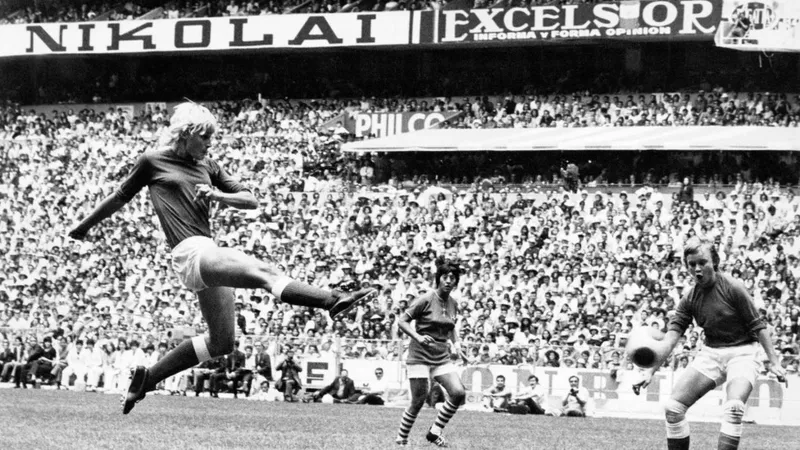
On 5 September 1971, more than 100,000 spectators packed into Mexico City’s Estadio Azteca to watch a women’s football final. The atmosphere was electric. Supporters filled the stands, cameras captured the occasion and two national teams competed for an international trophy.
Denmark defeated Mexico 3-0, with 15-year-old Susanne Augustesen scoring all three goals. It was a remarkable conclusion to a tournament that had attracted extraordinary attention throughout its three-week duration.
But there was something unusual about the competition.
Despite the enormous crowds, international participation and sporting spectacle, the tournament was not recognized by FIFA. There was no official FIFA Women’s World Cup trophy, no endorsement from football’s governing body and no place for the competition in the official history of the FIFA Women’s World Cup.
Some of the players who participated returned home to suspensions. Others gradually lost contact with their teammates. For decades, their achievements received little attention, and many people who had participated in the tournament found it difficult to convince others that it had happened.
This was the 1971 Women’s World Cup, also known as Copa 71. It was a competition that demonstrated the enormous appetite for women’s football long before the sport received the institutional support it enjoys today.
The 1971 Women’s World Cup: A Tournament Born Against the Odds

To understand the significance of the 1971 Women’s World Cup, it is necessary to understand the circumstances surrounding women’s football at the time.
For much of the twentieth century, women’s football faced institutional opposition across several countries. England provides one of the clearest examples.
In December 1921, the Football Association banned affiliated clubs from allowing women’s matches to be played on their grounds. The governing body argued that football was unsuitable for women and discouraged its promotion.
The decision effectively pushed women’s football away from established football grounds and deprived the game of important institutional support. Yet women continued playing.
Clubs such as the Dick, Kerr Ladies had demonstrated the popularity of women’s football decades earlier, attracting enormous crowds during and after the First World War. Their matches showed that there was a genuine audience for the women’s game, despite the resistance of football authorities.
The ban was eventually lifted in England in 1971, but the consequences of decades of exclusion remained.
Internationally, the situation was similarly complicated. FIFA had not established a recognised women’s World Cup, and national football associations offered little consistent support for international women’s competitions.
However, independent organisers were determined to create opportunities for female footballers.
An international women’s tournament had already been organized in Italy in 1970. Its success helped demonstrate the commercial possibilities of a larger competition and encouraged organizers to stage another tournament the following year. The result was the 1971 Women’s World Cup in Mexico.
Six Nations, One Tournament and Thousands of Supporters
The competition was organized by the Federation of Independent European Female Football, known by its Italian abbreviation, FIEFF. The organization was subsequently renamed the Federation of Independent Female Football (FIFF) in 1971.
It operated independently of FIFA and arranged the tournament without the recognition of football’s international governing body. Six national teams eventually participated: Mexico, Denmark, England, France, Italy, and Argentina. The competition took place between 15 August and 5 September 1971, with matches hosted in Mexico City and Guadalajara.
The tournament featured two groups of three teams, followed by knockout matches and classification fixtures. Although it was not an official FIFA competition, the organizers understood the importance of creating a major international sporting spectacle.
Mexico had hosted the men’s World Cup in 1970, and the country’s football infrastructure, enthusiastic supporters and established stadiums provided an excellent setting for the women’s tournament.
The organizers also invested heavily in publicity. The participating teams received considerable attention when they arrived in Mexico, with photographers, journalists and supporters following their movements. For the English players, many of whom were teenagers and had never experienced anything like it, the reception was extraordinary.
They were treated like sporting celebrities, with supporters gathering around their hotels and team buses. It was an experience that contrasted sharply with the conditions they had left behind in England.
The Lost Lionesses: England’s Unofficial World Cup Team

Among the most remarkable stories of the 1971 Women’s World Cup was the participation of England. The team was assembled by Harry Batt, a passionate advocate of women’s football who managed Chiltern Valley Ladies.
Batt was determined to take an English team to Mexico despite opposition from the football authorities. The players travelled under the name British Independents because the team did not have official recognition from the Football Association or the Women’s Football Association.
The squad included Carol Wilson, who captained the side, alongside players such as Paula Rayner, Jan Barton, Chris Lockwood, Lillian Harris and Gill Sayell. Many of the players were remarkably young. Paula Rayner, for instance, was just 15 when she travelled to Mexico.
In England, women’s football had only recently emerged from decades of institutional exclusion. Most players competed on local pitches, with limited facilities and little media attention. In Mexico, however, they experienced something entirely different.
The team received a celebrity-style welcome, attracted considerable media coverage and played before crowds that English women’s football had rarely experienced. But the excitement did not translate into success on the pitch.
England lost its opening group match against Argentina 4-1, with Paula Rayner scoring their goal. They subsequently suffered a 4-0 defeat against Mexico. They finished third in their group and were eliminated from the competition. In the fifth-place match, they lost 3-2 to France.
Despite the results, their participation was significant. They had represented England on an international stage that the country’s football authorities had not officially recognized. Their experience would become even more complicated when they returned home.
The Tournament That Filled the Azteca
One of the most extraordinary aspects of the 1971 Women’s World Cup was the number of people who attended its matches. At a time when women’s football was frequently dismissed by football administrators, the tournament attracted crowds that many modern women’s competitions would have struggled to imagine.
Mexico’s opening match against Argentina on 15 August attracted approximately 90,000 spectators at the Estadio Azteca.
When Mexico played England on 22 August, another crowd of approximately 90,000 watched the match. These were not isolated occasions. Supporters followed the tournament with considerable enthusiasm, and matches in Guadalajara also attracted thousands of spectators.
The competition was proving something that women’s football had been denied the opportunity to demonstrate for decades: there was an enormous audience for the women’s game.
The organizers had used publicity, television coverage and the popularity of Mexican football to create a major event. However, the crowds were not simply a product of advertising. The players delivered competitive football, dramatic moments and performances that kept supporters engaged.
The 1971 Women’s World Cup had become a genuine sporting spectacle. And its final would produce one of the most remarkable attendances in women’s sporting history.
Denmark’s Triumph and a 15-Year-Old’s Remarkable Hat-Trick
After the group stages, Denmark and Mexico emerged as the leading contenders for the championship. Denmark defeated Argentina 5-0 in the semi-final, while Mexico overcame Italy 2-1 in a controversial encounter.
The Italian team had two goals disallowed, including a disputed free kick from Elena Schiavo. The decisions provoked furious protests and a confrontation between players. Mexico eventually progressed to the final, setting up a meeting with Denmark.
The championship match took place on 5 September 1971 at the Estadio Azteca.
Approximately 110,000 spectators were in attendance, with some later reports putting the figure at 112,500. Either way, it was an extraordinary crowd for a women’s sporting event.
The hosts had enormous support behind them, but Denmark were determined to take the trophy home. Their star forward was Susanne Augustesen, a 15-year-old striker who had already demonstrated her goalscoring ability throughout the competition.
She delivered the performance of her young career. Augustesen scored in the 28th minute, added a second in the 42nd minute and completed her hat-trick in the 51st minute. Mexico could not recover. Denmark won 3-0, becoming champions of the tournament. Augustesen had announced herself as one of the competition’s outstanding players, and her three goals ensured that her name would remain part of its history.
For the Danish players, it was a remarkable achievement. They had travelled to Mexico without the backing and recognition associated with an official FIFA competition, yet they returned home as international champions.
Unfortunately, the celebrations would not last for everyone.
What Happened When the Players Returned Home?

For the English players, the reception in Mexico was dramatically different from what awaited them back home. The Women’s Football Association was establishing its own structure for the national game and had not authorized the team’s participation in the tournament.
Their decision to travel to Mexico was therefore treated as a breach of the organization’s rules. Following their return, the players received suspensions from the Women’s Football Association. Most were banned for three months, while captain Carol Wilson received a six-month suspension.
Harry Batt, who had organized and managed the team, was banned for life by the organization.
The consequences went beyond the immediate disciplinary measures. The players had experienced international recognition, competed before enormous crowds and represented their country in a tournament that had attracted worldwide attention.
Yet their achievements were not properly celebrated at home. The players gradually lost contact with one another, and the tournament became something many rarely discussed.
For years, their experience remained largely absent from mainstream accounts of English women’s football.
The story was not unique to England. The wider women’s game continued to face institutional resistance, and the victorious Danish side was eventually disbanded. The Mexican Football Federation also withdrew support from its women’s team.
The tournament had demonstrated what women’s football could achieve, but it had not immediately transformed the institutions responsible for supporting the sport.
Why the 1971 Women’s World Cup Disappeared From History
The absence of FIFA recognition was a significant reason why the competition received so little attention in subsequent accounts of international football. Because FIFA did not organize or sanction the tournament, it was excluded from the official lineage of the FIFA Women’s World Cup, which began in 1991.
Its absence from FIFA’s recognized competition history contributed to the impression that women’s international football had little significant history before 1991. That impression was misleading.
The 1971 Women’s World Cup was not the first international women’s football competition, either. The 1970 tournament in Italy had preceded it, while women’s football had a much longer history in several countries. There was also a broader problem with preserving the history of women’s sport.
Without consistent institutional support, systematic record-keeping and regular media coverage, the experiences of players and organizers were often poorly documented.
The women who participated in Mexico did not necessarily have the platforms or resources to preserve their achievements for future generations.
Their memories remained with them, but the wider football world gradually moved on. The result was a strange historical gap: thousands of people had watched the tournament, yet decades later, many football supporters had never heard of it.
Copa 71: The Documentary That Brought the Story Back to Life

For decades, the players’ experiences survived largely through personal memories, photographs and scattered newspaper reports. Then came Copa 71.
Released in 2023 on the international film festival circuit and subsequently in cinemas in 2024, the documentary, directed by Rachel Ramsay and James Erskine, revisited the tournament through the experiences of the women who participated.
The film included previously unseen colour footage from the competition, showing the matches, the crowds, the celebrations and the extraordinary attention the players received in Mexico.
Its production was supported by executive producers including Serena Williams, Venus Williams and Alex Morgan. The documentary helped restore a forgotten chapter of women’s football to public attention It also created an opportunity for former teammates to reconnect.
In 2019, the BBC had already helped locate and reunite the members of England’s 1971 squad after almost five decades apart. The 14-member squad was brought back together, allowing players to revisit an experience that many had believed would remain buried in the past.
For some, it was the first opportunity in nearly 50 years to see former teammates again. For others, it was an opportunity to finally have their achievements acknowledged. The documentary and subsequent media coverage helped a new generation discover the story.
It also encouraged a wider conversation about the pioneers who helped build women’s football long before the professional era.
A World Cup That Deserves Its Place in Football History
The 1971 Women’s World Cup did not have FIFA’s approval, but it had something that no governing body could manufacture: the enthusiasm of players and supporters who believed in the game. Six nations participated. Thousands of people attended the matches, and more than 100,000 spectators watched the final.
Denmark became champions, Susanne Augustesen produced a remarkable hat-trick, and the tournament demonstrated the enormous potential of women’s international football. Yet, for many years, the players received little recognition for what they had achieved.
Today, the women’s game has developed into a global sporting industry, with professional leagues, international competitions, commercial partnerships and enormous television audiences.
The FIFA Women’s World Cup has become one of the most important competitions in international sport. But its modern success did not emerge from nowhere.
It was built upon the efforts of generations of women who continued playing despite institutional resistance, limited opportunities and a lack of recognition. The women who travelled to Mexico in 1971 were part of that history.
Their tournament may never carry the official status of a FIFA World Cup, but its place in the development of women’s football should never be questioned. They played before enormous crowds when many football authorities still doubted the women’s game.
They competed for a trophy when FIFA offered no official championship. And when they returned home, some were punished for participating in an event that had brought them international recognition.
More than half a century later, their story is finally receiving the attention it deserves.
The 1971 Women’s World Cup was never just a forgotten football tournament. It was proof that women’s football had an audience, a history and a future long before the world was ready to acknowledge it.
