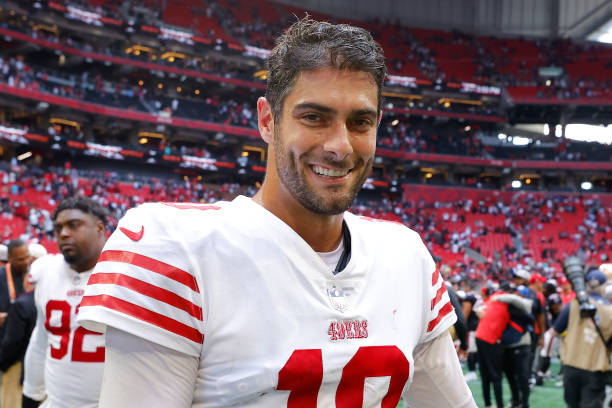
The conversation around Jimmy Garoppolo has taken a sharp turn. What initially looked like a quiet offseason for the Los Angeles Rams now carries an unexpected layer of uncertainty, as the veteran quarterback is reportedly considering stepping away from the NFL.
For a player who has spent much of his career in the spotlight without always being the headline act, this moment feels significant. Garoppolo’s potential retirement is not just about one player walking away. It speaks to the changing dynamics of quarterback careers, financial security, and long-term health in modern football.
Jimmy Garoppolo’s Career Reaches a Crossroads
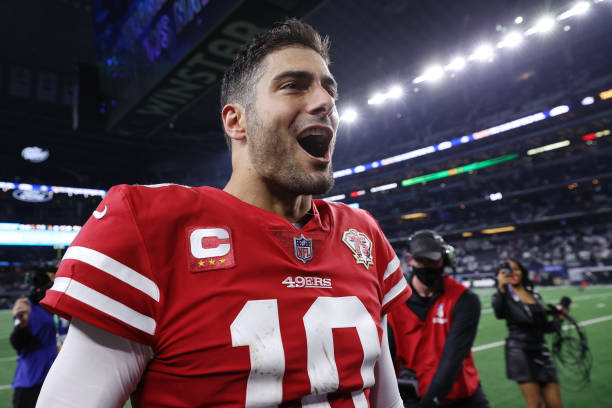
At 34, turning 35 later this year, Jimmy Garoppolo finds himself at a natural decision point. He is no longer the rising prospect who entered the league with the New England Patriots in the 2014 NFL Draft, nor the starting quarterback who once led the San Francisco 49ers to a Super Bowl appearance.
Instead, he is now a veteran with experience, wealth, and perspective. Reports suggest he is evaluating whether continuing as a backup quarterback, potentially behind Matthew Stafford in Los Angeles, aligns with his personal and professional goals.
This is not a decision driven by necessity. With career earnings exceeding $156 million, Garoppolo has already secured financial stability at a level few athletes ever reach. That reality changes everything about how retirement is viewed. It becomes less about timing and more about intention.
A Career Defined by Opportunity and Timing
Garoppolo’s journey through the NFL has always been shaped by timing. Drafted as a second-round pick, he began his career behind Tom Brady in New England. That apprenticeship brought success in the form of two Super Bowl rings, even if his on-field contributions during those title runs were limited.
His move to San Francisco marked a turning point. There, he transitioned from understudy to starter, leading the 49ers with efficiency and composure. His win-loss record as a starter, 43 wins to 21 losses, reflects a quarterback who understood how to operate within a system and deliver results.
However, injuries and inconsistency often interrupted his momentum. Each time he seemed poised to establish himself as a long-term franchise cornerstone, setbacks would shift the narrative. That pattern followed him through later stints, including time with the Las Vegas Raiders and eventually the Rams.
The Rams’ Perspective: Planning for the Future
From the Rams’ standpoint, Garoppolo’s potential retirement introduces a new layer of urgency. The franchise has already been navigating the later stages of Matthew Stafford’s career. Any uncertainty around the backup position only amplifies the need for long-term planning.
If Garoppolo steps away, the Rams may accelerate their search for a developmental quarterback. This could come through the NFL Draft or via a younger free agent option. Either way, the depth chart would require immediate attention.
There is also a broader strategic question. Do the Rams continue to build around Stafford in the short term, or do they begin transitioning toward a new era at quarterback? Garoppolo’s situation, while secondary on paper, could influence that timeline more than expected.
The Reality of Being a Veteran Backup
For many players, the idea of remaining in the league as a backup quarterback is appealing. It offers continued involvement in the game with reduced physical demands. But for someone like Garoppolo, the equation is different.
He has been a starter. He has led teams deep into the postseason. Accepting a long-term backup role requires a shift in mindset that not every player is willing to make.
There is also the physical toll to consider. Even as a backup, the demands of NFL preparation, practice intensity, and the ever-present risk of injury remain significant. When combined with financial security and a complete résumé, the incentive to continue diminishes.
Legacy Beyond the Headlines
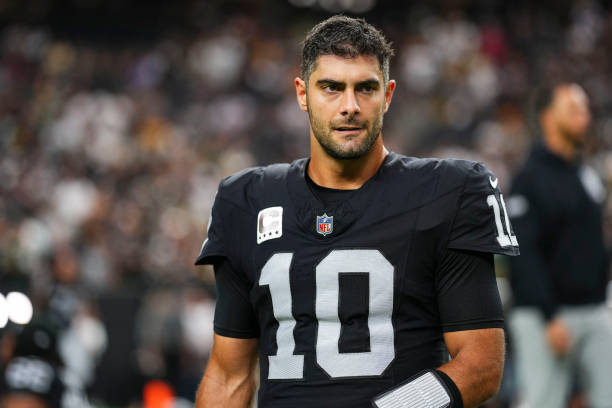
Garoppolo’s career may not be defined by MVP awards or record-breaking statistics, but it carries its own form of respect. He represents a category of quarterbacks who thrive within structure, who win games without dominating headlines, and who contribute to team success in ways that are sometimes understated.
His completion rate of 67.4 percent and nearly 16,000 passing yards reflect efficiency and consistency. More importantly, his teams often found ways to win with him under center.
If he chooses retirement, his legacy will not be one of unfulfilled potential, but rather one of steady contribution in a league that demands constant excellence.
What Comes Next for Jimmy Garoppolo
If Garoppolo does decide to retire, the next phase of his career becomes an intriguing question. Many former quarterbacks transition into broadcasting, coaching, or front-office roles. His experience across multiple franchises and systems would make him a valuable voice in any of those areas.
There is also the possibility that he simply steps away from football entirely. Not every player seeks a second act within the sport. For some, retirement is about reclaiming time, exploring new interests, and building a life beyond the game.
A Decision That Reflects a Changing NFL
Garoppolo’s situation highlights a broader trend in the NFL. Players are increasingly aware of their long-term well-being, both physically and financially. The traditional expectation of playing as long as possible is being replaced by more calculated decisions about when to step away.
For quarterbacks, in particular, the landscape is evolving. Younger, more mobile players are entering the league, while veterans must constantly reassess their role and value.
Garoppolo stands at the intersection of those changes. His decision, whatever it may be, will be shaped not just by his past, but by the realities of the modern NFL.
Conclusion
The possibility of Jimmy Garoppolo retiring may not dominate headlines in the same way as a superstar exit, but it carries meaningful implications. For the Los Angeles Rams, it could influence roster strategy. For the league, it reflects shifting priorities among veteran players.
Most importantly, it represents a personal decision from a player who has experienced nearly every role the NFL can offer. Starter, backup, champion, and competitor.
Now, he faces perhaps the most important decision of all: when to walk away.
