The 2026 FIFA World Cup has already become one of the most politically charged editions of the tournament in modern football history, and one of the most closely watched storylines involves Iran’s confirmed participation and where its matches will be played. Despite months of speculation, diplomatic tension, and calls for relocation, FIFA President Gianni Infantino has firmly stated that Iran will not only participate in the tournament but will also play its group-stage matches in the United States.
This confirmation has added both clarity and controversy to a situation that blends global sport with international politics, security concerns, and the evolving role of FIFA as a governing body navigating geopolitical pressure.
FIFA’s Firm Position on Iran’s Participation
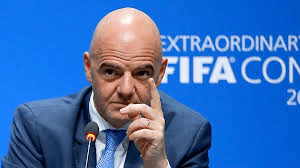
At the center of the announcement is FIFA President Gianni Infantino, who reiterated during the FIFA Congress in Vancouver that Iran’s place in the tournament is secure. According to his statement, Iran will compete in the 2026 World Cup and will play matches in the United States as originally scheduled.
Infantino emphasized a consistent message: football must remain inclusive and act as a unifying force.
He stated that Iran “will be participating” and specifically confirmed that the team will “of course play in the United States of America.”
This position effectively shuts down earlier speculation that Iran might be removed, replaced, or relocated due to ongoing geopolitical tensions involving the United States and Iran.
The Political Backdrop Behind the Decision
Iran’s participation in the 2026 World Cup has not been a straightforward sporting matter. It is deeply tied to broader geopolitical tensions, particularly between Iran, the United States, and other Western nations involved in Middle Eastern conflicts.
Earlier in the year, concerns escalated after diplomatic strain intensified following military incidents and sanctions-related disputes. These tensions led to speculation about whether Iran would be allowed to enter the United States at all for the tournament or whether their matches might need to be relocated to neutral venues such as Mexico or Canada.
At one point, Iranian officials even requested that their group-stage matches be moved out of the United States due to security concerns and political sensitivities. However, FIFA rejected this proposal and maintained its original hosting plan.
Infantino’s stance has remained consistent throughout the controversy: the tournament will proceed as planned, and Iran will participate under the same conditions as every other qualified nation.
Iran’s Place in the 2026 World Cup Structure
Iran qualified for the 2026 tournament through the Asian Football Confederation (AFC), securing their place on sporting merit. This will mark their seventh appearance at a FIFA World Cup finals, continuing a history that includes appearances in 1978, 1998, 2006, 2014, 2018, and 2022.
In the expanded 48-team format of the 2026 World Cup, Iran has been placed in Group G alongside Belgium, Egypt, and New Zealand.
Also Read- How Football Clubs Scout Players Across Africa
All of Iran’s group-stage matches are scheduled to take place in North America, with fixtures spread across major U.S. cities including Los Angeles and Seattle. Reports also indicate that Iran’s base camp will be located in Tucson, Arizona, giving the team a U.S.-based operational footprint throughout the tournament.
This setup reinforces FIFA’s commitment to centralized logistics while also ensuring teams remain within their assigned host regions for efficiency and security coordination.
Why the United States Is a Key Talking Point
The most controversial element of the announcement is not Iran’s participation itself, but the fact that Iran will play matches in the United States.
Given the long-standing political tensions between the two countries, this has naturally raised questions about:
- Player safety
- Visa and entry approvals
- Security coordination
- Public and political reaction during matches
Despite these concerns, FIFA has maintained that there is no alternative arrangement. Infantino has repeatedly rejected suggestions of relocating Iran’s matches to Mexico or Canada, stressing that the tournament structure must remain intact.
He also pushed back against external proposals suggesting Iran could be replaced by another nation, including speculative suggestions involving Italy. FIFA made clear that Iran qualified fairly and will not be removed.
FIFA’s Philosophy: “Football Unites the World”
A recurring theme in Infantino’s messaging is the idea that football should transcend political disputes. During his remarks, he reinforced FIFA’s belief that the World Cup is a global platform meant to bring countries together, not divide them.
This philosophy is central to why Iran remains part of the tournament despite external pressure. Infantino has consistently argued that excluding teams based on geopolitical conflicts would undermine the core values of international football.
In his words, FIFA’s responsibility is to ensure participation and unity, not exclusion. This framing positions the governing body as a neutral organizer in a highly polarized global environment.
Reactions and Diplomatic Sensitivities
Unsurprisingly, the announcement has triggered mixed reactions across different regions.
Some political observers in the United States and allied countries have raised concerns about:
- Security logistics for Iranian delegation members
- Potential protests during matches
- Visa restrictions tied to individuals linked to sanctioned organizations
- Broader geopolitical symbolism of hosting Iran on U.S. soil
At the same time, other voices have supported FIFA’s decision, viewing it as an opportunity for sports diplomacy and controlled engagement rather than exclusion.
Iranian officials have also expressed frustration in the past about treatment at border entry points and administrative hurdles, further highlighting the complexity of organizing such participation.
Despite these tensions, FIFA and host nation authorities have reiterated that the event will proceed with strict but standard security protocols applied to all participating nations.
Historical Context: Iran vs. United States in Football
This is not the first time Iran and the United States have shared a politically symbolic football moment.
One of the most famous encounters occurred during the 1998 FIFA World Cup, when Iran defeated the United States 2–1 in a match widely remembered for its symbolic handshake and diplomatic significance.
That match was celebrated as a rare moment of sports diplomacy, showing how football can temporarily ease political tension between rival states.
The 2026 edition now brings a new chapter to that history, potentially setting the stage for another politically symbolic encounter depending on the tournament draw and progression.
Security and Logistical Planning
With Iran confirmed to play in the United States, FIFA and local organizers are expected to implement enhanced security protocols. These measures typically include:
- Coordinated security between FIFA, host cities, and national agencies
- Restricted access zones around team hotels and training facilities
- Controlled travel routes for teams and officials
- Strict visa vetting processes for delegation members
Given the sensitivity of Iran’s participation, these protocols are likely to be more closely scrutinized than for many other teams.
What This Means for the 2026 World Cup
Iran’s confirmed participation and U.S.-based matches highlight a broader reality: the 2026 World Cup is not just a sporting event, but also a geopolitical stage.
With three host nations (United States, Canada, and Mexico) and an expanded 48-team format, the tournament is already the largest in FIFA history. Adding politically sensitive matchups only increases its global significance.
For FIFA, the challenge is balancing:
- Sporting fairness
- Security considerations
- Diplomatic tensions
- Global broadcasting expectations
- Fan experience
Iran’s situation represents one of the clearest tests of that balance.
Conclusion
The confirmation that Iran will play in the 2026 FIFA World Cup and specifically in the United States cements FIFA’s commitment to its original tournament structure despite political pressure and international tension.
Gianni Infantino’s message is consistent and clear: Iran earned its place through qualification, and football must remain a platform for inclusion rather than exclusion.
While the decision may continue to generate debate, it also underscores a defining feature of modern global sport the increasing intersection of football, politics, and diplomacy on the world’s biggest stage.
As the tournament approaches, Iran’s participation will remain one of the most closely watched storylines, not just for football reasons, but for what it represents in the broader global landscape.