Football has witnessed fierce rivalries, heated arguments, and controversial moments. But no match in the history of the World Cup has descended into chaos quite like the battle of Santiago.
The infamous clash between Chile and Italy at the 1962 FIFA World Cup was so violent that police officers repeatedly entered the pitch to restore order. Players traded punches. Kicks flew off the ball. Two players were sent off. Several others should have been. By the end, football had become secondary to survival.
More than six decades later, the battle of Santiago remains the benchmark for on-field disorder. It was not just a football match. It was a street fight broadcast to the world.
How Chile vs Italy 1962 Became Personal
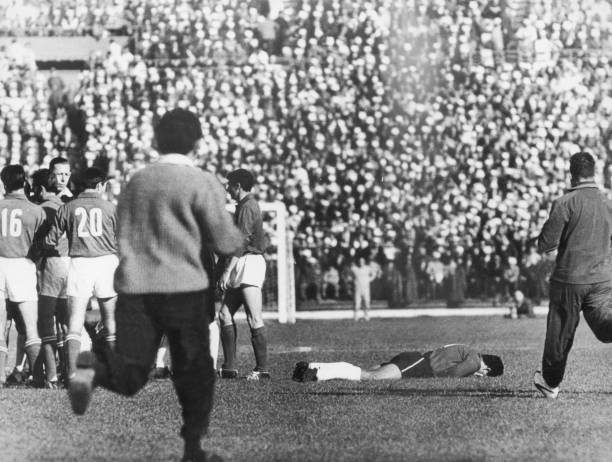
To understand the battle of Santiago, you first need to understand the tension surrounding the tournament.
Chile had won the right to host the 1962 World Cup despite suffering one of the most devastating earthquakes in recorded history just two years earlier. Entire cities were destroyed, thousands lost their lives, and the country faced enormous rebuilding challenges.
In the build-up to the tournament, two Italian journalists wrote articles describing Chile as impoverished, backward, and unfit to host a World Cup.
The reports outraged Chileans.
Local newspapers responded furiously. Public opinion turned against Italy. By the time the teams prepared to meet on 2 June 1962, emotions were already running dangerously high.
The match was no longer just football.
It had become a matter of national pride.
The Battle of Santiago Explodes Almost Immediately
From the opening whistle, it was clear that Chile vs Italy in 1962 FIFA World Cup would not be a normal game.
Players launched into reckless tackles within seconds.
Referee Ken Aston, the English official later credited with inspiring the yellow and red card system, quickly found himself overwhelmed.
Only a few minutes had passed when Italy’s Giorgio Ferrini committed a foul that led to his dismissal.
The problem was that Ferrini refused to leave.
For several minutes, the Italian midfielder argued, protested, and resisted attempts to remove him from the field.
Police officers eventually entered the pitch and physically escorted him away.
The match had barely begun.
Punches Replace Passes
If anyone thought Ferrini’s dismissal would calm things down, they were mistaken.
The violence only intensified.
Italian defender Mario David kicked Chile’s Leonel Sánchez in the face during one confrontation. Aston somehow missed the incident.
Moments later, Sánchez responded with a brutal left hook that struck David squarely in the face.
The punch was caught clearly on television cameras.
Amazingly, Sánchez was not sent off.
David eventually lost patience and retaliated with a dangerous kick, earning a red card and reducing Italy to nine men.
At this point, football had become almost impossible to recognise.
Every challenge threatened to spark another fight.
Every stoppage carried the possibility of fresh violence.
Chile vs Italy 1962 World Cup Descends Into Chaos
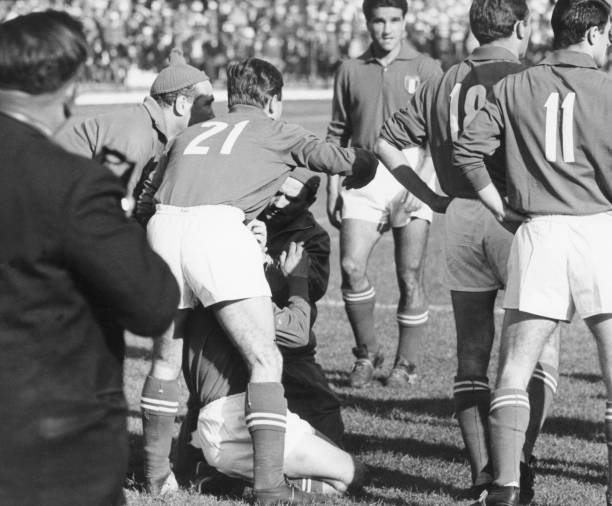
The battle of Santiago continued to deteriorate throughout the match.
Players pushed, punched, and kicked each other with little regard for the ball.
Several footballers suffered injuries.
Accounts from the game describe broken noses, bruises, cuts, and countless dangerous tackles.
Television commentators struggled to believe what they were witnessing.
The BBC’s legendary commentator David Coleman famously introduced highlights of the match with a warning. He described it as “the most stupid, appalling, disgusting and disgraceful exhibition of football.”
Few have disagreed with that assessment.
Even by the rough standards of football in the 1960s, the game was shocking.
Police Enter the Pitch Multiple Times
One reason the battle of Santiago remains so famous is the repeated involvement of law enforcement.
Police officers entered the field on several occasions. Their role was not crowd control.
They were there to manage the players.
Imagine a modern World Cup match where police have to escort footballers off the pitch and intervene during multiple confrontations.
It sounds impossible.
Yet that was exactly what happened in Santiago. The remarkable part is that the game never stopped. Despite the chaos, the referee continued the contest.
Today, such a match would almost certainly be abandoned.
Chile Finally Focus on Football
Lost amid the violence is the fact that a football match actually took place.
Chile eventually regained enough composure to take advantage of Italy’s reduced numbers.
The hosts scored twice during the second half to secure a 2-0 victory.
The goals were celebrated wildly by the home supporters, who viewed the win as much more than a sporting result.
For Chile, defeating Italy carried symbolic significance after the criticism their country had received before the tournament.
The result helped propel Chile toward a memorable third-place finish, still the best World Cup performance in the nation’s history.
Yet when people remember the battle of Santiago, they rarely remember the scoreline.
They remember the violence.
How the Battle of Santiago Changed Football
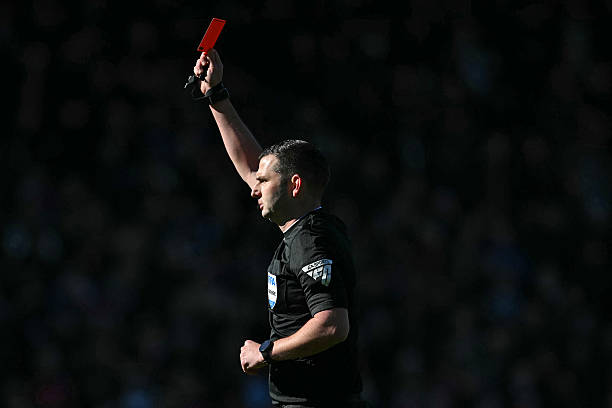
The lasting impact of the battle of Santiago extends far beyond the 1962 World Cup.
Referee Ken Aston left the match deeply frustrated by his inability to communicate disciplinary decisions clearly.
Years later, while driving in London and watching traffic lights change from yellow to red, he had an idea. Why not use colored cards in football?
The concept was simple. Yellow would mean caution. Red would mean dismissal.
The system was eventually adopted worldwide and remains one of football’s most important innovations.
In a strange way, one of the ugliest matches ever played helped create one of the sport’s most effective tools for maintaining order.
Could the Battle of Santiago Happen Today?
Modern football is far more controlled than it was in 1962. VAR reviews dangerous incidents. Referees have greater authority. Players face lengthy suspensions for violent conduct. Television cameras capture every angle.
If the events of Chile vs Italy in 1962 happened today, multiple players would likely be sent off within the opening minutes. Several could face bans lasting months. The match itself might not even reach halftime. Social media would explode. VAR officials would be working overtime.
The idea of police repeatedly entering the pitch during a World Cup match feels almost unimaginable.
Why the Battle of Santiago Still Matters
The battle of Santiago remains one of football’s most fascinating cautionary tales. It demonstrated what can happen when political tensions, national pride, media controversy, and sporting rivalry collide without proper control.
It was football at its most chaotic. It was football at its most embarrassing.
Yet it also became one of the most significant matches in World Cup history because of the lessons it taught the sport.
More than sixty years later, no game has surpassed it for sheer disorder.
The battle of Santiago remains football’s ultimate warning about what happens when emotions completely overpower the game itself.
And if anything remotely similar occurred today? VAR might genuinely combust.
