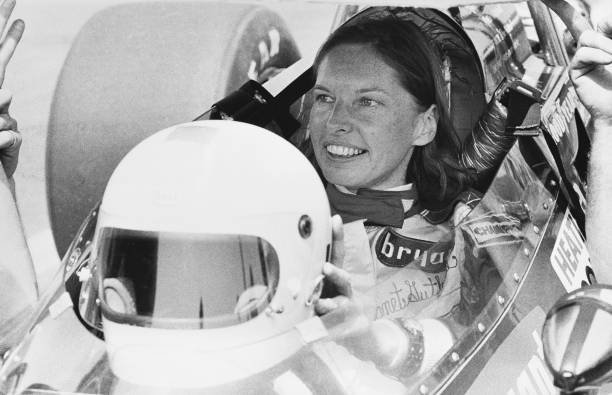
The first woman to qualify for the Indianapolis 500 was not handed a place in the history books. She had to fight for the opportunity, overcome widespread resistance and prove herself in one of the most demanding competitions in American motorsport. Her name was Janet Guthrie, and her achievement in 1977 challenged a tradition that had kept women away from the starting grid for generations.
For decades, the Indianapolis 500 had represented one of the most exclusive institutions in American racing. Its history was filled with legendary drivers, fierce rivalries and extraordinary performances, but it was also shaped by a culture in which women were rarely considered serious competitors. The assumption was that the speed, physical demands and risks of professional racing made it unsuitable for them.
Guthrie challenged that assumption through determination and ability. She did not simply become a historic figure by appearing at Indianapolis. She had spent years competing, developing her technical knowledge and establishing herself as a professional driver before earning the opportunity to take part in America’s most famous race.
Her story was about more than breaking a record. It was about forcing a sport to reconsider who deserved a place in its most prestigious competitions.
Janet Guthrie’s Journey From Engineering to Motorsport

Born on 7 March 1938 in Iowa City, Iowa, Janet Guthrie did not follow the conventional route into professional racing. Her early interests were rooted in science and aviation. She graduated from the University of Michigan in 1960 with a degree in physics and went on to work as an aerospace engineer.
She was also an accomplished pilot. Guthrie earned her pilot’s license at 17 and, in 1964, applied for the first Scientist-Astronaut program, making it through the initial round of selection. Her background in engineering and aviation gave her a technical foundation that would later prove valuable in motorsport.
Her interest in racing developed in the early 1960s. She began competing with the Sports Car Club of America in 1963, initially driving a Jaguar XK120 before moving to a Jaguar XK140. She became deeply involved in the mechanical side of racing, learning how to build and maintain engines, transport her own car to events and prepare for competition.
By 1972, Janet Guthrie had become a full-time professional racer. Her progress was rewarded in 1973 when she won the SCCA North Atlantic Road Racing Championship in a Toyota Celica. She also recorded class victories at the 12 Hours of Sebring, one of the most demanding endurance races in the United States.
These achievements established Guthrie as a serious competitor long before she arrived at Indianapolis. She had spent years learning the sport, competing against experienced drivers and demonstrating that she could handle the demands of professional racing.
First Woman to Qualify for the Indianapolis 500: The Barrier Falls
The Indianapolis 500 was more than another race. First held in 1911, it had grown into one of the most celebrated events in international motorsport. Its 500-mile distance, high speeds and demanding oval circuit made it a test of endurance, precision and courage.
However, its traditions also reflected the exclusions of its time. Women had long been prevented from entering important areas of the Indianapolis Motor Speedway, including the garage and pit areas. Although restrictions on women’s access to these spaces were lifted in the early 1970s, allowing women into the speedway was very different from accepting one as a competitor.
Guthrie wanted to race, but getting to Indianapolis required more than demonstrating her driving ability. She needed a team willing to give her an opportunity, a competitive car and the financial resources to challenge drivers who had spent years building their careers in the series.
Her first opportunity came in 1976, when car owner and mechanic Rolla Vollstedt invited her to test an Indy car. She became the first woman named to drive an Indianapolis 500 entry, although she did not make a qualifying attempt that year. The experience brought her closer to the competition she had spent years working towards.
The following season, she returned with another opportunity. This time, she was determined to secure a place in the field.
In May 1977, Guthrie qualified 26th for the Indianapolis 500, becoming the first woman to qualify for the Indianapolis 500 in the event’s history. It was a landmark achievement in American motorsport, but it was also a personal victory after years of competing for recognition in a sport that had rarely made room for women.
The qualification process demanded exceptional speed and composure. Drivers had to complete four consecutive laps, with their average speed determining whether they had done enough to secure a place. At Indianapolis, where even a small mistake could have serious consequences, the pressure was immense.
Guthrie completed the challenge and earned her place on the starting grid. She was no longer simply trying to convince the racing establishment that a woman could compete. She had qualified, and the sport had to recognize her achievement.
Her race ended early because of engine problems, leaving her 29th in the final classification. The result was disappointing, but it could not diminish the importance of what she had accomplished. The first woman to qualify for the Indianapolis 500 had finally taken her place among the competitors.
A Ninth-Place Finish That Silenced More Doubts

Guthrie returned to Indianapolis in 1978 and delivered an even stronger performance. She finished ninth, recording one of the most significant results by a female driver in the history of the event.
The achievement was particularly impressive because she had fractured her wrist in a charity tennis match just two days before the race. She competed with an elastic brace, managing the physical demands of the event despite the injury.
Her performance was important for another reason. It demonstrated that her historic qualification the previous year had not been a one-off achievement. Guthrie was not simply present to make a statement about women’s participation. She was capable of competing and producing results against established drivers.
She returned to the Indianapolis 500 again in 1979, completing three appearances at the event. Her ninth-place finish in 1978 remained her best result and stood as a benchmark for women at Indianapolis for many years.
The significance of her achievement extended beyond the final classification. Guthrie had shown that the first woman to qualify for the Indianapolis 500 could also compete at a level that demanded respect from the sport’s established names.
Beyond Indianapolis: Conquering the Daytona 500

Guthrie’s breakthrough was not limited to open-wheel racing. In February 1977, she also became the first woman to qualify for and compete in the Daytona 500, NASCAR’s most famous race.
She finished 12th, becoming the top rookie in the event. It was another important achievement in a career that was increasingly challenging the boundaries of American motorsport.
Her NASCAR career continued to develop. Guthrie competed in 33 races in the series then known as the Winston Cup, recording five top-ten finishes. In 1977, she became the first woman to lead a NASCAR Cup Series race, taking the lead for five laps at Ontario Motor Speedway. Her best finish was sixth at Bristol that year.
These performances demonstrated that Guthrie was not simply a symbolic participant invited to make history. She was a competitive driver capable of challenging established names in different forms of racing.
Her achievements were especially significant because professional racing required substantial financial backing, reliable machinery and access to experienced teams. Guthrie often competed without the resources available to better-funded drivers. In 1978, she even formed, owned and managed her own Indianapolis team, taking on responsibilities that extended well beyond driving.
Her experience revealed a wider problem within motorsport. Talent alone did not determine who received an opportunity. Access to sponsorship, equipment and influential team owners could make the difference between a promising driver and a successful professional career.
Resistance, Doubt and the Cost of Being a Pioneer
Guthrie’s breakthrough did not immediately transform the culture of racing. Some spectators welcomed her achievement, while others questioned her presence. She faced sexist remarks, public scrutiny and doubts that had little to do with her actual performances.
The resistance was not limited to comments from spectators. She had to convince team owners and sponsors that supporting a woman driver was worthwhile. Even when she demonstrated her ability on the track, securing the machinery and financial backing required to compete remained a challenge.
That distinction is important. Being permitted to compete did not mean being given the same opportunities as everyone else. Guthrie’s career revealed how an institution could formally open its doors while leaving many of the practical barriers to participation in place.
She also carried the burden of being treated as a representative of her gender. Male drivers were generally judged by their individual performances, but Guthrie’s successes and failures were often interpreted as evidence about women as a whole. A mechanical problem could become an argument against female participation, while a strong result had to overcome years of entrenched scepticizm.
Guthrie understood that the most effective response was to perform. She did not want to be treated as a novelty or given a place simply because her presence attracted attention. She wanted to race, compete and be judged as a driver.
Her ninth-place finish at Indianapolis in 1978 was particularly powerful in that regard. She had demonstrated that her place in the field was not an act of goodwill. It had been earned through ability and performance.
Janet Guthrie’s Legacy in Women’s Motorsport

Guthrie’s career helped create a path for women who followed her into professional racing. Her achievement demonstrated that the Indianapolis 500 was not beyond the reach of female drivers and made it harder for the sport to defend its old assumptions.
In 1980, she was inducted into the International Women’s Sports Hall of Fame. Her later honors included induction into the International Motorsports Hall of Fame and the Motorsports Hall of Fame of America. Her racing helmet and driver’s suit are also preserved at the Smithsonian Institution, reflecting the historical importance of her contribution.
Her influence can be seen in the careers of Lyn St. James, Sarah Fisher, Danica Patrick and other women who competed in major American racing series in the years that followed. Their journeys were different, and the barriers they faced were not identical, but they entered a sport in which Guthrie had already demonstrated that women could compete at the highest level.
The significance of her breakthrough was never that one woman had permanently solved the problem of gender inequality in motorsport. Women continued to face difficulties securing seats, sponsorship and long-term opportunities. Rather, Guthrie made it impossible to argue convincingly that the barriers were the result of an absence of ability.
Her story also extends beyond racing. Institutions often defend exclusion through tradition, presenting established practices as natural or necessary. Progress begins when someone challenges those assumptions and demonstrates that ability should matter more than gender.
More Than a Place on the Starting Grid
Janet Guthrie’s place in motorsport history cannot be measured by race results alone. Her career was built around a refusal to accept that a driver’s gender should determine the limits of their ambition.
When she became the first woman to qualify for the Indianapolis 500 in 1977, she broke into a world that had spent decades treating women as spectators rather than competitors. She did not ask the sport to make an exception for her. She demanded the opportunity to prove herself, then did exactly that.
Her ninth-place finish in 1978 provided further evidence of her ability, while her appearances in the Daytona 500 showed that her breakthrough was not limited to one racing series.
The Indianapolis 500 remains one of motorsport’s most demanding competitions, and Guthrie’s name belongs among the figures who helped shape its history. She opened a door that had been closed to women, not through a symbolic gesture, but through speed, skill and persistence.
Long before women became more visible in professional racing, Janet Guthrie had already shown that they belonged on the grid.
