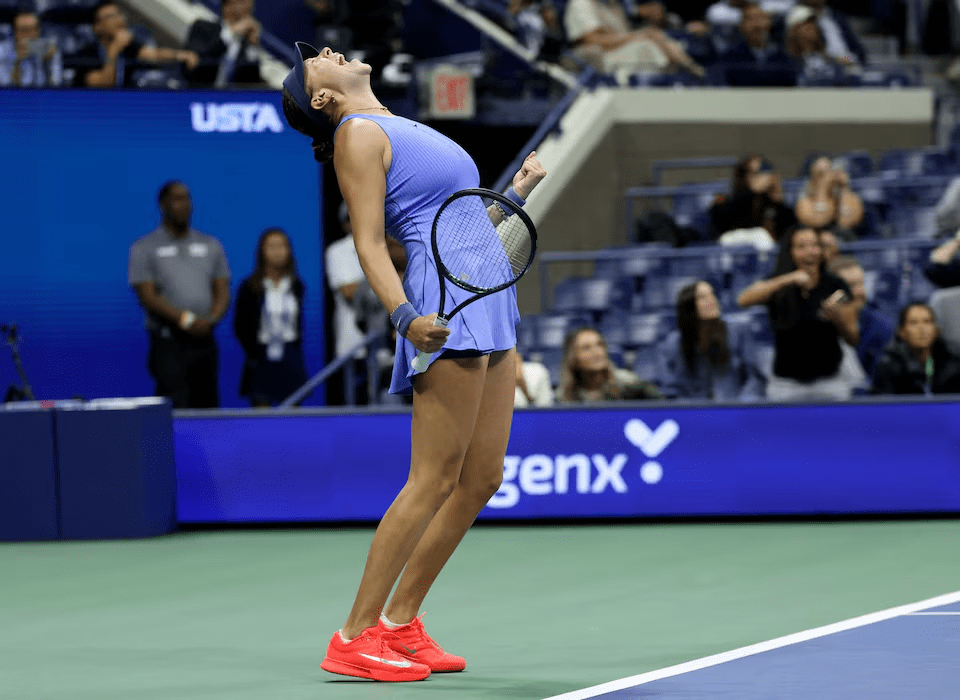
Amanda Anisimova delivered one of the most dramatic comebacks of the tournament, edging past Naomi Osaka in a late-night thriller to secure her place in the US Open final. The final score read 6-7(4), 7-6(3), 6-3 in a match that tested nerves, resilience, and mental fortitude on the hard courts of Flushing Meadows.
For Amanda, this represents a landmark achievement—her first final at the US Open. It’s been quite a journey: earlier this summer, she endured a brutal 6-0, 6-0 loss to Iga Swiatek in the Wimbledon final. To bounce back from that crushing defeat and now reach a second consecutive Grand Slam final shows just how much mental strength and growth she has achieved.
The match itself was an emotional rollercoaster. Osaka, making her first Grand Slam semi-final since 2021, came out firing and slipped away with the first set 7-6. But Amanda found her rhythm, holding firm in an intense tiebreak to snatch the second set. That fightback proved pivotal. As fatigue set in for Osaka, Amanda seized control in the decider and closed out the match 6-3.
Anisimova credited her turnaround not just to physical strength but to hard-earned mental toughness. In her post-match comments, she revealed the growth this run has brought her—that this comeback is proof of her perseverance and mental evolution since the Wimbledon loss.
Now she will face defending champion and world number one Aryna Sabalenka in what promises to be a high-voltage final. Sabalenka earned her spot in the decider with a gritty comeback of her own, beating Jessica Pegula 4-6, 6-3, 6-4.
This matchup pits two power-hitting players against one another—Anisimova armed with vibrant shot-making and renewed belief, and Sabalenka with her trademark aggression and emotional fire. It’s a clash of redemption and dominance—Anisimova chasing her first Grand Slam title, Sabalenka fighting to defend hers.
At just 24, Anisimova is now the youngest American to reach the women’s singles finals at both Wimbledon and the US Open in the same season since Serena and Venus Williams in 2002.
It was nearly 1 a.m. local time by the end, a testament to the endurance and drama on show. A near three-hour battle, this marathon brought out extraordinary qualities from Anisimova. Every point felt like a test of will. She responded with power, precision, and unyielding focus
Osaka, meanwhile, embraced a more reflective tone after the loss. She acknowledged Anisimova’s performance and spoke about being inspired rather than deflated by the outcome.
Looking ahead, the final between Anisimova and Sabalenka is set to be electric. For fans of tennis, this is what storylines are made of—a shot at redemption against the unrelenting force of a reigning champion. Anisimova’s journey from summer lows to a marquee final here in New York is exactly the kind of narrative that makes the sport thrilling.