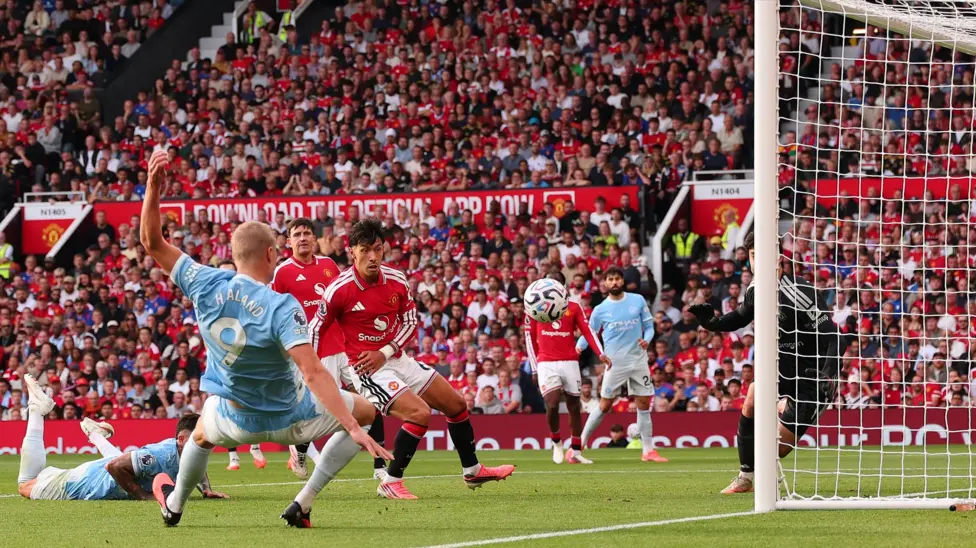
The Premier League refereeing body Pro Ref has admitted an “error of judgement” over Erling Haaland’s controversial winner in Manchester City’s 1-0 victory against Manchester United, acknowledging that the VAR should have recommended an on-field review after failing to properly assess Enzo Fernandez’s involvement in the build-up.
Haaland scored in the 60th minute at Old Trafford after turning in Josko Gvardiol’s low, deflected cross at the back post, although the goal was initially ruled out for offside before VAR intervened and determined that the Norwegian striker had been kept onside by Patrick Dorgu’s boot. The decision allowed City to secure a remarkable victory despite playing with 10 men for more than 70 minutes, but the subsequent controversy has now led to an admission from the refereeing body.
Pro Ref has since acknowledged that VAR failed to recognize the likely impact of Fernandez’s position and should have sent referee Michael Oliver to the pitchside monitor for a subjective offside decision.
Premier League refereeing body admits VAR mistake

The controversy centered on two separate questions that were ultimately connected by the same passage of the offside law. Although Haaland appeared to be beyond the defensive line when Gvardiol delivered the cross, VAR’s review showed that the striker was actually played onside by the boot of Dorgu, meaning the original decision against him was incorrect.
However, Fernandez was also in an offside position and was positioned centrally between Haaland and the United goal as he attempted to reach the cross with a diving header.
The Argentine did not make contact with the ball, but that alone did not necessarily mean that he could not commit an offside offence. Under the relevant interpretation of the law, a player in an offside position can still be penalized if they are clearly attempting to play a nearby ball and that action impacts an opponent.
That distinction became crucial because Fernandez’s movement appeared to affect the players around him, particularly United defender Lisandro Martinez, who was positioned behind him as the cross travelled into the penalty area.
Pro Ref acknowledged that the decision was subjective, but said the VAR failed to recognize the likely impact of Fernandez’s position and should therefore have recommended an on-field review. The refereeing body subsequently contacted Manchester United to acknowledge what it described as an “error of judgement”, while confirming that the incident would be reviewed.
Haaland’s winning goal sparks offside debate

Haaland’s winning goal became controversial because the VAR review correctly established that the City striker himself was onside, yet the review did not fully address whether Fernandez’s attempt to play the ball constituted interference.
The Premier League Match Centre initially explained that VAR had checked the referee’s decision and determined that Haaland was in an onside position, while also concluding that Fernandez did not play the ball.
That interpretation, however, overlooked the subjective element of the offside law, which considers the impact of a player’s attempt to play a nearby ball rather than simply asking if they made contact with it.
Fernandez threw himself towards the cross in an attempt to make a diving header, with Martinez immediately behind him, and that movement potentially influenced the defender’s ability to react to Haaland’s position.
The same issue could also be applied to goalkeeper Senne Lammens, who briefly reacted to Fernandez’s attempt to play the ball, adding another layer to the argument that the offside player had interfered with an opponent.
BBC Sport’s analysis concluded that the goal should ultimately have been disallowed for Fernandez’s offside offence, while the VAR should have sent Oliver to the monitor because the issue was subjective.
That would have produced the unusual situation of a goal initially disallowed for the wrong offside offence remaining disallowed after review, but that was the process that should have been followed according to the analysis.
Manchester United furious after controversial decision

The admission from Pro Ref is likely to offer little comfort to Manchester United, who had already expressed significant frustration immediately after the final whistle.
Lisandro Martinez described the decision as an “injustice”, particularly because United had played against 10 men for the majority of the match and created several opportunities to take advantage of their numerical superiority.
United manager Michael Carrick was similarly frustrated, questioning the interpretation being applied to interference and expressing concern about the implications for future decisions.
The anger was understandable because United had struck the woodwork twice after Phil Foden was dismissed in the 23rd minute. Marcus Rashford’s dipping free-kick hit the post shortly before half-time, while Kobbie Mainoo’s curling effort struck the woodwork again early in the second period.
Instead of taking advantage of those opportunities, United conceded on the counter and ultimately lost the derby.
The controversy has therefore overshadowed an impressive defensive performance from City, who managed to protect their lead despite their numerical disadvantage.
Foden red card adds another layer of controversy

The Haaland incident was not the only contentious decision during the match, as Foden’s first-half dismissal also generated significant debate.
The City midfielder was shown a straight red card after kicking out at Fernandes while lying on the ground following a challenge involving the United captain. Replays showed that Fernandes had made contact with Foden’s back first, although the City player retaliated and was subsequently dismissed.
Opinions were divided over whether the action justified a straight red card, with some pundits arguing that it was more of a flick or gesture than a violent kick, while others believed the referee was entitled to regard it as violent conduct.
The decision was reviewed by VAR and ultimately upheld, meaning City had to play with 10 men for more than 70 minutes.
Despite that disadvantage, Haaland’s decisive finish gave City all three points and maintained their perfect start to the Premier League campaign.
However, with the Premier League refereeing body now admitting that VAR made an error over the decisive goal, the result is likely to remain one of the most debated Manchester derbies in recent memory.
For Manchester United, the admission reinforces their feeling that an important decision went against them. For City, it does not erase the resilience required to defend with 10 men, but it ensures that the circumstances surrounding their victory will continue to dominate the conversation long after the final whistle.
