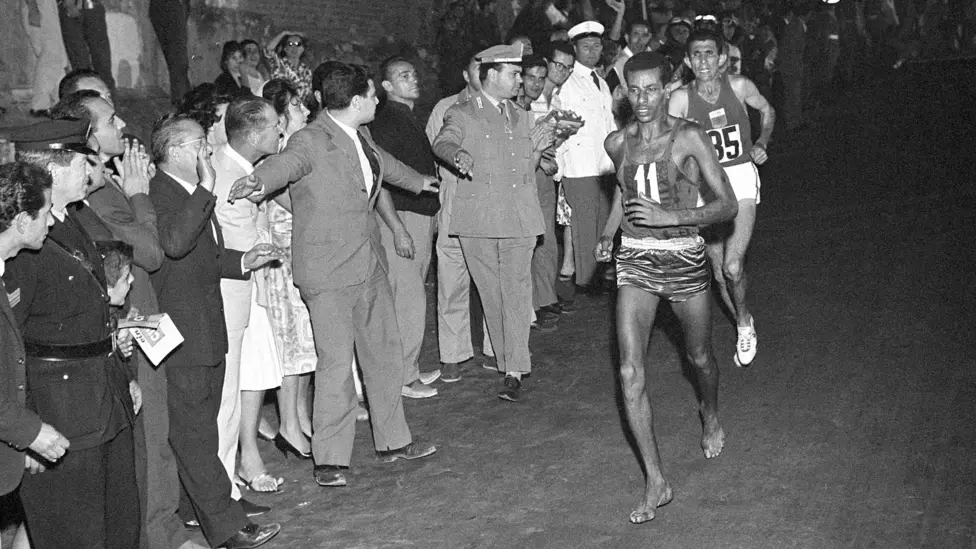
The 1960 Olympic marathon produced one of the most extraordinary performances in athletics history. On a warm September evening in Rome, an Ethiopian runner with no international reputation crossed the finish line barefoot, setting a new world record and becoming the first black African to win an Olympic gold medal. His name was Abebe Bikila, and his victory would change the history of distance running forever.
On 10 September 1960, beneath the ancient monuments of the Italian capital, Bikila ran 42.195 kilometers in 2 hours, 15 minutes and 16.2 seconds. He defeated a field that included some of the world’s finest distance runners, including the pre-race favorite Sergey Popov of the Soviet Union.
But it was not simply the gold medal or the record that made the occasion unforgettable. It was the sight of a barefoot Ethiopian running through the streets of Rome, the former colonial power that had invaded his homeland barely a quarter of a century earlier.
His triumph became a landmark for African sport, opening the door for generations of East African distance runners who would eventually dominate international athletics.
Abebe Bikila: From Ethiopian Shepherd to Olympic Champion

Born on 7 August 1932 in Jato, Ethiopia, Abebe Bikila grew up in a rural environment. His early life was far removed from the international sporting arenas where he would eventually make history.
As a young boy, he worked as a cattle herder, developing the physical endurance that would later become one of his greatest advantages. Running was not initially a professional ambition. His path towards athletics began when he travelled to Addis Ababa as a teenager and encountered the Imperial Bodyguard Forces training near the palace of Emperor Haile Selassie.
Impressed by what he saw, Bikila decided to join the Imperial Bodyguard. He was accepted at the age of 19, and the physical training required of its members provided an opportunity for him to discover his natural running ability.
Initially, he competed in shorter distance events, including the 5,000 and 10,000 meters. However, his potential as a marathon runner soon became apparent.
A Swedish coach, Onni Niskanen, who was serving as Ethiopia’s athletics director, recognized his talent and began developing him through a structured training program. Niskanen introduced demanding endurance sessions, interval training and long runs through the hills surrounding Addis Ababa.
Bikila’s marathon debut came in 1959 during the Military Forces Day celebrations in Addis Ababa. His progress was remarkable, and by 1960 he had established himself as one of Ethiopia’s leading distance runners.
Just one month before the Rome Olympics, he won the Ethiopian marathon trials in 2:21:23, a time faster than the existing Olympic record.
That performance secured his place on the Ethiopian Olympic team. However, few outside his country knew much about the slender athlete preparing to take on the world’s best.
Why Abebe Bikila Ran the 1960 Olympic Marathon Barefoot
One of the most recognizable details of Bikila’s story is that he ran the Olympic marathon without shoes. However, the decision was not originally intended to make a statement or attract attention.
Bikila had trained both with and without running shoes under Niskanen’s supervision. In the final days before the race, his shoes fell apart. He attempted to find a suitable replacement at a local shop in Rome, but the new pair caused blisters and discomfort.
Rather than risk running 42 kilometers in footwear that affected his movement, he decided to compete barefoot.
It was a decision that would become one of the most enduring images in Olympic history.
The circumstances surrounding the race were equally unusual. Unlike modern Olympic marathons, which typically begin and finish inside an athletics stadium, the 1960 event took competitors through some of Rome’s most historic locations.
The race began at the Piazza del Campidoglio at 5:30 pm, with the route passing landmarks including the Baths of Caracalla and the ancient Appian Way before finishing beneath the Arch of Constantine.
Because the race continued after sunset, Italian soldiers lined sections of the route with torches to illuminate the runners’ path.
There were 69 competitors representing 35 countries. Among them was Sergey Popov, the Soviet world record-holder, who was widely considered the favorite.
Bikila, by contrast, arrived without the international recognition enjoyed by his rivals. Yet as the race unfolded, it became clear that he was capable of challenging for the greatest prize in athletics.
The Race That Made History in Rome

The early stages of the marathon featured a leading group that included Bikila, Morocco’s Rhadi Ben Abdesselam, Britain’s Brian Kilby and Belgium’s Aurèle Vandendriessche.
Bikila remained composed, gradually moving into contention as the kilometers passed. By the 20-kilometre mark, he and Ben Abdesselam had separated themselves from the rest of the field.
The two African runners began to build a significant advantage, working together as they approached the final stages of the race. Their closest pursuers were increasingly unable to match their pace.
By 35 kilometers, Bikila and Ben Abdesselam were still running together, with the battle for the gold medal appearing to be between the two of them.
The decisive moment came as they approached the final kilometers.
After leaving the ancient Appian Way, the runners passed through the Piazza di Porta Capena, where an Ethiopian historical landmark stood. It was the Obelisk of Axum, a monument that had been taken from Ethiopia by Italian forces following the country’s invasion in 1935 and occupation in 1936.
The symbolism was impossible to ignore. An Ethiopian athlete was running through the streets of Rome, approaching a monument taken from his homeland during a period of Italian aggression.
With approximately 500 meters remaining, Bikila made his move. He accelerated away from Ben Abdesselam, who could no longer maintain his pace.
Bikila continued towards the finish, navigating an unexpected motor scooter near the final stretch before crossing beneath the Arch of Constantine.
His time was 2:15:16.2, a new world and Olympic record.
Ben Abdesselam finished approximately 25 seconds behind to take silver, while New Zealand’s Barry Magee claimed bronze.
The barefoot Ethiopian had conquered Rome.
The Meaning of an Ethiopian Victory

Bikila’s achievement carried significance far beyond the sporting arena. He became the first black African to win an Olympic gold medal, a milestone that transformed perceptions of African athletes in international sport. His victory also made him Ethiopia’s first Olympic gold medalist.
The location made the achievement even more powerful. Italy had invaded Ethiopia in 1935 under Benito Mussolini, and the occupation had continued until 1941. Just 19 years after the end of that occupation, an Ethiopian athlete had returned to Rome and won one of the most demanding events at the Olympic Games.
The sight of Bikila crossing the finish line barefoot became a powerful symbol of African excellence, resilience and national pride.
His success also inspired a generation of athletes across East Africa. Runners from Ethiopia, Kenya and neighboring countries would go on to establish themselves among the greatest distance athletes in the world.
The 1960 Olympic marathon was therefore not simply the beginning of an extraordinary individual career. It was an important moment in the development of African athletics.
Abebe Bikila Refuses to Stop: A Second Olympic Gold
Rome was only the beginning of Bikila’s remarkable Olympic story. Four years later, he returned to defend his marathon title at the 1964 Tokyo Olympics. This time, he wore running shoes, but his preparation had been far from straightforward.
Just 40 days before the competition, Bikila had undergone an appendectomy. Many observers questioned whether he would recover sufficiently to compete, let alone defend his title.
However, he produced another extraordinary performance.
After initially allowing other runners to dictate the pace, Bikila moved ahead and gradually established a commanding lead. He crossed the finish line in 2:12:11.2, breaking his own world record by more than three minutes.
He won by over four minutes, becoming the first athlete to win consecutive Olympic marathon titles.
His victory in Tokyo confirmed that Rome had not been an isolated achievement. Bikila was one of the greatest marathon runners of his generation, having won 12 of the 13 marathons he contested between 1960 and 1966. His only defeat during that period came at the 1963 Boston Marathon, where he finished fifth.
The Tragedy That Ended a Remarkable Career
Bikila returned to the Olympic marathon at the 1968 Mexico City Games, hoping to achieve another historic victory. However, injury forced him to withdraw after approximately 17 kilometers.
His body could no longer sustain the demands of competition at the highest level, and his attempt to win a third consecutive Olympic title came to an end. The following year, tragedy struck.
In 1969, Bikila was involved in a car accident that left him with severe spinal injuries and paralyzed from the waist down. The accident brought an abrupt end to his running career, but it did not destroy his competitive spirit.
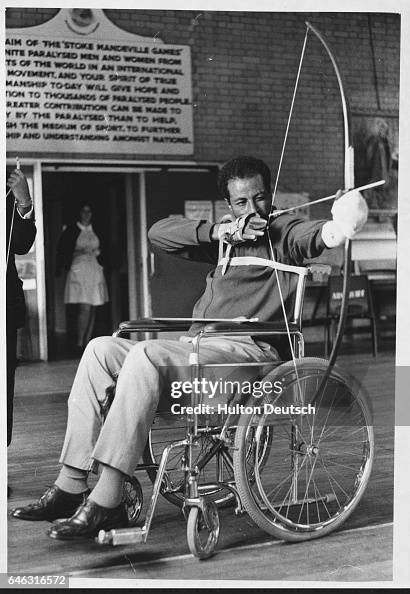
During rehabilitation, he explored other sporting activities, including archery and table tennis. In 1970, he participated in the Stoke Mandeville Games in England, an event associated with the development of the Paralympic movement.
His determination to remain involved in sport despite his disability reflected the same resilience that had defined his running career. On 25 October 1973, Bikila died in Addis Ababa following a brain haemorhage. He was just 41 years old.
Thousands attended his funeral, as Ethiopia mourned a man whose achievements had brought international recognition to the country.
The Legacy of the Barefoot Runner
More than six decades after his triumph, Abebe Bikila remains one of the most important figures in Olympic history.
His victory in Rome established a new standard for African distance running and inspired athletes who would follow in his footsteps. From Mamo Wolde and Haile Gebrselassie to Kenenisa Bekele and Eliud Kipchoge, generations of East African runners have continued to shape the history of the marathon.
Bikila’s achievement was also remarkable for its consistency. He returned to the Olympic Games in 1964 and won again, this time in shoes, proving that his success in Rome had been the product of extraordinary ability, discipline and preparation rather than a single remarkable evening.
The 1960 Olympic marathon remains one of the defining moments of his career, not simply because he ran barefoot or broke a world record, but because of what his victory represented.
On the streets of a city that had once witnessed the occupation of his homeland, an Ethiopian runner stood above the world’s finest athletes.
He arrived in Rome relatively unknown. He left as an Olympic champion, a national hero and a pioneer whose influence would extend far beyond his lifetime. Abebe Bikila did not just conquer a marathon. He helped change the future of African athletics.
