
The history of football rules is a story of constant change, shaped by the need to make the game fairer, safer and more exciting. From an era when two club-appointed umpires settled disputes to the introduction of Video Assistant Referees (VAR), football has undergone remarkable transformations since its earliest organized form in the nineteenth century.
Many features that supporters now consider essential were once absent. There were no penalty kicks, substitutions, red cards or modern offside interpretations. Even the role of the referee has changed significantly, moving from an official who intervened when necessary to the central authority responsible for controlling every aspect of a match.
Over more than 160 years, these developments have influenced how football is played, coached, officiated and experienced by supporters. Understanding the history of football rules therefore offers more than a journey through old regulations. It reveals how the sport adapted to professionalism, technological progress and changing expectations of fairness.
The Birth of Football’s First Official Rules

Before 1863, football had no universally accepted set of rules. Different schools, universities and clubs played according to their own codes, with significant differences concerning handling the ball, physical contact and the definition of offside.
The Cambridge Rules, developed in the nineteenth century, and the Sheffield Rules, written in 1858, were among the important attempts to establish organized systems of play. However, the growing popularity of football created a need for a common framework that clubs could follow.
On 26 October 1863, representatives of London clubs met at the Freemasons’ Tavern in London and established the Football Association (FA). The meeting led to the development of the first formal Laws of the Game, with Ebenezer Morley playing a central role in their creation.
The original 13 laws established important principles, including the prohibition of carrying the ball and restrictions on handling. They also prohibited hacking, the practice of kicking opponents on the shins, helping to distinguish association football from other forms of football played at the time.
The first recorded match under the new FA rules took place on 19 December 1863 between Barnes and Richmond, ending in a goalless draw. As the sport continued to expand, further changes followed, including the introduction of goal kicks in 1869 and corner kicks in 1872.
To ensure consistency across the different British associations, the International Football Association Board (IFAB) was established in 1886. FIFA later joined the organization in 1913, and IFAB remains the authority responsible for maintaining and amending football’s Laws of the Game.
From Two Umpires to the Modern Referee
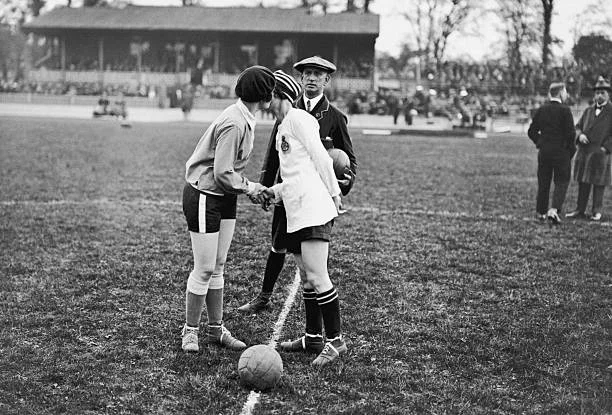
The history of football officiating is another important part of the evolution of the sport. In the early years, matches commonly relied on two umpires, with each team appointing one to settle disputes involving their players. A separate referee, initially positioned off the field, could be consulted when the umpires disagreed.
This arrangement reflected the early belief that players and team representatives could resolve many disagreements themselves. However, as football became more competitive and professional, disputes became increasingly difficult to settle through officials appointed by the competing clubs.
The referee gradually gained greater authority during the late nineteenth century. In 1891, the Laws were changed to establish the referee as the principal decision-maker on the field, while the two umpires were replaced by linesmen who assisted with decisions, particularly those concerning the ball going out of play.
The referee also moved from the touchline onto the pitch, equipped with a whistle to manage the match. The introduction of the whistle in 1878 had already given officials a more effective way to communicate decisions.
Over time, the linesmen developed into assistant referees, with responsibilities that included judging offside positions and identifying when the ball crossed the touchlines. The modern officiating team now includes a referee, two assistant referees, a fourth official and, in competitions using the system, VAR officials.
The change from two club-appointed umpires to an independent referee represented a fundamental shift in football governance. It established the principle that match decisions should be made by neutral officials rather than representatives of the competing sides.
The Evolution of the Offside Rules
Few football regulations have generated as much debate as the offside law. Its development has repeatedly influenced attacking tactics, defensive organization and the balance between goalscoring opportunities and defensive protection.
Under the original 1863 rules, a player was effectively offside if positioned ahead of the ball. This made forward passing difficult and encouraged a style of play that relied heavily on dribbling and short combinations.
The law was relaxed in 1866, allowing an attacker to remain onside if at least three opposing players were positioned between them and the goal. This encouraged more passing and helped the game develop beyond its earlier emphasis on individual dribbling.
A major change arrived in 1925 when the required number of opponents was reduced from three to two. The amendment created more attacking opportunities and contributed to a significant increase in goalscoring.
The offside rules were adjusted again in 1990, when a player level with the second-last opponent was no longer considered offside. This change favored attackers and encouraged more forward movement.
In 1995, the offside law was further clarified through the introduction of the distinction between interfering with play, interfering with an opponent and gaining an advantage from being in an offside position. The concept of passive offside was subsequently incorporated into the modern interpretation.
Today, a player is not automatically penalized simply for occupying an offside position. They must become involved in active play in one of the ways defined by the Laws. The law also recognizes that a player cannot be offside directly from a goal kick, throw-in or corner kick.
The evolution of the offside rules demonstrates how a relatively small adjustment can transform the tactical identity of football.
Penalty Kicks: Introducing a Punishment for Fouls
Before 1891, football had no penalty kick. Serious fouls committed close to goal were dealt with through the existing rules, but there was no special punishment that gave the attacking team a direct opportunity to score from 12 yards.
The penalty kick was introduced in 1891 following growing concerns about deliberate fouls and unfair attempts to prevent goals. It was initially controversial, with some people considering the punishment inconsistent with the sporting spirit of the game.
The original penalty kick could be taken from any point along a line 12 yards from the goal. The modern penalty area and penalty mark were introduced in 1902, establishing the familiar arrangement used today.
The penalty kick became one of football’s most important disciplinary mechanisms, giving referees a way to punish certain offences committed inside the penalty area. It also created one of the sport’s most pressurized individual contests: the penalty taker against the goalkeeper.
However, the introduction of the penalty kick did not resolve every match that ended in a draw, particularly in knockout competitions.
The Penalty Shootout Changes Knockout Football
For decades, football competitions used different methods to separate teams that remained level after extra time. Some tournaments relied on replays, while others used methods such as drawing lots or even a coin toss.
The penalty shootout offered a more direct sporting solution. The first official penalty shootout took place on 5 August 1970, when Hull City defeated Manchester United in the Watney Cup after the teams had drawn 1-1.
The system subsequently became established in major competitions. Its first appearance in a European Championship final came in 1976, when Czechoslovakia defeated West Germany in Belgrade. Antonín Panenka’s famous chipped penalty secured the trophy and gave the shootout one of its most iconic moments.
The shootout introduced a structured method of deciding knockout matches, with teams initially taking five penalties each before moving to sudden death if the scores remained level.
Although it remains controversial because a team can lose despite performing well over 120 minutes, the shootout has become an accepted part of modern tournament football.
Substitutions: From Playing Through Injuries to Tactical Changes

For much of football’s early history, teams were not permitted to replace players during a match. An injured footballer was generally expected to continue if possible, leaving their team at a disadvantage if they could not.
Substitutions were gradually introduced, initially for injured players. In 1958, the Laws permitted substitutions for an injured goalkeeper and one other injured player, subject to competition approval.
At the 1970 World Cup in Mexico, teams were permitted to make two substitutions per match. The Soviet Union made the first substitution in World Cup history when Anatoli Puzach replaced Viktor Serebryanikov against Mexico on 31 May 1970.
The rules continued to develop. Three substitutions became standard at the 1998 World Cup, while an additional substitution during extra time was introduced for the 2018 tournament in Russia.
The COVID-19 pandemic accelerated another major change. To help manage player workloads during a congested fixture schedule, football authorities introduced the option of five substitutions. The change was subsequently made permanent in the Laws, although competitions determine how it is implemented, including the number of opportunities teams have to make changes.
Substitutions have therefore evolved from a measure designed primarily to protect injured players into an essential tactical tool. Managers now use their benches to change formations, introduce fresh attacking options and manage the physical demands of modern football.
Red and Yellow Cards: Making Discipline Visible
Before 1970, referees could caution or dismiss players, but there was no universally recognized visual system for communicating these decisions.
The need for a clearer system became particularly apparent during the 1966 World Cup, when confusion surrounding disciplinary decisions highlighted the difficulty of communicating cautions across language barriers.
English referee Ken Aston developed the idea of using yellow and red cards after considering the familiar traffic-light system. Yellow would represent a caution, while red would indicate dismissal.
The cards were introduced at the 1970 World Cup in Mexico. Interestingly, no player was sent off during that tournament. The first red card at a World Cup was shown to Chile’s Carlos Caszely during the 1974 tournament in West Germany.
Today, yellow cards are used to caution players for offences such as unsporting behavior, dissent and persistent infringement. A player who receives two cautions in the same match is sent off, while serious offences can result in a direct red card.
The introduction of cards made disciplinary decisions easier for players, officials and spectators to understand, establishing a universal language of football discipline.
The History of Football Rules: From Goal-Line Technology to VAR

Technology has arguably produced the most significant recent transformation in the history of football rules. For generations, referees and their assistants had to make decisions based on what they could see in real time, sometimes without a clear view of incidents.
Goal-line technology was approved by IFAB in 2012 to help determine whether the entire ball had crossed the goal line. The system was used at the 2014 World Cup in Brazil, reducing uncertainty over one of football’s most consequential decisions.
VAR represented a much broader development. Trials began in 2016, and IFAB formally approved its inclusion in the Laws of the Game in March 2018. It was subsequently used at the 2018 FIFA World Cup in Russia.
VAR is designed to assist referees with four categories of potentially decisive incidents: goals, penalty decisions, direct red-card incidents and cases of mistaken identity. It does not replace the referee or allow every decision to be reviewed simply because players disagree.
The technology has nevertheless transformed match officiating. Referees can now review footage on pitchside monitors, while video officials examine incidents from different camera angles and provide additional information.
More recently, semi-automated offside technology has introduced advanced tracking systems to assist with offside decisions. These developments aim to improve accuracy and reduce the time required to reach certain decisions.
However, technology has not eliminated controversy. Questions remain about delays, subjective interpretations and the consistency of decisions. VAR can provide additional evidence, but the final judgement in many situations still depends on the referee’s interpretation of the Laws.
How Football’s Rules Continue to Shape the Game
From the first 13 laws in 1863 to the introduction of VAR, football has continually adapted to the demands of the modern game. The development of the offside rules changed attacking and defensive tactics, substitutions transformed squad management, disciplinary cards established a clearer system of control, and penalty shootouts provided a sporting method of settling knockout matches.
The evolution of football rules has never been simply about adding more regulations. Each significant change has attempted to address a problem, improve fairness or respond to the changing nature of the sport.
Yet every amendment creates new debates. Supporters continue to disagree over VAR, managers question offside interpretations, and football authorities must constantly balance player welfare with the rhythm of the game.
What remains certain is that football’s rules will continue to evolve. The game played today is considerably different from the one established in 1863, and the decisions made by its lawmakers will shape how future generations experience the sport.
