Football has long been celebrated as “the beautiful game,” a sport built on passion, skill, and moments of brilliance. Yet for decades, it also carried a flaw human error in crucial decisions. Among the most controversial of these were goal-line calls, where referees had to judge in real time whether the ball had fully crossed the line. In a sport where goals are rare and decisive, such errors often had massive consequences.
The introduction of goal-line technology (GLT) marked a turning point. It brought precision, fairness, and confidence to one of football’s most critical decisions. Today, GLT is an essential part of elite football, shaping how matches are officiated and experienced by players, referees, and fans alike.
What Is Goal-Line Technology?
Goal-line technology is an electronic system used to determine whether the ball has completely crossed the goal line between the posts and beneath the crossbar. Its sole purpose is simple but vital: to confirm whether a goal has been scored.
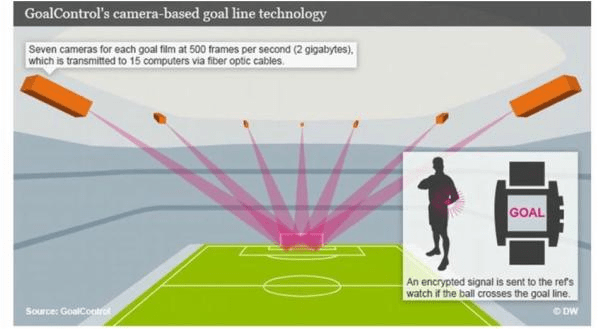
Unlike other officiating tools, GLT provides a binary outcome goal or no goal with no room for interpretation. Once the system detects that the entire ball has crossed the line, it sends an instant signal to the referee, typically via a vibrating watch, within about one second.
This immediacy ensures that the game continues smoothly without interruptions or lengthy reviews, preserving football’s natural rhythm while improving accuracy.
Why Goal-Line Technology Was Needed
Before GLT, referees and assistant referees relied solely on their vision and positioning. However, football is a fast-paced sport, and goalmouth incidents often occur in crowded, chaotic situations. Even the best officials could be unsighted or misjudge angles.
Several high-profile controversies exposed the limitations of human judgment:
- In 2005, a shot by Pedro Mendes for Tottenham clearly crossed the line against Manchester United, but no goal was awarded.
- During the 2010 FIFA World Cup, Frank Lampard’s shot for England against Germany crossed the line but was not given, sparking global outrage.
These incidents created pressure on governing bodies like FIFA and International Football Association Board to modernize the game.
In 2012, IFAB officially approved goal-line technology, and by the 2014 World Cup, it had become a standard feature in major competitions.
How Goal-Line Technology Works

Goal-line technology relies on advanced tracking systems to monitor the exact position of the ball. There are two primary types of GLT systems:
1. Camera-Based Systems (e.g., Hawk-Eye)
This is the most widely used method. Multiple high-speed cameras often seven per goal are positioned around the stadium, all focused on the goal area.
These cameras track the ball in real time, using software to calculate its exact location in three-dimensional space. The system can determine with extreme precision down to millimeters whether the ball has crossed the line.
2. Sensor-Based Systems
Some systems use magnetic fields or microchips embedded in the ball and goalposts. These sensors detect when the ball passes fully over the line and send a signal instantly.
The Decision Process
Regardless of the system used, the process follows the same steps:
- The ball moves toward the goal line.
- Sensors or cameras track its position continuously.
- The system determines whether the entire ball has crossed the line.
- If it has, a signal is sent instantly to the referee’s watch.
The key rule is that the whole ball must cross the line even a fraction remaining on the line means no goal.
Differences Between Goal-Line Technology and VAR
It is important to distinguish GLT from the Video Assistant Referee (VAR) system.
- Goal-Line Technology:
- Instant decision (within one second)
- No human interpretation
- Used only for goal-line decisions
- VAR:
- Involves video review by officials
- Covers multiple aspects (penalties, offsides, fouls)
- Can take longer and involve subjective judgment
GLT is therefore more straightforward and less controversial, as it deals with a single, objective question.
Also Read- How Injury Recovery Works in Professional Football
The Impact on Football
1. Improved Accuracy and Fairness
The most obvious benefit of goal-line technology is its accuracy. By eliminating guesswork, it ensures that correct decisions are made in situations where human officials might struggle.
This has significantly reduced the number of controversial “ghost goals” or wrongly disallowed goals, leading to a fairer game overall.
2. Increased Trust in Officiating
Football fans are passionate, and disputes over refereeing decisions often lead to frustration and distrust. GLT has helped rebuild confidence by providing clear, indisputable outcomes.
Players, coaches, and supporters now know that goal-line decisions are almost always correct, reducing arguments and controversy.
3. Preservation of Game Flow
One of the major concerns before introducing technology was that it might slow the game down. However, GLT was designed specifically to avoid this.
Because decisions are delivered instantly and only to the referee, there are no stoppages or delays.
This makes GLT one of the least intrusive technological innovations in football.
4. Influence on Major Competitions
Goal-line technology is now widely used in elite competitions, including:
- The FIFA World Cup
- UEFA Champions League
- Top domestic leagues such as the English Premier League
Its adoption has become a benchmark for professionalism and fairness in modern football.
5. Tactical and Psychological Effects
Interestingly, GLT has also influenced player behavior and tactics:
- Defenders are less likely to argue decisions and more focused on clearing the ball decisively.
- Attackers have greater confidence that legitimate goals will be awarded.
- Goalkeepers must be more precise, as marginal saves are now judged with exact accuracy.
The psychological certainty provided by GLT has subtly changed how players approach critical moments.
Criticisms and Limitations
Despite its many advantages, goal-line technology is not without criticism.
Cost and Accessibility
Installing GLT systems is expensive, which limits its use to top-tier competitions. Lower leagues and grassroots football often cannot afford it, creating a gap in officiating standards.
Dependence on Technology
Some critics argue that football risks becoming overly reliant on technology, reducing the human element that has historically been part of the game.
Rare Technical Failures
Although extremely reliable, GLT is not infallible. There have been rare instances where the system failed, reminding stakeholders that no technology is perfect.
Memorable Moments Involving GLT
Since its introduction, goal-line technology has been involved in several dramatic moments:
- Extremely close calls where goals were awarded or denied by mere millimeters
- Crucial league matches where title races were affected by accurate decisions
- High-stakes international games where controversies were avoided
These moments highlight the system’s importance not just in preventing errors, but in ensuring that outcomes reflect reality.
The Future of Goal-Line Technology
As technology continues to evolve, so too will goal-line systems. Possible future developments include:
- Greater integration with VAR systems
- Improved sensor accuracy and redundancy
- Wider adoption in lower leagues as costs decrease
Ultimately, GLT represents just one step in football’s broader technological evolution.
Goal-line technology has fundamentally transformed football by addressing one of its most persistent problems: uncertainty in goal decisions. By combining precision, speed, and reliability, it has enhanced fairness without disrupting the flow of the game.
Its impact goes beyond officiating. It has restored trust, reduced controversy, and allowed players and fans to focus on what truly matters the game itself.
In a sport defined by moments, where a single goal can decide championships and define careers, ensuring the accuracy of those moments is essential. Goal-line technology has achieved exactly that, securing its place as one of the most important innovations in modern football.
As the game continues to evolve, GLT stands as a powerful example of how tradition and technology can coexist preserving the spirit of football while improving its integrity.