
The history of the Harlem Globetrotters is about much more than basketball tricks, impossible-looking passes and players spinning the ball on their fingertips. For almost a century, the team has helped reshape how the sport is played, watched and understood, taking African American basketball talent from an era of racial exclusion to audiences across the world.
Founded in Chicago in 1926, the Globetrotters emerged when professional basketball offered very limited opportunities to Black players. They built a reputation through their extraordinary athletic ability, challenged racial assumptions through competition and eventually became one of the most recognizable sporting entertainment teams in history.
Their influence extended beyond the court. They helped popularise basketball, opened doors for Black athletes and introduced the game to millions of people who might otherwise never have experienced it.
The History of the Harlem Globetrotters Began in Chicago

Despite their name, the Harlem Globetrotters did not begin in New York. Their origins can be traced to Chicago, where a group of African American players formed a team known as the Savoy Big Five. Abe Saperstein, a sports promoter who later became the team’s manager and coach, recognized their potential and helped develop the organization.
The team played its first road game on 7 January 1927 in Hinckley, Illinois. Saperstein subsequently adopted the name Harlem Globetrotters, associating the players with Harlem, an important center of Black culture and identity during the Harlem Renaissance. Interestingly, the team did not actually play in Harlem until 1968.
In those early years, the Globetrotters were not simply entertainers. They were a serious basketball team competing against local opponents across the United States. Their touring schedule allowed them to reach communities where audiences had limited exposure to the sport, while their performances demonstrated the quality of African American players at a time when professional basketball remained deeply segregated.
Challenging Racial Barriers in Basketball

The Globetrotters’ emergence coincided with a period when Black athletes faced widespread discrimination in American professional sport. African American players were excluded from the leading professional basketball leagues, leaving teams such as the Globetrotters and the New York Renaissance to create opportunities outside the established system.
Their success challenged the assumption that Black players could not compete at the highest level. In 1940, the Globetrotters won the World Professional Basketball Tournament, defeating the Chicago Bruins to claim the championship.
Their most significant victories came in 1948 and 1949, when they defeated the Minneapolis Lakers, one of the strongest professional teams of the period. These victories attracted attention because they demonstrated the ability of an all-Black team to defeat the leading opposition of an era when professional basketball remained racially divided.
The impact became particularly visible in 1950. Nathaniel ‘Sweetwater’ Clifton, who had played for the Globetrotters, signed a contract with the New York Knicks, becoming the first African American player to sign an NBA contract.
Clifton’s move represented an important moment in the integration of professional basketball. Although the Globetrotters did not single-handedly end racial exclusion, their performances helped demonstrate the talent that segregation had kept away from the highest levels of the sport.
From Competitive Basketball to Global Entertainment

The team’s transformation into an entertainment phenomenon developed alongside its competitive success. During the late 1930s, the Globetrotters began incorporating more elaborate ball-handling tricks, comic routines and theatrical performances into their games.
Reece ‘Goose’ Tatum, who joined in 1946, became particularly associated with the team’s comedic style. His personality and creativity helped establish the combination of basketball excellence and humour that would become the Globetrotters’ trademark.
Their performances popularized elements of basketball entertainment, including spectacular dunks, fast breaks, inventive passing and intricate ball-handling routines. The figure-eight weave and other displays of coordination became part of their distinctive identity.
However, this transformation also carried a complicated history. Some historians have examined how the team’s comedy drew on racial stereotypes and traditions associated with minstrel entertainment. The performances offered visibility and celebrated Black athletic excellence, but they also existed within a society that often expected Black entertainers to conform to caricatures. This tension remains an important part of understanding the Globetrotters’ cultural legacy.
Taking Basketball to International Audiences
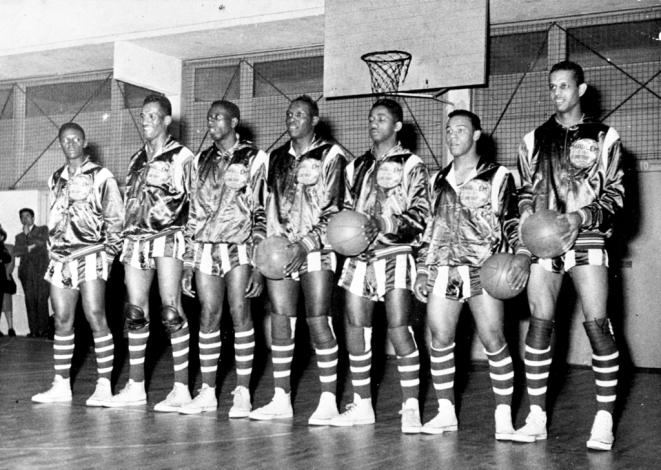
The Globetrotters’ influence was not limited to the United States. In 1950, they embarked on their first international tour, introducing their distinctive style to audiences beyond North America.
Their overseas appearances became an important part of basketball’s global development. They played in countries across Europe and beyond, attracting spectators through a combination of athletic skill, comedy and showmanship. Their tours included performances in post-war Europe, while their 1959 visit to the Soviet Union, featuring Wilt Chamberlain, became one of the most memorable episodes in their international history.
The team also became cultural ambassadors during the Cold War. Their international popularity offered an opportunity to showcase African American achievement, although the political significance of these tours was more complicated than simple sporting diplomacy. Scholars have examined how the tours were sometimes used to present an image of racial progress while discrimination continued within the United States.
Nevertheless, the Globetrotters helped make basketball familiar to audiences who had previously had little contact with the game. Their performances made the sport accessible through entertainment, leaving an influence that extended well beyond the results of individual matches.
A Century-Long Legacy Beyond the Court
The Harlem Globetrotters’ contribution to basketball has received formal recognition. In 2002, the team was inducted into the Naismith Memorial Basketball Hall of Fame, becoming the first team to receive that honor. Their story also includes legendary players such as Wilt Chamberlain, Meadowlark Lemon, Marques Haynes and Lynette Woodard, who became the first woman to play for the team in 1985.
Today, the organization says it has entertained more than 148 million fans across 123 countries and territories, continuing to stage games and community activities around the world.
The history of the Harlem Globetrotters is therefore not simply a story of sporting entertainment. It is a story of athletes who found a way to compete when professional opportunities were restricted, challenged perceptions through their performances and helped take basketball beyond its traditional boundaries. Their legacy is found not only in the tricks that delighted generations of spectators, but also in the doors they helped open, the audiences they reached and the place they secured for Black excellence in basketball history.
