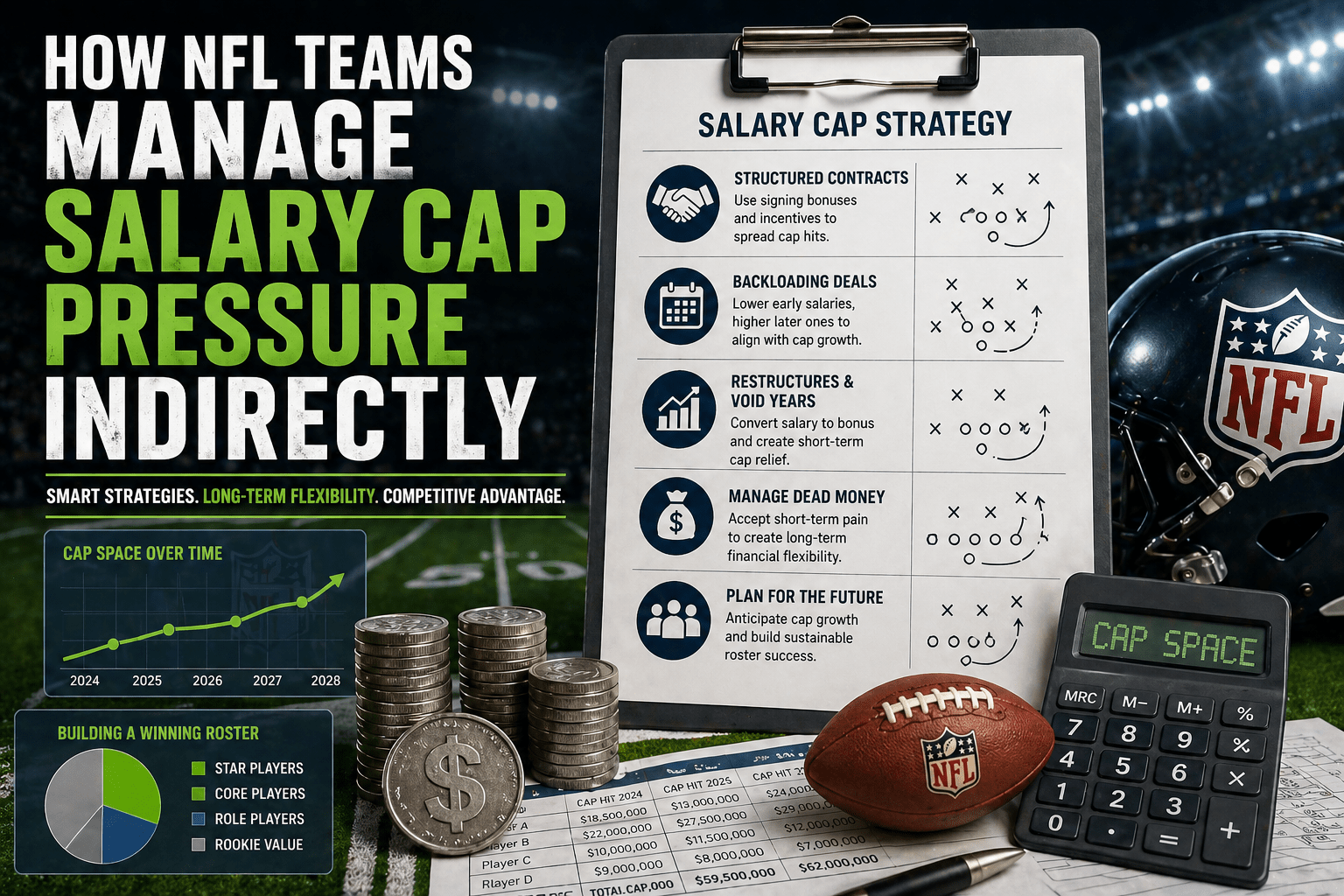
The NFL salary cap is often presented as a hard limit, a fixed number that teams must respect when building their rosters. On the surface, it looks simple. Spend within the cap or face penalties. In reality, however, the system is far more flexible. The smartest front offices do not just manage the cap directly. They manage it indirectly, using structure, timing, and financial engineering to stay competitive year after year.
Understanding how teams navigate salary cap pressure requires looking beyond contracts at face value. The real story lies in how deals are designed, how money is allocated across seasons, and how organizations anticipate future constraints before they arrive.
Understanding the Nature of the Salary Cap

The NFL salary cap is a limit on how much each team can spend on player salaries in a given league year. It is tied to league revenue, which means it rises over time, but not always predictably. Teams must account for not just current spending but also future obligations, including bonuses, guarantees, and incentives.
This creates a key tension. Teams want to win now, but they must avoid creating financial burdens that cripple them later. The most successful franchises handle this tension by shifting pressure away from the present without losing control of the future.
Structuring Contracts to Spread the Burden
One of the most common indirect strategies involves contract structure. Rather than paying players in straightforward annual salaries, teams rely heavily on signing bonuses and guaranteed money.
Signing bonuses are particularly important because they can be prorated over the length of a contract. Instead of counting fully against the salary cap in one year, the bonus is spread across multiple seasons. This allows teams to reduce the immediate cap hit while still rewarding the player.
For example, a player who receives a large signing bonus may have a relatively low salary cap hit in the first year of the deal. This gives the team flexibility to build around that player in the short term, even if the total contract value is high.
Backloading Deals for Competitive Windows
Another indirect method is backloading contracts. In this approach, a player earns less in the early years of a deal and significantly more in later years.
This strategy is often used when a team believes it is entering or already in a championship window. By keeping early cap hits low, the team can afford to sign or retain multiple key players at once. The expectation is that the salary cap will increase in future years, making the larger salaries more manageable.
However, this approach comes with risk. If performance declines or the team fails to contend, those backloaded years can become a financial burden. Successful teams mitigate this risk by pairing backloaded deals with flexibility, such as restructure options or manageable guarantees.
NFL Contract Restructures to Create Space
Restructuring contracts is another key tool in managing salary cap pressure indirectly. When a team restructures a deal, it typically converts part of a player’s salary into a signing bonus. This reduces the immediate cap hit while spreading the cost over future years.
This technique can free up significant cap space quickly, allowing teams to sign new players or extend existing ones. It is especially useful during free agency or when unexpected opportunities arise.
However, restructures are not free money. They push financial obligations into the future, increasing the risk of cap issues later. Teams that rely too heavily on restructures can find themselves in a cycle of constant financial juggling.
Leveraging Void Years for Flexibility
Void years are another creative mechanism used to manage the cap. These are additional years added to a contract that automatically void before they are played. Their primary purpose is to spread out bonus money over a longer period.
By adding void years, teams can reduce the annual cap hit of a contract without committing to keeping the player for those extra seasons. This creates short-term flexibility while maintaining long-term control.
The downside is that once the contract voids, any remaining prorated money accelerates onto the cap. This can create dead money charges that limit future spending. Teams must carefully plan for these outcomes to avoid financial strain.
Managing Dead Money Strategically
Dead money refers to cap space allocated to players who are no longer on the roster. It is often seen as a negative, but it can also be used strategically.
Teams sometimes accept a large amount of dead money in a single season to clear their books for the future. This approach is often referred to as a “reset year.” During this period, the team may not be highly competitive, but it positions itself for long-term success.
By absorbing dead money early, teams can enter future seasons with greater financial flexibility. This allows them to pursue high-impact players or extend their core roster without major restrictions.
Timing Extensions Before Market Inflation

Another indirect way teams manage salary cap pressure is through timing. Extending players before the market shifts can result in significant long-term savings.
When a team signs a player to an extension early, it often locks in a salary that appears high at the time but becomes a bargain as the market grows. This is particularly common with quarterbacks and elite skill players.
By anticipating market trends, teams can control future cap hits more effectively. This reduces the need for reactive measures like restructures or cuts.
NFL Roster Building Strategies
Roster construction plays a critical role in cap management. Teams must decide how much of their cap to allocate to star players versus depth.
Some teams invest heavily in a few elite players, accepting that they will need to fill the rest of the roster with cheaper options. Others take a more balanced approach, spreading resources across multiple solid contributors.
The indirect strategy lies in aligning spending with team identity. A team built around a franchise quarterback may prioritize protecting that player and surrounding him with key weapons, even if it means sacrificing depth elsewhere.
How NFL Teams Manage Salary Cap: Utilizing Rookie Contracts
Rookie contracts are one of the most valuable tools for managing the salary cap. Because these deals are fixed and relatively inexpensive, they provide teams with high-value production at a low cost.
Teams that draft well can build competitive rosters while spending significantly less on key positions. This creates financial flexibility to invest in other areas.
The most successful teams maximize this advantage by timing their competitive window around their rookie contracts. When a young star is still on a rookie deal, the team has a unique opportunity to allocate resources aggressively elsewhere.
Planning for Cap Growth

The NFL salary cap does not remain static. It generally increases over time, driven by league revenue. Smart teams plan for this growth when structuring contracts.
By projecting future cap increases, teams can take on larger commitments in later years with confidence. This allows them to remain aggressive in the present without compromising long-term stability.
However, this requires accurate forecasting. Unexpected changes in revenue or league conditions can disrupt these projections, making flexibility essential.
The Role of Front Office Strategy in NFL Salary Cap Management
Ultimately, managing salary cap pressure indirectly is about philosophy as much as technique. Every decision reflects a broader strategy.
Some teams prioritize sustained competitiveness, avoiding extreme financial moves and maintaining steady flexibility. Others are willing to take bigger risks, pushing cap obligations into the future in pursuit of immediate success.
The key is alignment. Ownership, management, and coaching staff must share a clear vision. Without that, even the most sophisticated cap strategies can fall apart.
Conclusion
The NFL salary cap is not just a limit. It is a system that rewards creativity, foresight, and discipline. Teams that succeed do not simply operate within the cap. They shape it to their advantage.
Through contract structuring, timing, and strategic risk-taking, franchises manage salary cap pressure in ways that are not always visible on the surface. These indirect methods allow them to remain competitive, adapt to changing circumstances, and build for both the present and the future.
In the end, the difference between success and struggle often comes down to how well a team understands not just the rules of the salary cap, but the opportunities hidden within them.
