Football has witnessed countless tactical revolutions, yet few have transformed the sport as profoundly as Total Football, a philosophy that challenged every convention about space, movement, and positional responsibility while inspiring generations of coaches to rethink how the game should be played. More than a system, it became a footballing ideology that blurred traditional roles, demanded extraordinary intelligence from every player, and elevated collective understanding above individual specialization, leaving an enduring legacy that continues to shape the modern game despite its decline as a dominant tactical approach.
Although the philosophy no longer reigns supreme in elite football, its influence can still be found whenever defenders initiate attacks, midfielders drift into unfamiliar spaces, or forwards retreat to orchestrate play, demonstrating that while Total Football may have faded from the spotlight, its principles remain woven into football’s tactical fabric.
How Total Football Was Born from Rinus Michels’ Revolutionary Vision
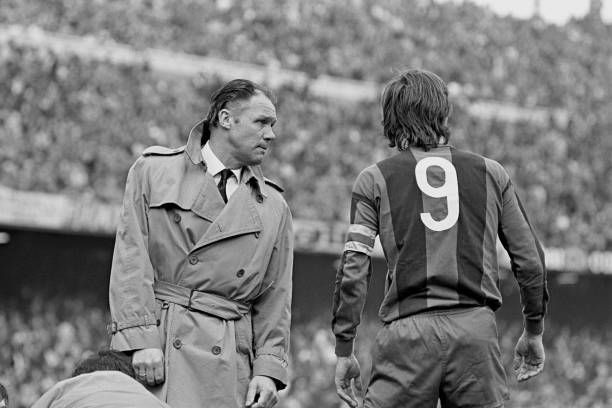
Every tactical revolution begins with someone willing to challenge accepted wisdom, and for Total Football, that visionary was Rinus Michels, the Dutch coach whose relentless pursuit of positional fluidity forever altered football’s tactical landscape.
When Michels took charge of Ajax during the 1960s, European football largely relied upon rigid positional structures in which defenders defended, midfielders created, and attackers remained close to goal, making tactical discipline synonymous with remaining in one’s assigned area of the pitch. Michels questioned that assumption because he believed players could become far more dangerous if they understood every phase of the game rather than simply fulfilling narrow positional duties.
His philosophy encouraged constant movement, intelligent pressing, and seamless positional exchanges, allowing every player to occupy spaces according to the needs of the moment rather than the constraints of a tactical diagram. Whenever one player vacated a position, another instinctively filled the space, ensuring that the team’s overall shape remained intact despite continuous movement across the pitch.
This revolutionary concept eventually became known as Total Football, and although it appeared almost chaotic to observers unfamiliar with its principles, every movement was carefully coordinated through rigorous coaching, exceptional technical ability, and remarkable tactical awareness.
Total Football Reached Perfection Through Johan Cruyff
No discussion of Total Football can be complete without acknowledging Johan Cruyff, whose extraordinary intelligence transformed Michels’ tactical blueprint into one of football’s most beautiful spectacles.
Cruyff possessed an uncommon ability to read the game several seconds ahead of everyone else, enabling him to exploit spaces before they even appeared while guiding teammates into positions that maximized collective superiority. Rather than remaining as a conventional striker, he drifted into midfield, moved toward the wings, or dropped deep to influence possession, forcing defenders into impossible decisions because marking him often created dangerous spaces elsewhere.
His interpretation perfectly embodied the football philosophies of Johan Cruyff, which emphasized technical excellence, intelligent movement, relentless pressing, and the belief that possession should always serve a tactical purpose rather than becoming an end in itself.
Under Michels and later through Cruyff’s own influence, Ajax dominated European football by winning three consecutive European Cups between 1971 and 1973, while the Netherlands captivated the world during the 1974 FIFA World Cup despite ultimately falling short against West Germany in the final.
Although the Dutch failed to lift the trophy, their performances ensured that Total Football became synonymous with innovation, courage, and artistic expression.
Why Position-less Play Redefined Football Intelligence
Perhaps the most revolutionary aspect of Total Football was its embrace of position-less play, an idea that remains remarkably modern even decades after its introduction.
Instead of treating positions as permanent assignments, the philosophy encouraged players to understand multiple responsibilities so thoroughly that they could exchange roles without disrupting the team’s structure. Full-backs frequently became attackers, midfielders covered defensive spaces, wingers drifted centrally, and forwards participated in midfield build-up, creating a fluid collective that continually adapted to changing situations during matches.
This concept of position-less play demanded far more than technical ability because every player needed exceptional tactical intelligence, physical endurance, communication skills, and complete trust in teammates. A single player who misunderstood the system could create defensive vulnerabilities, while one mistimed movement could unravel an otherwise coordinated attacking sequence.
Such demands explain why Total Football proved extraordinarily difficult to replicate outside teams possessing elite technical players and world-class coaching.
The Football Philosophies of Johan Cruyff Lived Beyond the Pitch
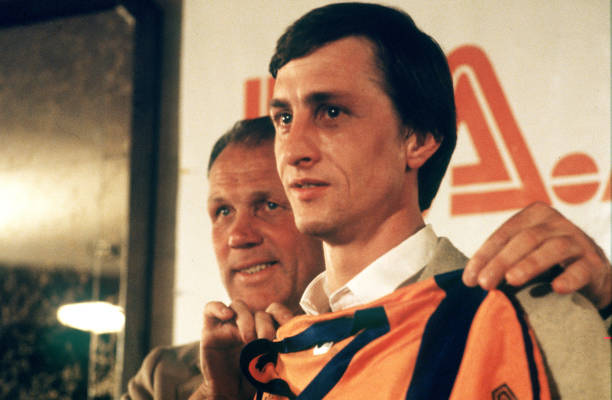
While Cruyff dazzled audiences as a player, his greatest influence arguably emerged after retirement because he transformed his playing philosophy into a coaching doctrine that would influence generations.
The football philosophies of Johan Cruyff emphasized youth development, technical excellence, intelligent possession, spatial awareness, and proactive football, encouraging players to dominate matches through the ball rather than reacting to opponents. These ideas reshaped Ajax’s academy while profoundly influencing Barcelona’s famed La Masia, where young footballers learned to interpret the game through movement, passing, and positional understanding rather than physical superiority alone.
It was within this environment that future stars developed, while coaches absorbed principles that would eventually spread throughout Europe and beyond.
Many of today’s elite managers openly acknowledge the lasting influence of the football philosophies of Johan Cruyff, proving that tactical ideas can outlive the generations that first introduced them.
Why Total Football Eventually Declined
Despite its revolutionary success, Total Football gradually lost its dominance because football itself continued evolving, and rival coaches discovered increasingly effective ways to neutralize its strengths.
Opponents began organizing defensive structures with greater discipline, reducing the spaces that Dutch teams had previously exploited through constant movement. Athletic demands also increased dramatically, making it difficult for players to sustain the relentless pressing and positional rotations that defined the philosophy across increasingly congested football calendars.
Furthermore, maintaining Total Football required squads filled with technically gifted, tactically intelligent, and physically versatile players, a combination that very few clubs consistently possessed. As football became more financially competitive, coaches often preferred systems that were easier to implement, less dependent upon exceptional football intelligence, and more adaptable to varied player profiles.
Although elements of position-less play remained attractive, few teams attempted to reproduce the original philosophy in its purest form because the margins for error had become considerably smaller.
Consequently, Total Football gradually evolved from a dominant tactical identity into a historical reference point whose principles survived even as its original structure disappeared.
How Modern Football Still Carries the DNA of Total Football
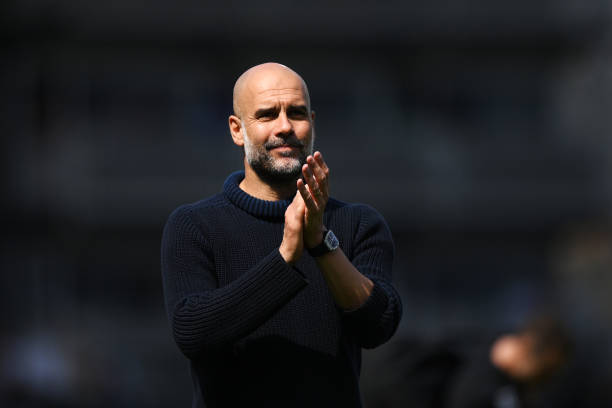
Although modern football has moved beyond the original Dutch model, the fingerprints of Total Football remain unmistakable across the world’s biggest clubs.
Pep Guardiola‘s positional play, Louis van Gaal’s structured possession, Marcelo Bielsa’s aggressive pressing, and Arsene Wenger’s fluid attacking movements all reflect ideas first refined by Rinus Michels and later elevated through Cruyff’s footballing vision. While each coach has adapted those concepts to contemporary tactical realities, they continue emphasizing intelligent movement, technical superiority, coordinated pressing, and collective understanding over rigid positional limitations.
Modern defenders routinely initiate attacks, goalkeepers function as additional playmakers, and midfielders interchange with forwards throughout matches, illustrating how position-less play has become an accepted feature of elite football rather than an extraordinary tactical experiment.
Even clubs that do not consciously identify with Total Football frequently employ principles that originated within the Dutch revolution, demonstrating how deeply its ideas have permeated the sport.
The Enduring Legacy of Total Football
The story of Total Football is not one of failure but of transformation because truly revolutionary ideas rarely disappear; instead, they evolve until they become so influential that they are no longer recognized as innovations.
The tactical masterpiece envisioned by Rinus Michels, perfected through the genius of Johan Cruyff, and sustained by the enduring football philosophies of Johan Cruyff forever changed how coaches understand space, movement, and teamwork. Although no modern team replicates the philosophy exactly as Ajax and the Netherlands once did, the game’s greatest clubs continue borrowing from its principles because they remain fundamentally effective when adapted to contemporary football.
Perhaps that is the greatest achievement of Total Football. It conquered football so completely that the sport eventually absorbed its revolutionary ideas into everyday tactical thinking, ensuring that even after its apparent fall, its spirit continues to influence every intelligent pass, every coordinated press, and every seamless positional rotation witnessed on football’s grandest stages.

1 comment
[…] the sport as profoundly as the offside rule. Every tactical revolution, from rigid formations to Total Football and modern high pressing, has been influenced by changes to this single law. The evolution of […]