Football has produced countless unforgettable moments across its history. There have been dramatic finals, stunning upsets, and legendary goals that generations of fans can recite from memory. Yet very few matches have ever been defined by a single player the way Argentina’s 1986 World Cup quarter-final against England was defined by Diego Maradona.
The story of the Hand of God and the goal of the century remains one of the most extraordinary chapters in football history. In the space of just four minutes, Maradona scored two goals that represented opposite ends of the football spectrum. One was controversial enough to spark debates that continue nearly four decades later. The other was so brilliant that it is still widely regarded as the greatest goal ever scored.
No player has ever compressed so much genius and controversy into one game.
The Build-Up to the 1986 World Cup Quarter-Final
The 1986 World Cup quarter-final between Argentina and England was never going to be an ordinary football match. The political and emotional backdrop added an extra layer of significance that went beyond sport.
Only four years earlier, Argentina and the United Kingdom had fought the Falklands War, known in Argentina as the Malvinas War. While footballers are not soldiers and football matches are not battlefields, there was no denying the emotional weight attached to this encounter.
Inside the Azteca Stadium in Mexico City on 22 June 1986, more than 100,000 spectators watched as two proud footballing nations collided for a place in the World Cup semi-finals.
At the centre of everything stood Diego Maradona.
The Argentine captain was already regarded as one of the most talented footballers in the world. However, true sporting immortality is usually reserved for those who deliver on the biggest stage. What happened against England would elevate Maradona from superstar to legend.
The Hand of God Goal That Changed Football History
The match was tightly contested during the opening fifty minutes. Neither side had managed to break the deadlock, and England looked capable of frustrating Argentina’s attacking stars.
Then came the moment that would define football history.
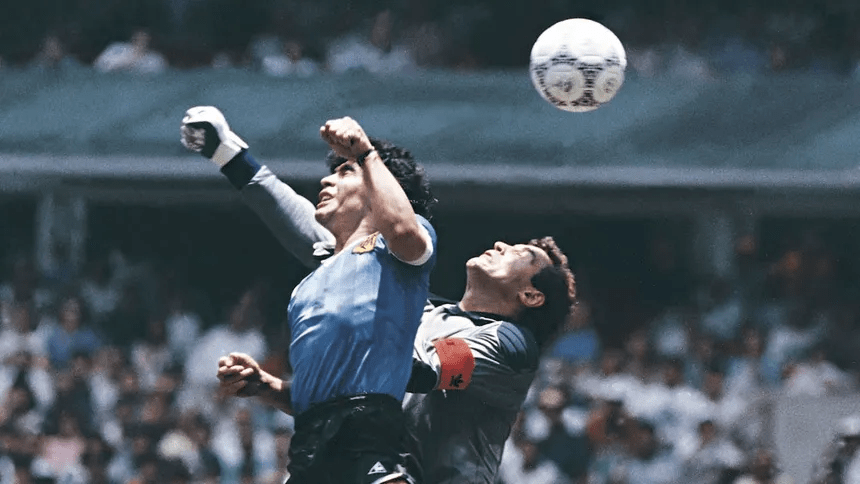
In the 51st minute, Maradona exchanged passes with teammate Jorge Valdano before the ball bounced awkwardly high into England’s penalty area. Goalkeeper Peter Shilton advanced confidently, expecting to collect it.
Standing at just 5ft 5in, Maradona had no realistic chance of beating the much taller Shilton in a fair aerial challenge.
Instead, he improvised.
As both players jumped, Maradona subtly punched the ball with his left hand over the goalkeeper and into the net. The referee failed to spot the infringement. The assistant referee missed it too.
The goal stood.
England’s players immediately protested, but their complaints were ignored. Argentina had taken a 1-0 lead.
After the match, Maradona famously described the goal as being scored “a little with the head of Maradona and a little with the hand of God.”
The phrase instantly entered football folklore.
To some fans, the Hand of God represented cheating. To others, it was clever opportunism. Regardless of where opinions fall, there is no denying its place among the most famous moments the sport has ever witnessed.
Four Minutes Later Came the Goal of the Century
Most footballers would spend an entire career being remembered for a moment like the Hand of God.
Maradona needed only four minutes before creating something even more remarkable.
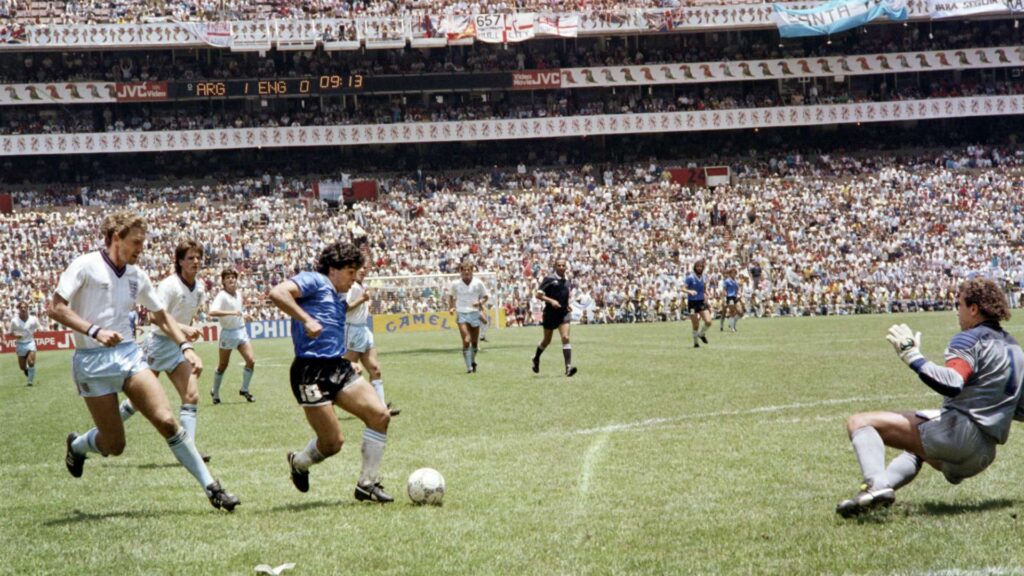
In the 55th minute, he received possession inside his own half. There appeared to be little danger for England at that stage. The defence was organised, and several players stood between Maradona and the goal.
What followed seemed almost impossible.
He accelerated away from Peter Beardsley before gliding past Peter Reid. The England midfielder desperately chased him but could not get close.
Maradona continued his run, weaving beyond Terry Butcher and Terry Fenwick with effortless balance and control. As he approached the penalty area, Peter Shilton rushed forward in an attempt to stop him.
It made no difference.
Maradona rounded the goalkeeper and calmly slotted the ball into the net after beating another desperate challenge from Butcher.
The entire run covered around 60 yards and lasted just over ten seconds.
The stadium erupted.
Commentator Victor Hugo Morales delivered the iconic words that would forever be associated with the goal:
“Cosmic kite! What planet did you come from?”
The goal of the century had been born.
Why the Goal of the Century Remains Unmatched
Football has seen countless spectacular goals since 1986, but few have ever matched the combination of difficulty, context, and significance of Maradona’s masterpiece.
What made the goal of the century so extraordinary was not simply the number of defenders beaten. It was the quality of those touches under immense pressure during a World Cup quarter-final.
Every England player knew exactly what Maradona was trying to do.
None of them could stop him.
The goal combined acceleration, close control, balance, composure, vision, and courage into one breathtaking sequence. It was football reduced to its purest form: one player, one ball, and a moment of genius.
Even many England supporters eventually admitted they had witnessed something special.
How Maradona Defined the Entire Tournament
The Hand of God and the goal of the century often dominate discussions about the 1986 World Cup, but Maradona’s influence extended far beyond that one match.
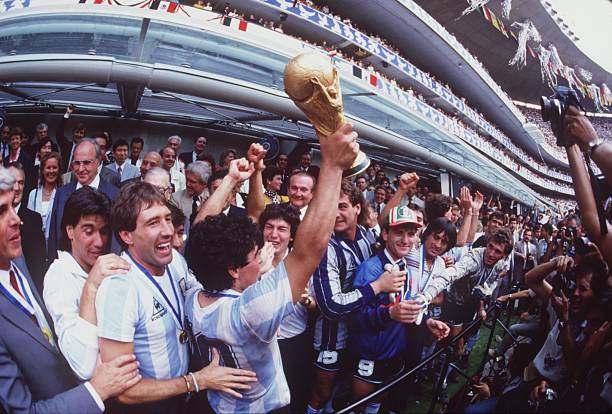
Throughout the tournament, he was the driving force behind Argentina’s success. He scored five goals and provided five assists, directly contributing to ten of Argentina’s fourteen goals.
After defeating England, Argentina overcame Belgium in the semi-finals, with Maradona scoring both goals in a 2-0 victory.
In the final, Argentina defeated West Germany 3-2 to lift the World Cup trophy.
Many football historians regard it as the greatest individual World Cup campaign ever produced by a player.
The Two Goals That Perfectly Captured Maradona
Perhaps the most fascinating aspect of the match is how perfectly the two goals reflected Maradona’s complex personality.
The Hand of God showcased his rebellious, controversial side. It was cunning, opportunistic, and morally questionable.
The goal of the century showcased his brilliance. It was pure artistry and footballing genius at its absolute peak.
One goal divided opinion.
The other united it.
Together, they created the most famous four-minute spell in football history.
Why the Hand of God Still Matters Today
Modern football now has VAR, multiple camera angles, and advanced technology designed to eliminate major officiating mistakes.
The Hand of God would be ruled out within seconds if it happened today.
Yet that is partly why the moment continues to fascinate people. It belongs to a different era of football, when human error played a much larger role in shaping the game’s biggest moments.
Meanwhile, the goal of the century remains timeless. Technology cannot diminish it. Tactical evolution cannot explain it away. It remains as breathtaking today as it was in 1986.
Maradona’s Four Minutes of Immortality
Many players have scored great goals. Many have been involved in controversy. Very few have managed to produce both in the same match.
Diego Maradona did it in four minutes.
The Hand of God gave football one of its most controversial moments. The goal of the century gave football one of its most beautiful.
Together, they transformed a World Cup quarter-final into a story that will be told for generations.
Nearly forty years later, fans still debate which moment was more significant. Some admire the audacity of the Hand of God. Others remain mesmerized by the brilliance of the goal of the century.
One thing is certain: no player has ever compressed so much controversy, genius, drama, and magic into four unforgettable minutes.
Hand of God or Goal of the Century, which Maradona moment hits harder?

1 comment
[…] discussions arise about the greatest captain in football, names such as Diego Maradona, Cafu, Paolo Maldini and Roy Keane often enter the conversation. Yet Beckenbauer’s […]