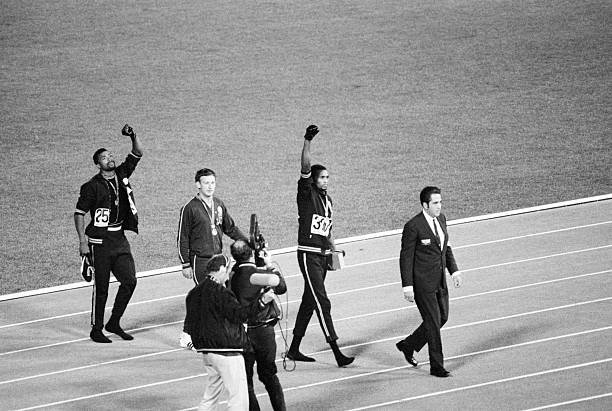
There are moments in sport when the result becomes less important than what happens after the final whistle. On 16 October 1968, at the Olympic Stadium in Mexico City, American sprinters Tommie Smith and John Carlos stepped onto the medal podium as Olympic champions and bronze medalists. Within minutes, they would become two of the most recognizable figures in sporting history, not simply for what they had achieved on the track, but for what they were prepared to sacrifice away from it.
As the American national anthem played at the1968 Olympic Medal Ceremony, Smith and Carlos lowered their heads and raised black-gloved fists into the air. They stood barefoot in black socks, wearing their medals and Olympic Project for Human Rights badges. It was a silent demonstration against racial discrimination, poverty and the treatment of Black people in the United States.
The image travelled around the world. But the response waiting for them was not celebration. Their protest brought suspension, expulsion from the Olympic Village, death threats and years of professional difficulties. What became an enduring symbol of resistance also came at a devastating personal cost.
The atmosphere behind the 1968 Olympic medal ceremony

To understand the significance of the protest, it is necessary to understand the world in which it happened. The 1960s were marked by civil rights struggles, racial violence and demands for equality in the United States. The assassinations of Malcolm X and Martin Luther King Jr had intensified the sense of urgency among those fighting racial injustice.
Black athletes were also questioning the conditions under which they competed. Many believed that their achievements were celebrated internationally while they continued to experience discrimination at home and within sporting institutions.
One organization seeking to challenge this situation was the Olympic Project for Human Rights (OPHR), led by sociologist Harry Edwards. It called attention to racial inequality in sport and society, including the lack of Black representation in coaching and administrative positions. The organization also opposed the participation of apartheid South Africa in the Olympics.
There had been discussions about boycotting the 1968 Games altogether, but Smith and Carlos ultimately decided to compete. They believed the Olympic platform could give their message an international audience.
Their decision was shaped by events beyond the sporting world. Just days before the opening ceremony, Mexican security forces violently suppressed a student protest at Tlatelolco’s Plaza of Three Cultures. The killings added to the atmosphere of political tension surrounding the Games and reinforced the wider struggle for human rights.
The race, the medals and the Black Power protest

On 16 October, Smith and Carlos competed in the men’s 200 meters final. Smith delivered a remarkable performance, winning gold in a world-record time of 19.83 seconds. Australia’s Peter Norman finished second in 20.06 seconds, while Carlos took bronze.
The three athletes then made their way to the podium. What followed transformed an ordinary medal presentation into one of the most consequential acts of protest in Olympic history.
Smith and Carlos wore black socks without shoes to draw attention to Black poverty. Carlos also wore a beaded necklace as a symbol of the victims of lynching. Each raised a black-gloved fist during the American national anthem, with Smith lifting his right hand and Carlos his left. They had originally intended to wear gloves on both hands, but Carlos had forgotten his pair. Norman suggested that they share Smith’s gloves.
The Australian silver medalist also wore an OPHR badge on his jacket, demonstrating his support for their cause. Although Norman did not raise a fist, his decision to stand alongside the Americans made him part of the protest.
The gesture was not an expression of hatred towards the United States, as Smith later explained. It was a demand that the country live up to the freedoms and equality it claimed to represent. Their bowed heads and raised fists communicated a message that words alone might not have carried to millions watching around the world.
The Black Power protest was therefore more than a dramatic sporting gesture. It was an attempt to use an international competition to draw attention to the experiences of people whose struggles were often ignored.
The punishment: Expulsion, death threats and broken careers

The reaction from Olympic authorities was swift. The International Olympic Committee, led by president Avery Brundage, objected to the demonstration, arguing that it violated the political neutrality expected at the Games.
Smith and Carlos were suspended from the United States Olympic team and expelled from the Olympic Village. They were sent home, despite having won two of the country’s medals in the competition. The IOC’s position was that allowing the demonstration to stand without punishment could encourage other athletes to use the Olympic platform for political statements.
Their return to the United States brought another wave of hostility. Rather than receiving the recognition that might normally accompany Olympic medal winners, they faced public criticism, racial abuse and death threats. Their families were also targeted.
The consequences extended into their professional and personal lives. Carlos struggled to find employment for years, while Smith’s military ambitions were affected. Both men experienced difficulties in their marriages, and their careers in athletics became increasingly difficult to sustain.
They did eventually find opportunities in professional American football. Smith played for the Cincinnati Bengals, while Carlos had spells with the Philadelphia Eagles and the Canadian Football League. However, their sporting careers could not erase the wider consequences of their decision to protest.
Peter Norman also experienced professional consequences in Australia. Despite finishing second in an Olympic final and setting a national record, he was not selected for the 1972 Munich Olympics. His support for the demonstration remained a source of controversy, and he later spoke about the isolation he experienced.
The three athletes had stood together on the podium, but the consequences followed them long after the cameras stopped recording.
From public hostility to an enduring legacy

Time gradually changed how the protest was remembered. In the years immediately following the 1968 Games, Smith and Carlos were frequently portrayed as troublemakers who had brought politics into sport. Decades later, their actions became recognized as an important moment in the history of athlete activism.
Both men eventually built careers as coaches and continued speaking about human rights. Their protest also became a reference point for later generations of athletes who used their public visibility to address social issues.
In 2005, San Jose State University, where Smith and Carlos had studied, unveiled a seven-meter statue commemorating the medal-podium demonstration. The monument recreated the iconic image, although the position representing Norman was left empty, allowing visitors to stand alongside the athletes.
In 2016, Smith and Carlos were recognized at the White House by President Barack Obama. Their appearance represented a remarkable change from the hostility they had encountered after returning from Mexico City nearly five decades earlier.
Their influence can also be seen in later sporting protests, including Colin Kaepernick’s decision to kneel during the United States national anthem before NFL games. Athletes such as LeBron James and Naomi Osaka have also used their platforms to speak about racial injustice and other social issues.
The story of the 1968 Olympic medal ceremony is not simply about two athletes raising their fists. It is about the difficult relationship between sport, politics and the responsibility athletes may feel towards the societies they represent.
Smith and Carlos knew their actions could carry consequences, but they believed the message was worth delivering. Their medals recognised what they had achieved as sprinters. Their protest ensured that history would remember what they stood for.
More than half a century later, the image remains powerful. The two raised fists that once provoked outrage have become symbols of courage, solidarity and the demand for equality. The price was heavy, but their legacy outlasted the punishment.
