In today’s Major League Baseball, the difference between good MLB pitchers and dominant ones often comes down to a number that fans rarely see on the scoreboard. Spin rate has quietly become one of the most important tools in pitching analytics, shaping how MLB pitchers approach every pitch they throw.
While traditional metrics like velocity and ERA still matter, spin rate has redefined how pitching effectiveness is measured. It influences movement, deception, and ultimately, a pitcher’s ability to overpower hitters.
What Spin Rate Means for MLB Pitchers

Spin rate refers to how fast a baseball rotates as it travels toward the plate, measured in revolutions per minute. For MLB pitchers, this number is not just a statistic. It directly affects how a pitch behaves in the air.
A fastball with high spin tends to resist gravity longer, creating the illusion that it is “rising.” In reality, it is simply dropping less than expected, which can cause hitters to swing underneath the ball.
On the other hand, breaking pitches like sliders and curveballs rely on spin to generate sharp movement. The direction and efficiency of that spin determine how dramatically the ball will break.
For MLB pitchers, mastering spin rate is about controlling physics to create deception.
Why High Spin Rate Fastballs Are So Effective
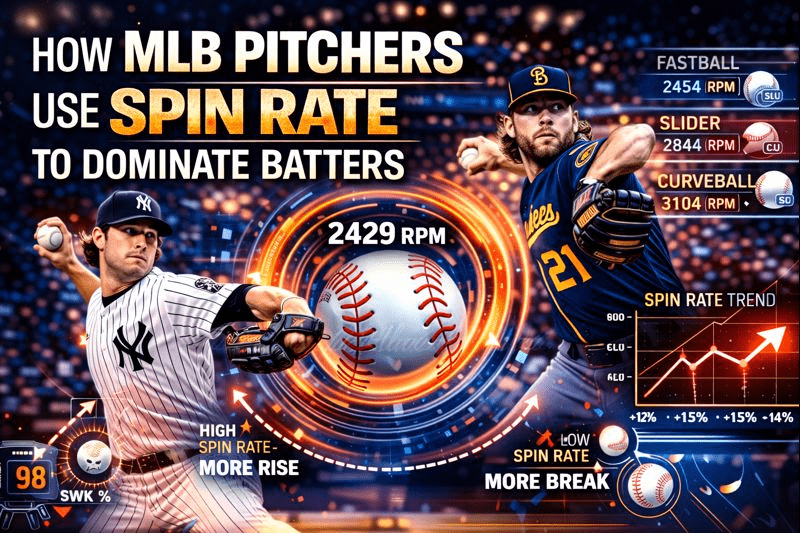
One of the biggest advantages for MLB pitchers with high spin rate fastballs is the ability to miss bats at the top of the strike zone. Hitters are trained to track the natural drop of a pitch, but high-spin fastballs disrupt that expectation.
Pitchers like Gerrit Cole have built elite arsenals around this concept. By combining velocity with high spin, they create pitches that appear faster and more difficult to square up.
This has led to a shift in pitching strategy. Instead of aiming low in the zone, many MLB pitchers now attack hitters up in the zone, using spin to generate swings and misses.
The result is a modern pitching style that prioritises strikeouts and weak contact over traditional ground-ball approaches.
Breaking Balls and Spin Efficiency
Spin rate is even more critical for breaking pitches. However, it is not just about how fast the ball spins. It is also about how efficiently that spin is used.
A curveball with high spin efficiency will have a tight, downward break, making it extremely difficult for hitters to track. Similarly, a slider with the right spin characteristics can move sharply across the plate, forcing hitters into poor contact.
Pitchers like Trevor Bauer have famously emphasized the importance of understanding spin in pitch development. By analyzing data, pitchers can refine their grips and release points to maximize movement.
For MLB pitchers, this level of precision turns average pitches into elite weapons.
The Role of Technology in Spin Rate Development

The rise of spin rate in baseball is closely tied to advancements in technology. High-speed cameras, tracking systems, and data analytics tools now allow MLB pitchers to measure and adjust their pitches with incredible accuracy.
Systems like Statcast provide real-time feedback on spin rate, velocity, and movement. This allows pitchers and coaches to make immediate adjustments during training sessions.
As a result, pitching has become more scientific. MLB pitchers are no longer relying solely on feel. They are using data to optimise every aspect of their performance.
This technological edge has accelerated the evolution of pitching across the league.
How Hitters Are Adjusting to Spin Rate
As MLB pitchers have embraced spin rate, hitters have been forced to adapt. High-spin fastballs and sharp breaking pitches have made it harder to maintain consistent contact.
Hitters now focus more on pitch recognition and timing. Training methods have evolved to help batters identify spin early, giving them a better chance to react.
Despite these adjustments, the advantage still often lies with the pitcher. The ability to vary spin rate and pitch movement keeps hitters guessing, maintaining the upper hand for MLB pitchers.
The Sticky Stuff Controversy Among MLB Pitchers
Spin rate became a major talking point in baseball due to the use of foreign substances, often referred to as “sticky stuff.” These substances allowed MLB pitchers to increase grip and generate higher spin rates.
The league responded by cracking down on illegal substances, leading to noticeable drops in spin rates for some pitchers. This enforcement highlighted just how significant spin rate had become in modern pitching.
While the controversy raised questions about fairness, it also reinforced the importance of spin rate as a competitive advantage.
Today, MLB pitchers must rely on legal methods, such as grip techniques and training, to maximise their spin.
Training Methods for Improving Spin Rate
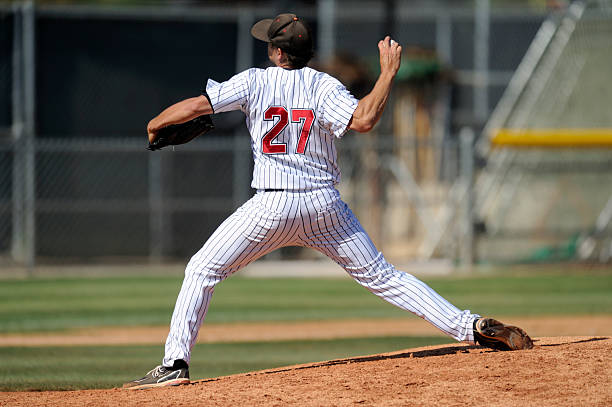
Improving spin rate is not just about natural ability. MLB pitchers use a variety of training methods to enhance their performance.
Strength training plays a key role, particularly in developing forearm and wrist strength. These muscles are essential for generating spin at release.
Pitch design sessions are another important tool. During these sessions, pitchers experiment with different grips and arm angles to find the most effective combinations.
Biomechanics also plays a role. By analysing their delivery, pitchers can identify inefficiencies and make adjustments to improve spin and control.
For MLB pitchers, development is a continuous process driven by both data and experimentation.
Why Spin Rate Defines Modern Pitching
Spin rate has become a defining feature of modern pitching because it directly impacts results. It influences strikeouts, weak contact, and overall effectiveness on the mound.
In an era where analytics drive decision-making, teams prioritise pitchers who can generate high spin rates and optimise pitch movement.
This has changed how pitchers are evaluated and developed. Scouts and coaches now look beyond traditional metrics, focusing on underlying data that predicts success.
For MLB pitchers, mastering spin rate is no longer optional. It is essential.
The Future of MLB Pitching
As technology continues to evolve, the role of spin rate in pitching is likely to grow even further. New tools and data models will provide deeper insights into how pitches behave and how they can be improved.
At the same time, the league may introduce additional regulations to maintain competitive balance. The challenge will be finding a balance between innovation and fairness.
What is certain is that spin rate will remain at the heart of pitching strategy. MLB pitchers will continue to refine their craft, using every available tool to gain an edge.
Conclusion
The rise of spin rate has transformed pitching in Major League Baseball. It has shifted the focus from raw power to precision, from instinct to data-driven strategy.
For MLB pitchers, spin rate is more than a statistic. It is a weapon that can define careers and change games.
As the sport continues to evolve, those who master spin rate will remain at the forefront, dominating hitters and shaping the future of baseball.
