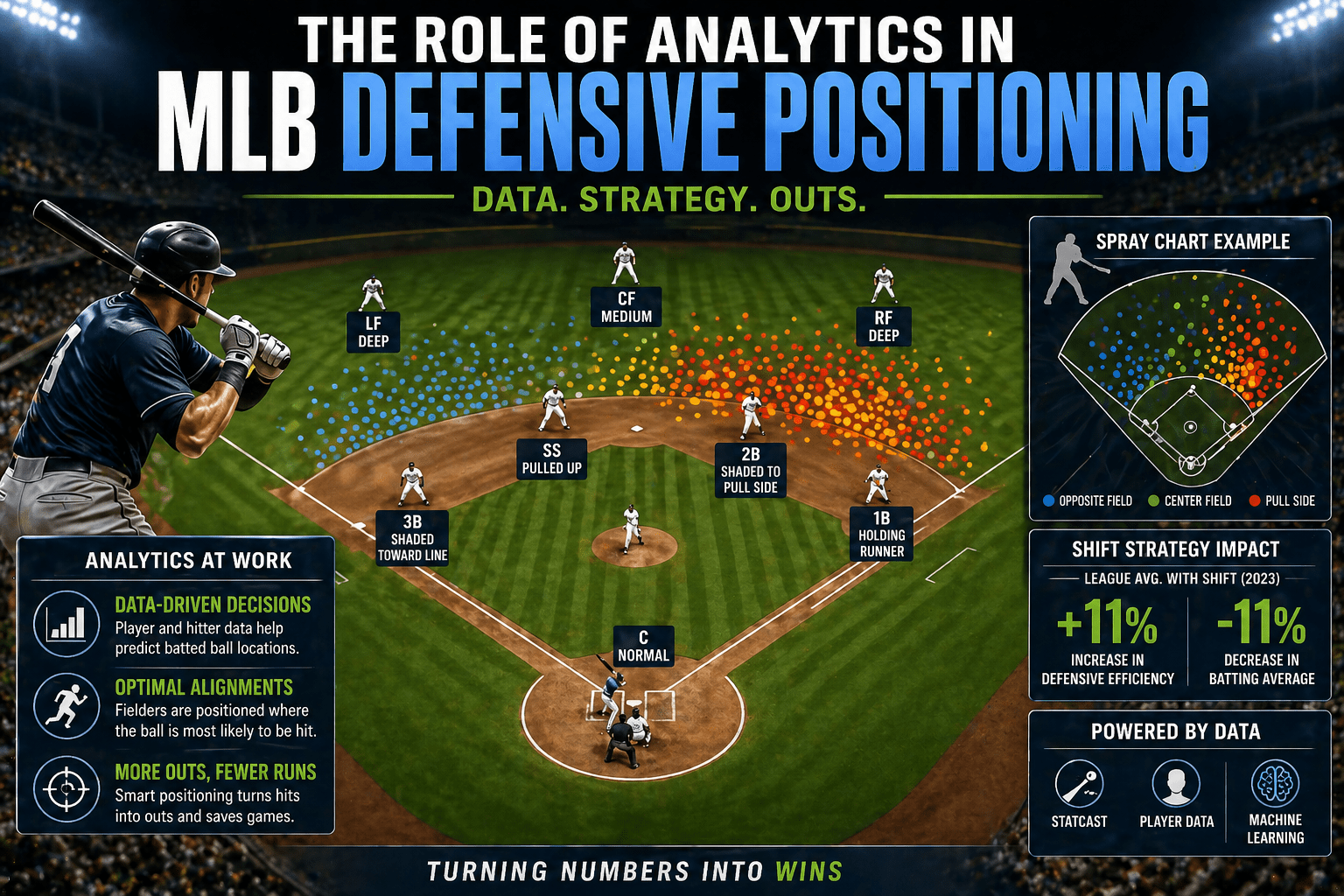
MLB defensive positioning has evolved from instinct and experience into one of the most data-intensive aspects of modern baseball. What was once guided by a coach’s eye is now powered by advanced analytics, real-time data tracking, and predictive modeling. The rise of analytics has fundamentally changed how teams position their defenders, turning every pitch into a calculated strategic decision.
At the heart of this transformation is the concept of MLB defensive positioning. Teams no longer rely solely on traditional alignments. Instead, they use data to anticipate where a ball is most likely to be hit, adjusting player positions accordingly to maximize outs and minimize scoring opportunities.
The Birth of MLB Defensive Shifts
The defensive shift is perhaps the most visible result of analytics in baseball. Initially used sparingly against extreme pull hitters, shifts have become a standard tool across the league. By analyzing a hitter’s tendencies, teams can reposition infielders and outfielders to areas where the ball is statistically most likely to land.
This approach is rooted in data collected over thousands of at-bats. Spray charts, which map where hitters typically send the ball, allow teams to identify patterns with remarkable accuracy. If a left-handed batter consistently pulls ground balls to the right side, teams will stack that side of the field, often leaving the opposite side nearly empty.
The result is a dramatic increase in defensive efficiency. Balls that once slipped through gaps are now routine outs because defenders are already in position.
Statcast Technology and the Data Revolution
The introduction of Statcast technology marked a turning point in MLB defensive positioning. Statcast tracks every movement on the field, including player speed, reaction time, and ball trajectory. This wealth of data enables teams to make more precise decisions about positioning.
Instead of relying on general tendencies, teams can now analyze reaction time of fielders, sprint speed and range, launch angle and exit velocity of batted balls, and historical matchup data between pitcher and hitter.
This level of detail allows for hyper-specific positioning. For example, a team might shift slightly differently depending on the pitcher on the mound, the count, or even the weather conditions.
The Role of Predictive Modeling
Modern MLB defensive positioning goes beyond historical data. Teams now use predictive models to anticipate future outcomes. These models incorporate machine learning algorithms that analyze patterns and generate probabilities for where the ball will be hit.
This means MLB defensive positioning is no longer reactive. It is proactive.
For instance, if a hitter tends to adjust their approach with two strikes, the model will account for that. Fielders may shift back to a more balanced alignment, anticipating a defensive swing rather than a power hit.
Predictive modeling also helps teams adapt in real time. Coaches receive data-driven insights during games, allowing them to tweak positioning based on evolving conditions.
Impact on Infield Defense

Infield positioning has seen the most dramatic changes due to analytics. Traditional roles, such as shortstop and second baseman, have become more fluid. Players are now expected to cover unconventional areas depending on the situation.
This flexibility has led to the rise of versatile defenders who can adapt quickly. Teams prioritize players with strong instincts, quick reactions, and the ability to execute plays from unusual positions.
However, the heavy use of shifts has also sparked debate. Critics argue that it reduces offensive excitement by turning hard-hit balls into outs. This concern led to recent rule changes limiting extreme infield shifts, forcing teams to find new ways to optimize positioning within the rules.
Outfield Positioning and Depth Control
While infield shifts get most of the attention, analytics have also transformed outfield positioning. Outfielders now adjust their depth and lateral positioning based on detailed data.
For example, if a hitter frequently produces high exit velocity line drives, outfielders may play deeper to prevent extra-base hits. Conversely, against hitters who favor soft contact, outfielders may move in to cut off singles.
Positioning is also influenced by the pitcher’s style. Ground-ball pitchers allow outfielders to play shallower, while fly-ball pitchers require deeper coverage.
This level of coordination ensures that the entire defense operates as a cohesive unit, maximizing coverage across the field.
Communication and Execution
Data alone is not enough. Effective MLB defensive positioning requires seamless communication between players, coaches, and analysts.
Before each game, teams review scouting reports and positioning strategies. During the game, signals from the dugout or catcher may indicate adjustments. Players must quickly interpret this information and execute it flawlessly.
This integration of analytics and on-field execution is what makes modern defensive systems so effective. It is not just about knowing where to stand, but understanding why.
The Balance Between Data and Instinct in Baseball Analytics

Despite the dominance of analytics, player instinct still plays a crucial role. Baseball is unpredictable, and no model can account for every variable.
Elite defenders combine data-driven defensive positioning with natural instincts. They read the game in real time, adjusting their movements based on subtle cues such as a hitter’s stance or swing path.
The best teams strike a balance between analytics and intuition. They use data as a guide, not a rigid rulebook.
Rule Changes and the Future of MLB Defensive Positioning
Recent MLB rule changes have placed limits on defensive shifts, requiring teams to rethink their strategies. Infielders must now stay within certain boundaries, reducing the effectiveness of extreme alignments.
This has led to a new phase in MLB defensive positioning. Teams are focusing more on:
- Pre-pitch positioning within legal limits
- Improved player range and athleticism
- Advanced scouting and situational awareness
Analytics remain central, but the approach is evolving. Instead of relying on extreme shifts, teams are refining their positioning to gain smaller, more consistent advantages.
Why MLB Defensive Positioning Matters
MLB defensive positioning is not just a tactical detail. It is a critical factor in team success. A well-positioned defense can save runs, support pitchers, and shift the momentum of a game.
In an era where margins are razor-thin, even a slight improvement in positioning can make a significant difference over a full season.
Teams that excel in defensive analytics often outperform expectations, proving that smart positioning is just as important as offensive power.
MLB Defensive Analytics
The role of analytics in MLB defensive positioning has reshaped the game. From the rise of defensive shifts to the integration of Statcast data and predictive modeling, teams now approach defense with a level of precision that was unimaginable a decade ago.
As the game continues to evolve, MLB defensive positioning will remain at the forefront of innovation. The balance between data, skill, and instinct will define the next generation of defensive excellence.
In modern baseball, where every inch of the field matters, positioning is no longer just strategy. It is science.
