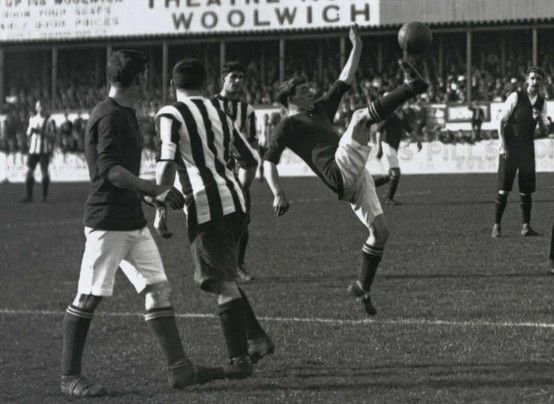
Today, nobody thinks twice about the color of a football. Whether it is rolling across a Premier League pitch, flying towards the goal in a Champions League final or being kicked around by children in a local park, the familiar white ball has become one of the most recognizable symbols of the beautiful game.
But there was a time when football authorities, players and even manufacturers wanted nothing to do with it.
In 1927, an attempt to introduce a white football to English football was met with widespread criticism. Players complained that it was difficult to control, referees questioned its visibility and one manufacturer reportedly considered producing it practically impossible. What seemed like a simple improvement was dismissed as an unnecessary experiment.
Yet, almost 25 years later, the Football League finally approved the use of the white football. The innovation would eventually transform how football was watched, particularly during evening matches and the early years of televised football.
The history of the white football is a fascinating reminder that some of the most familiar features of modern sport were once considered terrible ideas.
Before the White Football: A Game Played With Brown Leather

For much of football’s early history, the ball was made from an inflated rubber bladder enclosed within a stitched leather casing. The outer leather was naturally brown, giving the traditional football its familiar appearance.
These balls were far removed from the lightweight, technologically advanced products used today.
They were often difficult to control, particularly when wet. Leather absorbed water, causing the ball to become heavier during rainy matches. A ball that had been manageable at the beginning of a game could become significantly more difficult to kick and head as the match progressed.
Visibility was another problem.
During winter afternoons, football matches in England were frequently played under grey skies, fading daylight and poor weather conditions. The brown ball could become difficult for spectators to follow, particularly when it travelled through the air against the background of dark stands or gloomy skies.
The problem became even more noticeable during evening matches.
Interestingly, the idea of changing the ball’s color was not entirely new. White-painted footballs had appeared in sporting experiments dating back to the late nineteenth century, while clubs in other countries had occasionally used them when lighting conditions made traditional balls difficult to see.
In 1925, for example, Derby County encountered a white ball during a pre-season visit to the Netherlands to play Ajax. When darkness made the traditional ball difficult to follow, a white replacement was introduced. The English players reportedly rejected it, dismissing it as a lump of whitewash.
The idea, however, was not going away.
How the White Football Was Introduced in 1927
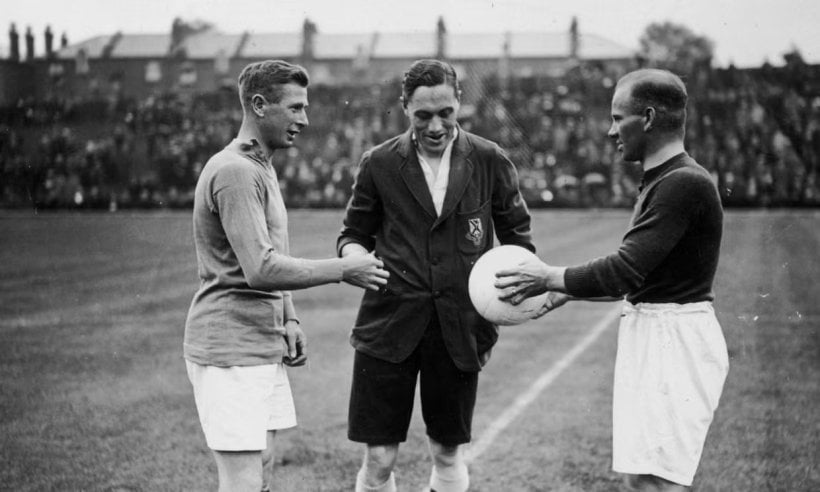
The person who helped bring the proposal back into the English football conversation was not a famous manager, professional footballer or manufacturer. He was E. L. Roberts, a reader from Kingsland, Shrewsbury.
In July 1927, Roberts wrote to the Athletic News, a sporting newspaper, arguing that football should consider replacing the traditional brown ball with a white alternative.
His argument was straightforward. A white ball would be easier to see, particularly for spectators watching from the stands. He also believed that its movement would make the game more exciting to follow.
The letter attracted the attention of Ivan Sharpe, the newspaper’s editor and a former footballer who had represented Britain at the 1912 Olympic Games.
Sharpe was sufficiently impressed to publish Roberts’ suggestion alongside an editorial supporting further consideration of the idea.
The proposal soon attracted the attention of several football managers, including Herbert Chapman, who was then managing Arsenal.
Chapman was known for his willingness to explore new ideas about football. He was interested in improving the spectator experience and was already associated with other innovations that would eventually influence the modern game.
He supported testing the new ball during pre-season matches, and several clubs agreed to experiment with it.
On 13 August 1927, Arsenal organized a trial involving their first and second teams at Highbury. The players tested two different versions of the white ball: one with a shiny enamel finish and another with a matt surface.
From the stands, the experiment appeared promising. The white ball stood out against the darker background of the spectators, making it considerably easier to follow when it travelled across the pitch.
However, the players were not nearly as enthusiastic.
Arsenal captain Billy Blyth complained that the enameled ball was difficult to control, describing how it seemed to slip off players’ boots at unpredictable angles. Although it was visible on the ground, following its movement through the air was another matter.
The referee, W. T. Guttridge, also experienced difficulties. On one occasion, he reportedly lost sight of the ball when it passed against the white crossbar.
Other clubs were equally unimpressed. At Reading, the referee believed the ball could disadvantage goalkeepers on bright days. At Huddersfield, the white paint quickly wore away during the match, while players at Blackpool expressed their dislike of the innovation.
The experiment was turning into a disappointment.
Why Football Manufacturers and Players Rejected the Idea

The reaction to the early trials was revealing. For supporters of the proposal, visibility was the biggest advantage. For the players, however, the practical difficulties of using the ball outweighed its potential benefits.
The shiny finish made controlling the ball difficult, while its appearance against certain backgrounds created new visibility problems.
There were also concerns about whether the ball would remain white after repeated use. Football was a physical game, and a ball had to withstand constant contact with boots, the ground and the occasional collision with advertising boards and other objects around the pitch.
Manufacturers were not convinced either.
One football manufacturer reportedly declared that producing a white football was practically impossible. The difficulty was not simply changing the color of the leather. The finish needed to survive the demands of a football match without affecting the ball’s performance.
The rejection was almost immediate. Herbert Chapman himself refused to continue with the experiment, explaining that the trial had not been successful enough to justify abandoning tradition.
The Burnley News went further, suggesting that the proposal had originated from a craze for novelty and that the experiment had demonstrated its futility. For a time, it appeared that the white football had been permanently rejected.
But the problem it was designed to solve remained.
The Comeback: How the White Football Finally Won Acceptance
The late 1940s brought renewed interest in making football easier to follow under different playing conditions. Television was becoming increasingly important to the sport, and the visibility of the ball was becoming a more pressing concern.
One particularly important moment came during a televised international between England and Italy at White Hart Lane in 1949.
As daylight faded, the traditional brown football became increasingly difficult to follow against the stadium background. FIFA president Sir Stanley Rous, who was present, insisted that a white ball should be introduced.
The experiment attracted a positive response from television audiences, and football authorities began considering alternative colours more seriously.
Further trials followed. In February 1950, England B played Switzerland B at Hillsborough, using a yellow ball in the first half and an orange one in the second.
These experiments demonstrated that color could make a meaningful difference to visibility. However, the real breakthrough came in 1951.
The Football League officially permitted the use of white footballs, particularly for matches played under floodlights.
There was also an important manufacturing development. Improvements in the treatment and finishing of leather made it possible to produce a white ball that could withstand the physical demands of professional football.
A layer of white paint gave the ball its color, while a protective cellulose coating helped preserve the finish and provided additional resistance to water.
This was particularly significant because traditional leather footballs could absorb considerable amounts of water during wet matches. The improved coating reduced that problem, helping the ball retain its weight and playing characteristics.
The white football was no longer simply an experiment. It had become a practical alternative. Its introduction was initially gradual, with some matches beginning with traditional brown balls before white alternatives were introduced as daylight faded.
But attitudes were changing. By 1953, the Football Association was recommending that white balls should be used from the beginning of matches rather than introduced midway through them, although the final decision remained with the referee.
The innovation that had been dismissed in 1927 was finally becoming part of football’s mainstream identity.
The 1958 World Cup and the White Football’s Global Breakthrough

If the 1951 approval helped establish the white ball in English football, the 1958 FIFA World Cup helped introduce it to a much wider international audience.
Held in Sweden, the tournament was the first FIFA World Cup to use a white ball. This was an important moment in the history of the white football because the World Cup provided a global platform for showcasing football’s changing equipment and presentation.
The tournament also produced one of the most memorable finals in the competition’s history.
Brazil defeated hosts Sweden 5-2, with a 17-year-old Pelé announcing himself to the world through a remarkable performance. The images of Brazil’s triumph, featuring the white ball moving across the pitch, became part of football’s growing visual history.
However, the story of the ball did not end with its adoption. In 1970, Adidas introduced the Telstar, a football featuring 20 white hexagonal panels and 12 black pentagonal panels.
The design was developed with television viewing in mind. Its contrasting black-and-white pattern made the ball easier to distinguish on television screens, particularly when broadcasts were still largely in black and white.
The Telstar became one of the most recognisable football designs ever produced and helped establish the familiar image of a football that generations of supporters would grow up recognising.
It was a further development of the visibility principle that had inspired the original white-ball proposal decades earlier.
From a Rejected Experiment to a Footballing Icon
Today, football manufacturers compete to produce balls with increasingly sophisticated materials, aerodynamic designs and visual patterns.
Modern match balls are engineered to meet strict performance requirements, with extensive testing carried out to assess their weight, shape, water resistance and flight characteristics.
The traditional leather ball has largely disappeared from professional football, replaced by synthetic materials and advanced manufacturing techniques.
Yet the principle behind the white football remains relevant. Visibility is still an important consideration when designing match balls, particularly for televised competitions and games played under artificial lighting.
The white football was not the first attempt to improve how the game was played or watched, and its adoption was not immediate. It took decades of experimentation, criticism and improvements in manufacturing before it became widely accepted.
Its history also reveals something interesting about football itself. The game has never stopped changing. Innovations that supporters now take for granted, from shirt numbers to floodlights, colored balls and goal-line technology, have all faced resistance at different points in history.
In 1927, a white football was considered an unnecessary novelty. By 1951, it had earned official approval in the English Football League. By 1958, it had reached the World Cup.
What began as a suggestion from an ordinary newspaper reader eventually helped reshape one of the most recognisable objects in world sport.
And the next time a white football rolls across a pitch, it is worth remembering that its place in the beautiful game was once anything but guaranteed.
