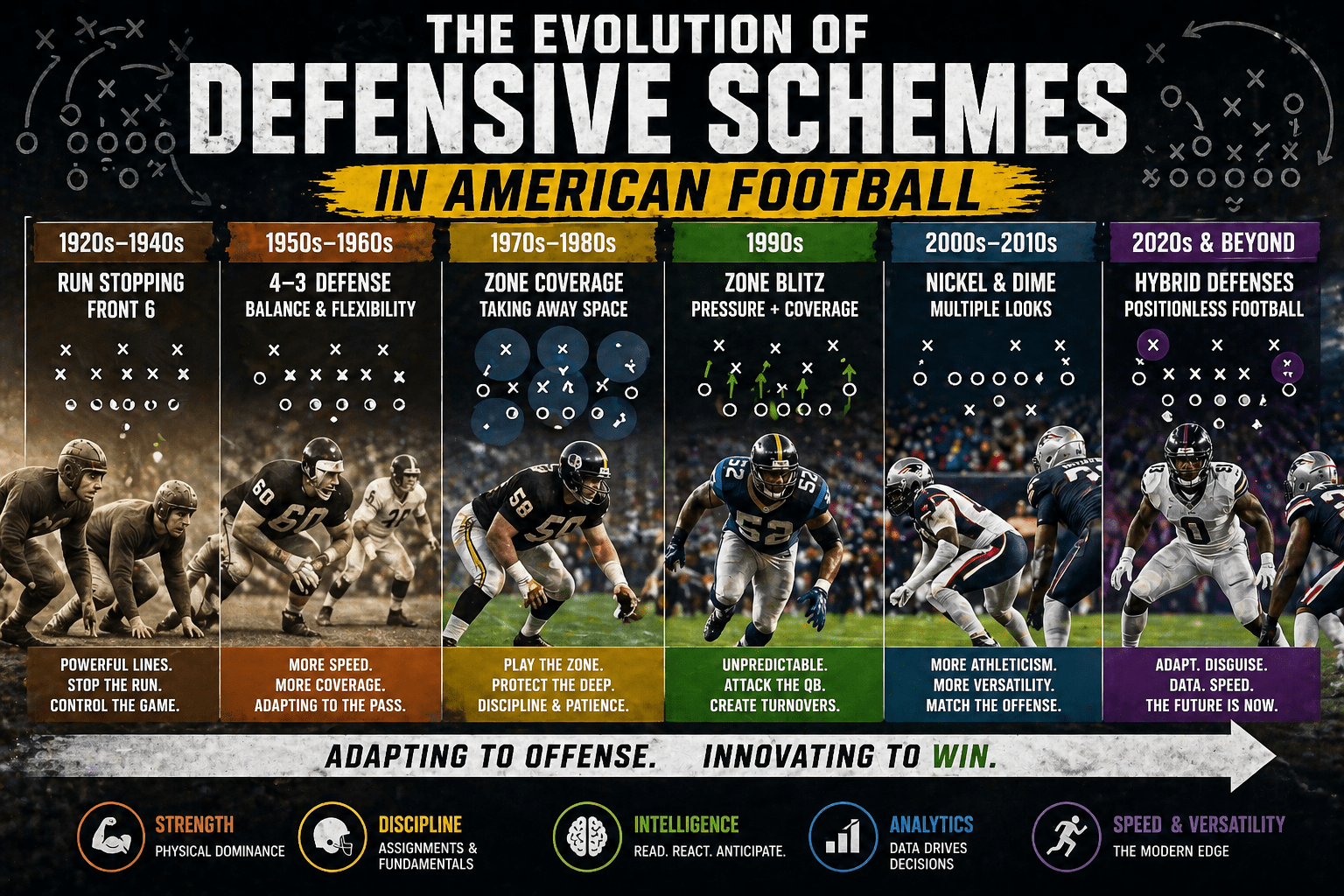
Defensive football has never stood still. From the rugged, run-heavy days of early gridiron battles to today’s high-speed, pass-driven spectacle in the National Football League, defensive schemes in American football have constantly evolved to meet new offensive challenges. Every innovation on offense has forced a counterpunch on defense, creating a tactical arms race that continues to shape how the game is played.
Understanding the evolution of defensive schemes in American football reveals not just how defenses work, but why they look the way they do today.
Early Foundations: Stopping the Run First
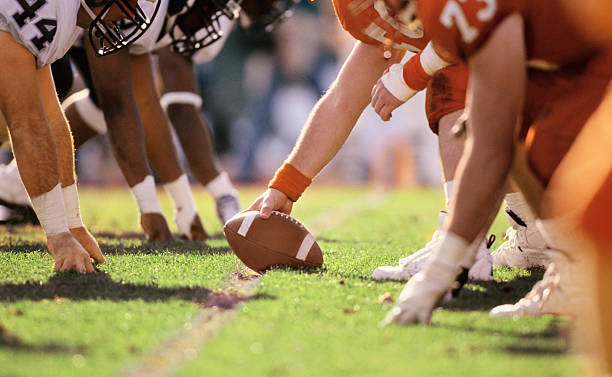
In the early decades of American football, offenses were built almost entirely around the running game. Naturally, defensive schemes focused on stacking the line of scrimmage and physically overwhelming blockers.
The most common formations were simple and aggressive. Teams relied on variations of the 6-2 or 5-3 defense, loading up defenders near the line to plug gaps and stop ball carriers before they could gain momentum. Speed was secondary to strength and positioning.
At this stage, defensive thinking was straightforward. Win at the point of attack, dominate physically, and force offenses into mistakes. There was little need for complex coverage systems because passing was not yet a consistent threat.
Defensive Schemes in American Football: The Rise of the Passing Game
As quarterbacks began to throw more frequently and effectively, defensive schemes in American football had to adapt. The introduction of more sophisticated passing concepts forced defenses to reconsider their structure.
This shift gave rise to formations like the 4-3 defense, which balanced run support with improved pass coverage. By using four defensive linemen and three linebackers, teams could still defend the run while adding more flexibility behind the line.
Zone coverage concepts also began to emerge. Instead of each defender marking a specific receiver, players were assigned areas of the field to protect. This made it harder for offenses to exploit mismatches and created a more cohesive defensive unit.
The game was no longer just about stopping the run. It became about controlling space.
Modern Defensive Schemes in Football: The Birth of Modern Coverage Systems
As offenses grew more creative, defenses responded with structured coverage systems that are still foundational today. Concepts like Cover 2 defense and Cover 3 defense became central to defensive strategy.
Cover 2 divided the deep field between two safeties, allowing cornerbacks to focus on shorter routes. This limited big plays while keeping everything in front of the defense. Cover 3, on the other hand, used a single high safety with two cornerbacks covering deep thirds, providing a balance between run support and deep protection.
These systems introduced a level of discipline and coordination that had not existed before. Defenders had to read the quarterback, anticipate routes, and react in unison.
Defensive football became more cerebral. It was no longer just about strength and speed, but also awareness and decision-making.
The Impact of the West Coast Offense
The emergence of the West Coast offense in the 1980s changed everything. Built on quick, short passes and precise timing, this system neutralized aggressive pass rushes and exposed gaps in traditional zone defenses.
Defenses had to adapt quickly. Linebackers became more versatile, required to cover tight ends and running backs in space. Nickel and dime packages, which added extra defensive backs, became more common.
This era also emphasized the importance of disguise. Defenses began to show one coverage before the snap and switch to another after the ball was snapped, confusing quarterbacks and disrupting timing.
Flexibility became essential. Static defenses were easily exploited, while adaptable units could survive.
The Zone Blitz Revolution
One of the most significant innovations in defensive schemes in American football came with the introduction of the zone blitz. Popularized in the 1990s, this strategy combined aggressive pass rushing with zone coverage behind it.
Traditionally, blitzing meant sending extra defenders to pressure the quarterback, leaving the secondary exposed in man coverage. The zone blitz flipped this idea. Defenses could send unexpected rushers while dropping linemen into coverage, creating confusion and forcing mistakes.
Quarterbacks struggled to identify where pressure was coming from and which defenders were covering passing lanes. This unpredictability made the zone blitz a powerful weapon.
It also marked a turning point. Defense was no longer reactive. It became proactive, dictating terms to the offense.
NFL Defensive Formations: Hybrid Defenses and Positionless Football
As offenses continued to evolve, particularly with the rise of mobile quarterbacks and spread formations, defensive schemes in American football entered a new phase.
Modern defenses are increasingly hybrid. The traditional labels of linebacker, safety, and cornerback are becoming less rigid. Players are expected to perform multiple roles depending on the situation.
Edge defenders might drop into coverage. Safeties might play near the line like linebackers. Linebackers must cover receivers one play and stop the run the next.
This shift reflects the complexity of modern offenses. Spread systems force defenses to cover the entire width of the field, while dual-threat quarterbacks add another layer of unpredictability.
To survive, defensive schemes in American football must evolve such that defenses must be just as versatile.
The Influence of Analytics
Analytics has also played a major role in shaping defensive schemes in American football. Data now informs decisions about formations, coverage tendencies, and situational strategies.
Teams analyze opponent tendencies to predict play calls and adjust accordingly. They study route combinations, quarterback preferences, and even subtle patterns in formation alignment.
This information allows defenses to position themselves more effectively before the snap. It also influences in-game adjustments, helping coordinators make smarter decisions under pressure.
The result is a more calculated and efficient defensive approach, where every movement is backed by data.
Countering the Modern Passing Explosion
Today’s game is dominated by high-powered passing attacks. Rule changes have favored offenses, making it harder for defenders to make contact and easier for quarterbacks to exploit mismatches.
In response, defensive schemes in American football have become more focused on limiting explosive plays. The priority is no longer just stopping drives, but preventing big gains.
Two-high safety looks have become more common, keeping both safeties deep to protect against long passes. Defenses are willing to concede short gains in exchange for avoiding touchdowns.
This “bend but don’t break” philosophy reflects the realities of modern football. Offenses will move the ball, but defenses aim to control how they do it.
The Role of Coaching Innovation
Behind every evolution in defensive schemes is a wave of coaching innovation. Defensive coordinators constantly study trends, experiment with new ideas, and adapt to changing conditions.
Coaches are now blending concepts from college football, where spread offenses originated, with traditional pro-style defenses. This cross-pollination has accelerated tactical development.
Communication has also become more sophisticated. Players must quickly interpret signals, adjust alignments, and execute complex assignments in real time.
The margin for error is smaller than ever. Success depends on preparation, discipline, and the ability to adapt instantly.
The Future of American Football Defensive Schemes
Looking ahead, the evolution of defensive schemes in American football shows no signs of slowing down. Offenses will continue to innovate, and defenses will respond with new strategies.
Artificial intelligence and advanced tracking data could further transform how defenses prepare and perform. Real-time analytics may soon influence play-calling during games, providing instant insights into offensive tendencies.
Player development will also play a crucial role. The next generation of defenders will need to be faster, smarter, and more versatile than ever before.
One thing is certain. Defense will always be about solving problems. As offenses create new challenges, defenses will find new answers.
Evolution of Football Defenses
The evolution of defensive schemes in American football is a story of constant adaptation. From run-heavy formations to complex hybrid systems, defenses have transformed to keep pace with an ever-changing game.
What began as a battle of strength has become a contest of intelligence, strategy, and precision. Today’s defenses are not just reacting to offenses. They are anticipating, adjusting, and competing on equal footing.
The evolution of defensive schemes in American football and the defensive innovation remains one of the most fascinating aspects of the sport. And as the game continues to evolve, so too will the schemes designed to stop it.
