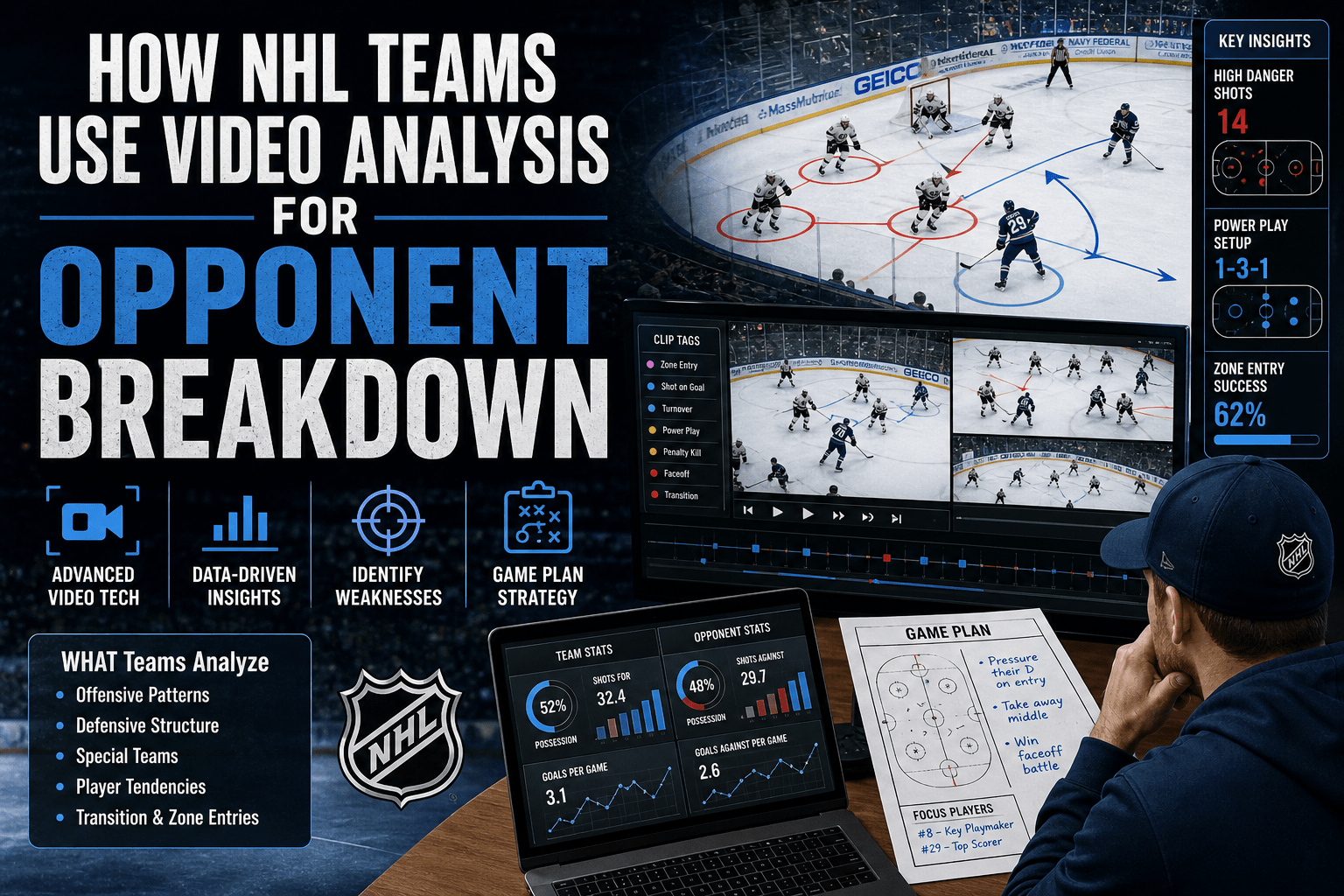
In today’s National Hockey League, preparation goes far beyond practice drills and physical conditioning. The modern game is driven by information, and one of the most powerful tools teams rely on is video analysis. At the center of this process is opponent breakdown, a systematic approach to studying rivals through film to gain tactical advantages.
Video technology has transformed how teams prepare for games, turning hours of footage into actionable insights. From identifying scoring patterns to exposing defensive weaknesses, NHL teams now approach each matchup with a level of detail that was unimaginable just a decade ago.
The Evolution of Opponent Breakdown in the NHL
Opponent breakdown was once a manual process. Coaches and analysts would review game tapes, often relying on memory and handwritten notes to track tendencies. The process was time-consuming and limited in scope.
Today, advanced video platforms allow teams to tag, sort, and analyze specific sequences within seconds. Every shift, shot, pass, and defensive rotation can be isolated and studied. This shift has elevated opponent breakdown from a basic review process to a core strategic function within every NHL organization.
The speed of the modern game makes this evolution necessary. Teams no longer have the luxury of reacting during games. They must anticipate, and video analysis provides the foundation for that anticipation.
How Video Analysis Shapes Opponent Breakdown
At its core, opponent breakdown involves identifying patterns. NHL teams use video analysis to understand how opponents behave in different situations.
One key area is offensive structure. Analysts study how opposing teams enter the zone, whether they prefer controlled entries or dump-and-chase tactics. They also examine puck movement in the offensive zone, identifying which players drive play and where scoring chances typically originate.
Defensively, video analysis reveals gaps. Teams look for breakdowns in coverage, slow transitions, or tendencies to overcommit. These insights allow coaches to design strategies that exploit weaknesses.
Special teams play is another major focus. Power plays and penalty kills are heavily studied through video. Analysts identify formations, passing lanes, and shooting preferences, helping teams prepare specific countermeasures.
The Role of Technology in Modern Video Analysis
Technology is the engine behind effective opponent breakdown. NHL teams use specialized software that integrates video with data analytics.
These systems allow analysts to tag clips based on specific events such as zone entries, turnovers, or scoring chances. Once tagged, clips can be grouped and reviewed to identify trends.
Artificial intelligence is also becoming increasingly important. AI tools can automatically detect patterns, highlight key moments, and even predict tendencies based on historical data. This reduces the time required for manual analysis and increases accuracy.
In addition, high-speed cameras and multiple viewing angles provide a more complete picture of the game. Analysts can examine plays from different perspectives, uncovering details that might be missed in real-time viewing.
How Coaches Use Opponent Breakdown
The insights generated through video analysis are only valuable if they are effectively communicated. Coaches play a critical role in translating opponent breakdown into actionable strategies.
Before games, coaching staff present players with curated video clips. These sessions focus on key tendencies, such as how an opponent defends odd-man rushes or how their top line creates scoring opportunities.
During games, real-time video analysis allows coaches to make adjustments. Clips can be reviewed between periods, helping teams adapt their approach based on what is happening on the ice.
After games, video review continues. Teams analyze both their own performance and how effectively they executed their opponent breakdown strategies. This feedback loop ensures continuous improvement.
Sports Analytics: Player-Specific Opponent Breakdown

Not all opponent breakdown is team-focused. A significant portion targets individual players.
For example, goaltenders study shooters extensively. They analyze release points, preferred shooting angles, and tendencies under pressure. This preparation can make the difference in high-stakes moments.
Defensemen review opposing forwards to understand their movement patterns. Some players rely on speed, others on positioning. Recognizing these tendencies helps defenders anticipate plays and react more effectively.
Forwards, on the other hand, study opposing defensemen and goalies. Understanding how a goalie tracks the puck or how a defenseman handles pressure can create scoring opportunities.
NHL Tactical Analysis: The Psychological Edge of Video Analysis
Beyond tactics, opponent breakdown provides a psychological advantage. Players enter games with a clear understanding of what to expect, reducing uncertainty and increasing confidence.
When a team knows an opponent’s tendencies, it can dictate the pace and flow of the game. This control often leads to better decision-making and fewer mistakes.
However, there is a balance to maintain. Too much information can overwhelm players. Successful teams focus on delivering concise, relevant insights that players can apply without hesitation.
Real-Time Adjustments and In-Game Analysis
One of the most significant advancements in NHL video analysis is the ability to make real-time adjustments.
Teams now have access to instant replay systems that allow analysts to review plays as they happen. This information is quickly relayed to coaches, who can adjust tactics between shifts or during intermissions.
For example, if an opponent is consistently exploiting a particular defensive gap, coaches can address the issue immediately. This level of responsiveness can shift momentum within a game.
Real-time analysis also enhances special teams performance. Coaches can identify changes in an opponent’s power-play setup and adapt their penalty kill accordingly.
Challenges in Opponent Breakdown

Despite its advantages, opponent breakdown is not without challenges. The sheer volume of data can be overwhelming. Teams must filter out noise and focus on meaningful insights.
There is also the risk of predictability. If a team relies too heavily on pre-game analysis, it may struggle to adapt when opponents deviate from expected patterns.
Additionally, the effectiveness of video analysis depends on execution. Identifying a weakness is one thing; exploiting it on the ice is another. Players must translate insights into action under pressure.
The Future of Hockey Video Analysis
The future of opponent breakdown in the NHL is closely tied to technological innovation. As AI and machine learning continue to զարգe, video analysis will become even more sophisticated.
Predictive analytics could allow teams to anticipate opponent strategies before they unfold. Enhanced tracking systems may provide deeper insights into player movement and positioning.
Virtual reality is another emerging tool. Players could soon experience simulated game situations based on opponent tendencies, improving preparation and decision-making.
These advancements will further integrate video analysis into every aspect of the game, making opponent breakdown even more precise and impactful.
Conclusion
Opponent breakdown has become a cornerstone of success in the NHL. Through advanced video analysis, teams gain a deeper understanding of their rivals, allowing them to prepare with precision and confidence.
From identifying tactical patterns to enabling real-time adjustments, video technology has transformed how the game is played and coached. As the NHL continues to evolve, the importance of opponent breakdown will only grow.
Teams that master this process will not just react to the game. They will control it.
