There are football results that shock you. There are results that confuse you. And then there is the Mineirão massacre, a result so staggering, so incomprehensible, that even the people inside the stadium couldn’t process what they were watching in real time.
July 8, 2014. Belo Horizonte, Brazil. The World Cup semi-final between the host nation and Germany. What unfolded that evening at the Estádio Mineirão was not just a defeat. It was a demolition. A humiliation so total and so public that it permanently altered how Brazil sees itself as a football nation. The Mineirão massacre did not just end a tournament, it ended an era.
The Build-Up to the Mineirão Massacre: A Nation on the Edge
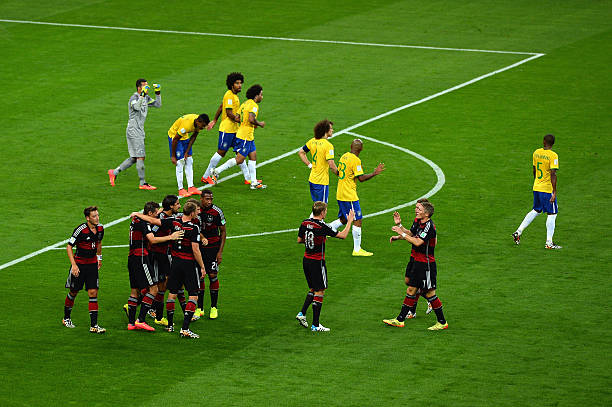
Brazil entered the 2014 World Cup semi-final carrying the weight of an entire country on their shoulders. They were playing at home. They were the five-time world champions. They were, in the minds of their fans, destined to win the tournament on home soil.
But cracks were already showing. Their captain and talisman Thiago Silva was suspended for the semi-final after picking up a yellow card. Their star striker Neymar had been ruled out with a fractured vertebra after a brutal challenge in the quarter-final. Brazil were already weakened before a ball was kicked. The stage was set for the Mineirão massacre, though nobody knew it yet.
The atmosphere inside the stadium was electric. Over 58,000 fans packed in wearing yellow and green, singing, crying, praying. Brazil had not lost a competitive home match in over 30 years. This felt like destiny.
They didn’t see the Germans coming.
The First Goal: The Warning Nobody Heeded
Thomas Müller opened the scoring in the 11th minute, a composed finish from close range after a corner was poorly defended. It was a warning. A signal that Brazil’s backline was vulnerable, disorganized, and suddenly very exposed without Thiago Silva marshalling them.
Brazil did not heed the warning. The Mineirão massacre was just getting started.
18 Minutes. Five Goals. Silence.
What happened between the 23rd and 29th minute of that semi-final is the centerpiece of the Mineirão massacre, and one of the most extraordinary sequences in World Cup history. Germany scored four goals in six minutes. Four. In six minutes. In a World Cup semi-final.
Miroslav Klose made it 2-0 in the 23rd minute, becoming the World Cup’s all-time top scorer in the process. Then Toni Kroos struck twice in two minutes, 3-0, then 4-0. Sami Khedira added a fifth before the half-hour mark. By the 29th minute, the score was 5-0.
The Brazilian crowd fell silent. Not the quiet of a stunned crowd processing a surprise. This was a deeper, more devastating silence, the silence of an entire footballing culture watching its identity collapse in real time. Players on the pitch stood still between kicks, eyes glazed, bodies moving through the motions. The Mineirão massacre had swallowed the home nation whole before halftime.
Brazilian players later recalled the dressing room at halftime as utterly silent. No shouting. No tactical adjustments being screamed across the room. Just silence. Luiz Felipe Scolari, the head coach, has since admitted he had no substitutions planned going into the game, his entire tactical plan had assumed a competitive match. By halftime, there was no plan left. The Mineirão massacre had rendered every preparation useless.
The Second Half: Mercy That Never Came
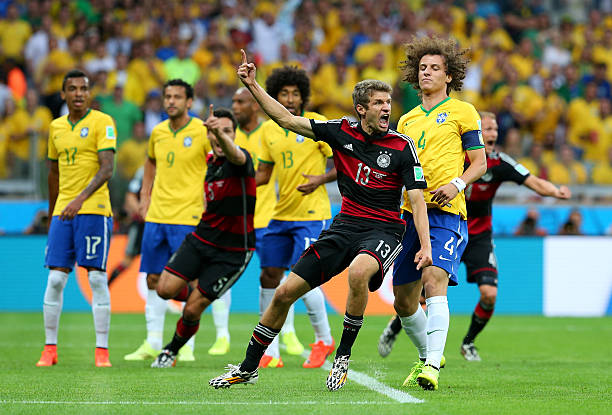
If Brazil hoped Germany would ease off in the second half, as sometimes happens in lopsided games, that hope evaporated quickly. André Schürrle scored twice after the break, making it 7-0. Oscar scored a consolation for Brazil in the 90th minute to make the final score 7-1, but by that point, the Mineirão massacre was already complete. The consolation goal felt hollow. It changed nothing.
German players, in interviews years later, have said they never discussed easing off. Their mentality was to play the full 90 minutes at full intensity. Joachim Löw, the German manager, made no apologies. In football, you play until the whistle. The Mineirão massacre was the result of that mentality meeting a Brazil side that had completely collapsed structurally and mentally.
What Went Wrong for Brazil
The Mineirão massacre was not simply bad luck. It was the product of multiple failures converging at once.
Without Thiago Silva, Brazil’s defensive organization disappeared. Without Neymar, their attacking threat was blunted. But beyond personnel, there was a deeper problem, Brazil had been carried emotionally through the tournament on home crowd energy and referee decisions rather than genuine footballing quality. Against a cold, clinical, brilliantly organized German team, that emotional crutch meant nothing.
Scolari’s tactical rigidity made things worse. His refusal to adapt mid-game, his admission that he had no substitution plan, and his failure to reorganise a panicking defence in real time all contributed directly to the Mineirão massacre becoming as catastrophic as it did.
The Aftermath of the Mineirão Massacre: A Nation in Mourning
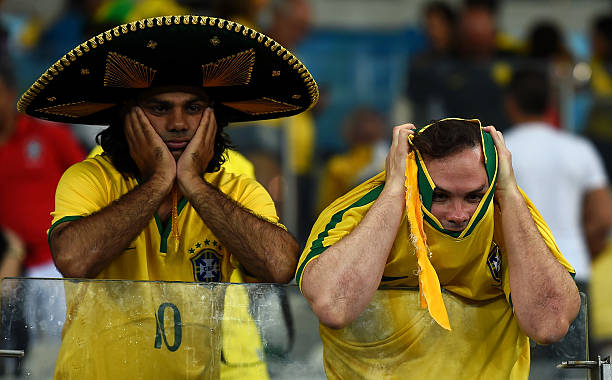
Brazilian fans wept openly in the stands and in the streets. Images of crying supporters circulated globally. The phrase “Sete a um” — seven to one — became a cultural shorthand in Brazil for total, humiliating failure. The Mineirão massacre triggered genuine national soul-searching about Brazilian football, its structures, its youth development, and the gap between its mythology and its reality.
Scolari resigned shortly after. Several players from that squad never fully recovered their reputations in Brazil.
Germany went on to win the World Cup four days later, beating Argentina 1-0 in the final. Their triumph was complete.
A Legacy in Shambles
The Mineirão massacre remains the defining result of the modern World Cup era. It sits alone as the most shocking single game in tournament history, not just because of the scoreline, but because of who it happened to, where it happened, and what it meant.
Brazil on home soil. A World Cup semi-final. Seven goals conceded. The Mineirão massacre is football at its most brutal, its most honest, and its most unforgettable.
