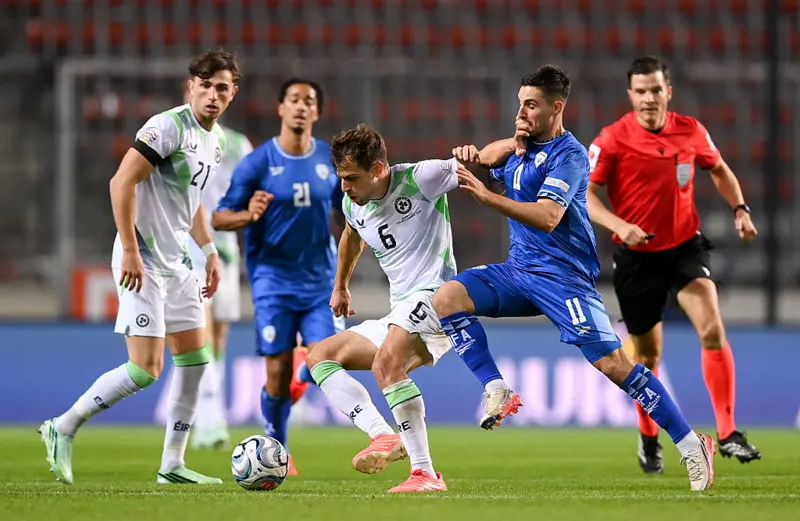
The Republic of Ireland defeated Israel 3-0 in a highly contentious Nations League fixture in Hungary, but the match was marked by a series of pre-match gestures from the Irish players in response to the wider controversy surrounding the fixture. The Republic of Ireland players did not shake hands with their Israeli opponents, while they also bowed their heads during Israel’s national anthem.
There was no exchange of pennants between Ireland captain Dara O’Shea and Israel captain Manor Solomon either, underlining the unusual circumstances surrounding the match. The fixture has been the subject of intense debate since the two nations were drawn together in Group B3 in February.
Republic of Ireland Players Make Protest Gestures

The decision not to participate in the traditional pre-match formalities followed a lengthy meeting at the Irish team’s hotel in Debrecen on Saturday.
The players voted by a significant majority to fulfil the fixture, but Football Association of Ireland chief executive David Courell subsequently confirmed that the team would not take part in handshakes and other customary pre-match formalities.
Ireland goalkeeper Gavin Bazunu went further by withdrawing from the squad. Bazunu said he believed it would be wrong for him to participate in Sunday’s match and the return fixture scheduled for 4 October in Backa Topola, Serbia.
Ireland’s players also wore black armbands during the match. Courell said the gesture was intended to recognise lives lost during the Gaza conflict.
After Ireland scored their third goal, Jack Moylan removed his armband and kissed it before kissing the team’s badge, adding another symbolic moment to an already politically charged fixture.
A small number of Israel supporters inside the stadium jeered the Irish players during their warm-up. The FAI had confirmed that no tickets would be sold to Republic of Ireland supporters for the match, although a handful of Irish fans were still seen inside the venue.
Israel vs Ireland Fixture Had Been Controversial

The controversy surrounding Israel vs Ireland has developed over several months, with calls for Ireland to boycott the matches becoming increasingly prominent.
A campaign organised by Irish Sport for Palestine urged the Irish team not to participate, while more than 160 Irish athletes signed an open letter calling for a boycott earlier in the week.
The FAI had previously taken a position on Israel’s participation in UEFA competitions. In November, the association approved a motion calling for UEFA to suspend Israel from its competitions.
The organisation later confirmed that the home fixture would be played away from Ireland. The match was moved from Dublin’s Aviva Stadium to Backa Topola, with the FAI citing operational challenges that could affect the delivery of the fixture on home soil.
At an extraordinary general meeting in July, delegates ultimately backed a motion to proceed with the matches. The FAI said boycotting the fixtures could cause significant and lasting harm to the association.
UEFA also rejected a request from the FAI for Ireland and Israel to be kept apart in future competition draws.
Hallgrimsson Says Players Raised Awareness

Republic of Ireland manager Heimir Hallgrimsson defended his players’ actions and said their decision had succeeded in drawing international attention to the issue.
“It has been so difficult for so many players,” Hallgrimsson told RTE after the match.
He said the players had “raised awareness worldwide” through their actions and comments, adding that he hoped the controversy would not continue to weigh on them in the next fixture.
Hallgrimsson also confirmed that Bazunu would return to the squad for Thursday’s match against Austria in Dublin but would not be involved in the second meeting with Israel.
The manager said Bazunu’s decision had not been questioned by the squad, although the timing of his withdrawal had made preparations more difficult.
When asked if players’ personal opinions about the fixture had influenced his team selection, Hallgrimsson said they had not.
“This team selection was about who we thought could make the best performance for Ireland,” he said.
Ireland’s players ultimately delivered on the pitch, securing a 3-0 victory despite the unusual circumstances surrounding the match.
Republic of Ireland and Israel Tensions Continue

Tensions between the two football associations had already increased before the match following comments made by Hallgrimsson.
The Ireland manager previously said, “we’re not playing with genocide, we’re playing against genocide”, a remark that prompted the Israel Football Association to accuse him of “ignorance, hypocrisy and stupidity”.
Hallgrimsson subsequently acknowledged that using the word genocide had been wrong on his part. Israel FA head of communications Shlomi Barzel said he would not apologise for the association’s response but withdrew the reference to “stupidity”.
The broader dispute exists against the backdrop of the ongoing Israel-Gaza war. Hamas attacked Israel on 7 October 2023, killing about 1,200 people and taking 251 hostages, according to figures cited by the supplied BBC report.
Israel subsequently launched a major military offensive in Gaza. The Gaza-based Hamas-run health ministry has reported more than 73,000 deaths, figures that the BBC report says are considered reliable by the United Nations. Israel has denied allegations that it has committed genocide, war crimes or crimes against humanity, saying its military operations are conducted in self-defence and in accordance with international law.
For the Republic of Ireland, the focus now turns to Thursday’s meeting with Austria before the second fixture against Israel on 4 October. The sporting result in Hungary has been accompanied by a series of gestures that have ensured the political controversy surrounding the fixture remains firmly in the spotlight.
